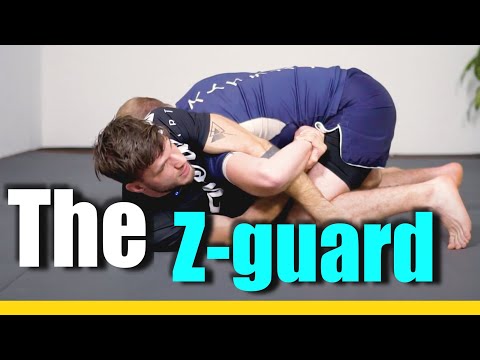
Z guard BJJ
0
Standard Low Mount·Energia Martial Arts·Added by Admin
Z guard BJJ Back to a full system again with the Z-guard this time. A beautiful halfguard/kneeshield variation with tons…
Translation: standard low mount
The Standard Low Mount positions the top fighter's hips on the opponent's waist or lower abdomen, with a wider base and lower centre of gravity for maximum stability. [1] The standard low mount prioritises control over submission access, making it ideal for ground-and-pound in MMA and for maintaining the mount against opponents with strong bridging escapes. [1],[2] From standard low mount, the top fighter can transition to full or high mount when ready to attack with submissions. [2],[3]
The standard low mount is the baseline mount position. [1]
The default mount position in BJJ. [1]
Used in all grappling competition. [1]
No images yet for this technique.
Sign in to suggest an image.
Z guard BJJ Back to a full system again with the Z-guard this time. A beautiful halfguard/kneeshield variation with tons…
No instructional courses yet for this technique.
Sign in to suggest a course.
Risk of injury to the person this technique is applied to
Top positions enable pressure and striking; rib compression risk under heavy pressure
Skill level needed to execute this technique reliably
Whether this technique is allowed under major competition rule sets
Mastering Jujitsu (Renzo Gracie & John Danaher, 2003)
Alias sources — [1] Jiu-Jitsu University (Ribeiro, 2008) [2] Mastering Jujitsu (Gracie & Danaher, 2003) [3] Mastering Jujitsu (Gracie & Danaher, 2003)
Effectiveness sources — [1] Mastering Jujitsu (Gracie & Danaher, 2003)
Standard katakana transliteration of Western martial arts terminology (外来語) — used in Japanese MMA, boxing, and BJJ communities
Alias sources — [1] Jiu-Jitsu University (Ribeiro, 2008) [2] Mastering Jujitsu (Gracie & Danaher, 2003) [3] Mastering Jujitsu (Gracie & Danaher, 2003)
Effectiveness sources — [1] Mastering Jujitsu (Gracie & Danaher, 2003)
base stability, heavy hips, ride ability
heavier build with strong hips for pressure
hip adductors, core, glutes, quadriceps
Keep constant pressure on your opponent's hips by squeezing your legs together—don't let your legs go slack. If your legs are too loose, your opponent can easily bumble to the side and start passing into half guard. Maintain this hip pressure throughout the position to control their movement.
Energia Martial Arts emphasizes that you shouldn't get up on the elbow too much unless you control the secondary arm, as your opponent can cross face you without proper control. Once you have arm control, you can safely transition to attacks like the Kimura.
Instead of shoving with your arms, extend your back to apply pressure. You can also use a shoulder crunch grip and bring your knee in front of their face to extend the arm from their body, then keep pressure back to prevent them from turning the arm as you rotate your hips out.
The Standard Low Mount positions the top fighter's hips on the opponent's waist or lower abdomen, with a wider base and lower centre of gravity for maximum stability. The standard low mount prioritises control over submission access, making it ideal for ground-and-pound in MMA and for maintaining the mount against opponents with strong bridging escapes.
The standard low mount is a control-focused mount position commonly used in MMA and self-defence contexts where maintaining the mount is more important than immediate submission attacks. It is taught as a controlling mount option alongside the standard and high mount.
IBJJF: legal — Legal, mount scores 4 points — highest-scoring position; IJF: legal — Legal, osaekomi (pin) — 10-19 seconds scores waza-ari, 20 seconds scores ippon; ADCC: legal — Legal, mount scores 2 points; Unified MMA: legal — Legal dominant position; UWW: legal — Legal, back exposure scores points, pin ends match by fall; FIAS Sport Sambo: legal — Legal, pin scores points
Danger rating 3/10. Moderate — top positions enable pressure and striking; rib compression risk under heavy pressure
The standard setup chain: Pass the Guard → Settle Weight → Control Arms → Threaten Submissions.
Standard counters include: Bridge (Upa) — explosive hip elevation to off-balance the top player / Elbow-Knee Escape (Shrimp) — create space by driving elbow to knee and hip-escaping / Frame — establish forearm frames to prevent the top player from settling weight.
Common variants: Low mount (hips heavy on the opponent's belly, grapevines in for sta…); High mount (knees under the armpits, arms isolated for submissions); S-mount (one knee high under the armpit, other leg across for arm …); Technical mount (one leg hooked, one knee posted, modified for back-take t…).
Used in all grappling competition.
Top errors to watch for: Not sinking the hips low enough — the hips must be heavy on the lower abdomen / Threading the hooks too deep — medium hook depth provides the best control and mobility / Not spreading the opponent's legs — the hooks should actively push the legs apart / Leaning too far forward and losing hip contact — the hips must stay on the opponent.
The Standard Low Mount is also known as Sutandādo Rō Maunto, Classic Low Mount, Basic Low Mount, Seated Low Mount.