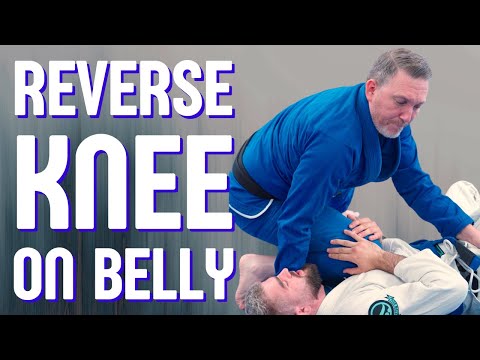
Standard Reverse Knee On Belly

Genus

スタンダードリバースニーオンベリー(Sutandādo Ribāsu Nī On Berī)

Transliteration

Translation: standard reverse knee on belly

Overview

The Standard Reverse Knee On Belly positions the top fighter facing the opponent's legs with one knee on the abdomen and the posted foot toward the head, providing access to straight ankle locks, toe holds, and transitions to leg entanglements. [1] The reversed orientation changes the available submissions and transitions compared to standard knee-on-belly, making it a valuable position for fighters with strong leg attack games. [1],[2] The position can be reached from standard knee-on-belly by spinning or from north-south transitions. [2],[3]

Also known as
Basic Reverse Knee Ride[1]Classic Reverse KOB[2]

History & Origin

The standard reverse knee-on-belly is an increasingly used position in modern BJJ, valued for its leg attack accessibility and unique tactical options. [1] Its importance has grown alongside the expansion of leg attack systems in no-gi competition. [2],[3]

Effectiveness

The standard reverse knee on belly is the baseline version of this position. [1]

Lineage

An advanced BJJ position. [1]

Competition Record

Used in BJJ competition. [1]

Images

No images yet for this technique.

Sign in to suggest an image.

Biomechanical Mechanism

Primary ActionEstablishing and maintaining a controlling position relative to the opponent
Joints InvolvedBody positioning determines which joints and limbs are available for control and attack
Force VectorVaries by position — gravity, frames, hooks, and pressure dictate control dynamics
Positional MechanicHierarchy of positions — each position offers different offensive and defensive capabilities

Position & Entry

From side controlRise up from side control, place the near knee across the opponent's belly or chest, post the far leg out for base
From guard pass (float pass)After passing guard, float the knee directly to the belly instead of settling to side control

Variants

Standard knee on bellyknee across the midsection, far foot posted for base
Knee on chestknee higher toward the chest for more pressure
Reverse knee on bellyfacing the opponent's legs instead of their head
Floating kneelight, mobile knee ride allowing quick transitions

Videos

Reverse Knee on Belly Options

0
Standard Reverse Knee On Belly·The Grapple Lab·Added by Admin

Reverse Knee on Belly Options. In this video we look at some of the options available from reverse knee on belly. Submis

1 video

Learn This Technique

No instructional courses yet for this technique.

Sign in to suggest a course.

Ratings

Danger Rating

Risk of injury to the person this technique is applied to

3
Moderate3/10

Top positions enable pressure and striking; rib compression risk under heavy pressure

Difficulty

Skill level needed to execute this technique reliably

Intermediate
Competition Legality

Whether this technique is allowed under major competition rule sets

IBJJF — Legal, knee on belly scores 2 points
IBJJF Rules Book v6.0, June 2024PDF
ADCC — Legal, knee on belly scores 2 points
ADCC Rules Update, April 2025PDF
Unified MMA — Legal dominant position
Unified Rules of MMA, August 2025PDF
UWW — Legal, back exposure scores points, pin ends match ...
UWW International Wrestling Rules, January 2026PDF
FIAS Sport Sambo — Legal, pin scores points
FIAS International Sambo Competition RulesPDF

Training Notes

Standard reverse knee on belly execution: from knee on belly, pivot 180 degrees to face the opponent's legs while keeping the knee on their abdomen, post the far foot wide, and control the near leg or hip (Danaher, Leglocks: Enter the System, 2017)
Step 1: from standard knee on belly, begin the 180-degree pivot by turning toward the opponent's legs
Step 2: keep the knee on the abdomen throughout the spin — do not lift the knee during the transition
Step 3: as you complete the pivot, post the far foot wide for balance
Step 4: control the opponent's near leg or hip with both hands
Step 5: from reverse knee on belly, attack: ankle lock (grab the near foot), kneebar (step over the far leg), or spinning armbar (spin back toward the head)
The spin must be smooth and continuous: any pause allows the opponent to escape
Drill: from knee on belly, spin to reverse and attack the ankle lock — 5 reps per side

Common Mistakes

!Lifting the knee during the spin — the knee must maintain pressure throughout the 180-degree pivot
!Spinning too slowly — the transition must be quick to prevent the opponent from escaping
!Not controlling a leg after completing the spin — immediately grab the near ankle or hook the far leg
!Posting the foot too narrow — the wide base is essential for stability in the reverse position
!Not attacking immediately after establishing reverse — the position is for attacking, not holding
!Spinning without purpose — know which submission you're targeting before the spin
!Not practising the spin in both directions — develop the ability to spin left and right

Related Techniques

Counter Techniques

Setup Chain

1Achieve Positiontransition into this position through passing, sweeping, or scrambling
2Stabilizeestablish controlling grips and weight distribution
3Maintainadjust to the opponent's escape attempts to hold position
4Attacklaunch offensive techniques from the stabilized position

Sources & References

Primary Source

Jiu-Jitsu University (Saulo Ribeiro, 2008)

1BookJiu-Jitsu University (Ribeiro, 2008)

Alias sources — [1] Jiu-Jitsu University (Ribeiro, 2008) [2] Mastering Jujitsu (Gracie & Danaher, 2003)

2BookBrazilian Jiu-Jitsu: Theory and Technique (Gracie & Gracie, 2001)

Effectiveness sources — [1] Jiu-Jitsu University (Ribeiro, 2008)

3OtherJapanese Combat Sports Katakana Convention

Standard katakana transliteration of Western martial arts terminology (外来語) — used in Japanese MMA, boxing, and BJJ communities

4CitationJiu-Jitsu University (Ribeiro, 2008)

Alias sources — [1] Jiu-Jitsu University (Ribeiro, 2008) [2] Mastering Jujitsu (Gracie & Danaher, 2003)

5CitationBrazilian Jiu-Jitsu: Theory and Technique (Gracie & Gracie, 2001)

Effectiveness sources — [1] Jiu-Jitsu University (Ribeiro, 2008)

Community

Athletics

Requires

body awareness, stability, control of weight distribution

Favours

athletic build with good proprioception

Key muscles

core, hips, legs for base stability

Frequently Asked Questions

How should I position my weight when applying reverse knee on belly?

Keep a lot of weight through your partner by maintaining good butt pressure on the shoulder. The Grapple Lab emphasizes that this weight distribution is critical for controlling the position.

Where should I control the arm from reverse knee on belly?

Keep the arm on the near side, holding it towards the ribs with a nice tight grip. This positioning allows you to apply pressure through the shoulder and set up your next moves effectively.

What are some good submission options from reverse knee on belly?

One effective option is a rolling over pass—reach down with the arm closest to your opponent's body to initiate the transition.

How does the Standard Reverse Knee On Belly work?

The Standard Reverse Knee On Belly positions the top fighter facing the opponent's legs with one knee on the abdomen and the posted foot toward the head, providing access to straight ankle locks, toe holds, and transitions to leg entanglements. The reversed orientation changes the available submissions and transitions compared to standard knee-on-belly, making it a valuable position for fighters with strong leg attack games.

Where does the Standard Reverse Knee On Belly come from?

The standard reverse knee-on-belly is an increasingly used position in modern BJJ, valued for its leg attack accessibility and unique tactical options. Its importance has grown alongside the expansion of leg attack systems in no-gi competition.

Is the Standard Reverse Knee On Belly legal in competition?

IBJJF: legal — Legal, knee on belly scores 2 points; IJF: legal — Legal, osaekomi (pin) — 10-19 seconds scores waza-ari, 20 seconds scores ippon; ADCC: legal — Legal, knee on belly scores 2 points; Unified MMA: legal — Legal dominant position; UWW: legal — Legal, back exposure scores points, pin ends match by fall; FIAS Sport Sambo: legal — Legal, pin scores points

How dangerous is the Standard Reverse Knee On Belly?

Danger rating 3/10. Moderate — top positions enable pressure and striking; rib compression risk under heavy pressure

How do I set up the Standard Reverse Knee On Belly?

The standard setup chain: Achieve Position → Stabilize → Maintain → Attack.

How do I defend against the Standard Reverse Knee On Belly?

Standard counters include: Bridge (Upa) — explosive hip elevation to off-balance the top player / Elbow-Knee Escape (Shrimp) — create space by driving elbow to knee and hip-escaping / Frame — establish forearm frames to prevent the top player from settling weight.

What are the variants of the Standard Reverse Knee On Belly?

Common variants: Standard knee on belly (knee across the midsection, far foot posted for base); Knee on chest (knee higher toward the chest for more pressure); Reverse knee on belly (facing the opponent's legs instead of their head); Floating knee (light, mobile knee ride allowing quick transitions).

How effective is the Standard Reverse Knee On Belly in competition?

Used in BJJ competition.

What are common mistakes when doing the Standard Reverse Knee On Belly?

Top errors to watch for: Lifting the knee during the spin — the knee must maintain pressure throughout the 180-degree pivot / Spinning too slowly — the transition must be quick to prevent the opponent from escaping / Not controlling a leg after completing the spin — immediately grab the near ankle or hook the far leg / Posting the foot too narrow — the wide base is essential for stability in the reverse position.

What are other names for the Standard Reverse Knee On Belly?

The Standard Reverse Knee On Belly is also known as Sutandādo Ribāsu Nī On Berī, Basic Reverse Knee Ride, Classic Reverse KOB.