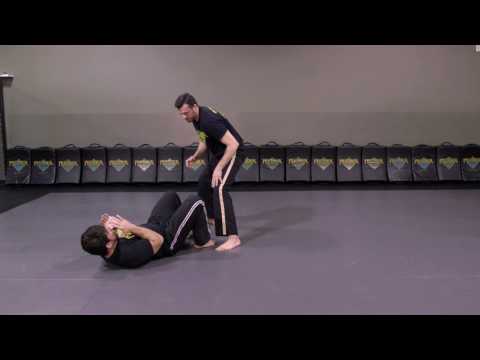
Krav Maga - Knee on Belly - Escape and 2 Submissions
0
Standard Knee On Chest·Premier Design·Added by Admin
Knee on Belly - Escape and 2 Submissions
Translation: standard knee on chest
The Standard Knee On Chest places the knee directly on the opponent's sternum or upper chest, with the shin applying diagonal pressure across the ribcage, while the posted foot provides base and the hands control the opponent's upper body. [1] The standard knee-on-chest creates maximum respiratory pressure and is particularly effective for setting up cross-choke attacks and armbar transitions. [1],[2] The higher placement makes it harder for the bottom fighter to create frames and escape. [2],[3]
The standard knee on chest is the baseline version of this high-pressure variant. [1]
A BJJ pressure position variant. [1]
Used in BJJ competition. [1]
No images yet for this technique.
Sign in to suggest an image.
Knee on Belly - Escape and 2 Submissions
No instructional courses yet for this technique.
Sign in to suggest a course.
Risk of injury to the person this technique is applied to
Top positions enable pressure and striking; rib compression risk under heavy pressure
Skill level needed to execute this technique reliably
Whether this technique is allowed under major competition rule sets
Jiu-Jitsu University (Saulo Ribeiro, 2008)
Alias sources — [1] Jiu-Jitsu University (Ribeiro, 2008) [2] Mastering Jujitsu (Gracie & Danaher, 2003)
Effectiveness sources — [1] Jiu-Jitsu University (Ribeiro, 2008)
Standard katakana transliteration of Western martial arts terminology (外来語) — used in Japanese MMA, boxing, and BJJ communities
Alias sources — [1] Jiu-Jitsu University (Ribeiro, 2008) [2] Mastering Jujitsu (Gracie & Danaher, 2003)
Effectiveness sources — [1] Jiu-Jitsu University (Ribeiro, 2008)
body awareness, stability, control of weight distribution
athletic build with good proprioception
core, hips, legs for base stability
Frame with your hands to protect your face, then shrimp your body while pushing the opponent's knee down with your elbow. Bring your own knee inside to help you shrimp further and block the opponent, then you can start kicking while maintaining defense.
Place your shin on the opponent's belly to maintain pressure, and keep your hands next to your leg ready to push and pull, creating space to transition into submissions like moving your knee behind their neck.
The Standard Knee On Chest places the knee directly on the opponent's sternum or upper chest, with the shin applying diagonal pressure across the ribcage, while the posted foot provides base and the hands control the opponent's upper body. The standard knee-on-chest creates maximum respiratory pressure and is particularly effective for setting up cross-choke attacks and armbar transitions.
The standard knee-on-chest is an aggressive variation of the knee-on-belly position used in BJJ competition and MMA, valued for its pressure and submission set-up capabilities. It is taught as an advanced variation of the knee-on-belly system.
IBJJF: legal — Legal, knee on belly scores 2 points; IJF: legal — Legal, osaekomi (pin) — 10-19 seconds scores waza-ari, 20 seconds scores ippon; ADCC: legal — Legal, knee on belly scores 2 points; Unified MMA: legal — Legal dominant position; UWW: legal — Legal, back exposure scores points, pin ends match by fall; FIAS Sport Sambo: legal — Legal, pin scores points
Danger rating 3/10. Moderate — top positions enable pressure and striking; rib compression risk under heavy pressure
The standard setup chain: Achieve Position → Stabilize → Maintain → Attack.
Standard counters include: Posture Control — maintain strong posture to limit the opponent's offensive options / Escape to Neutral — work back to standing or a neutral position.
Common variants: Standard knee on belly (knee across the midsection, far foot posted for base); Knee on chest (knee higher toward the chest for more pressure); Reverse knee on belly (facing the opponent's legs instead of their head); Floating knee (light, mobile knee ride allowing quick transitions).
Used in BJJ competition.
Top errors to watch for: Sliding the knee too far past the sternum — the knee should be on the chest, not on the neck / Not maintaining pressure during the transition from belly to chest — keep the weight driving down throughout / Losing the posting foot position — the far foot must remain wide and posted for stability / Not attacking from knee on chest — the position creates urgency; capitalize with submissions or transitions.
The Standard Knee On Chest is also known as Sutandādo Nī On Chesuto, Basic Knee on Chest, Classic Knee Ride High.