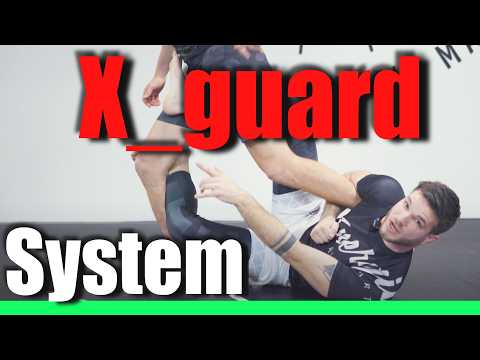
X guard No-GI System | Enter, sweep, submit
0
Full X-Guard·Energia Martial Arts·Added by Admin
X guard No-GI System | Enter, sweep, submit Whoop! Another no-gi guard system! Today we are sliding in the X-guard. A ph…
Translation: full X-guard
The Full X-Guard establishes the complete X-guard with both hooks fully inserted — one behind the opponent's knee and one on the hip — with the guard player's body directly underneath the opponent's centre of gravity. [1] The full X-guard provides the maximum sweeping power of any X-guard configuration because both hooks are fully engaged and the guard player's body mass is directly under the opponent's weight. [1],[2] Sweeps from full X-guard are among the most powerful and reliable in all of grappling due to this optimal mechanical positioning. [2],[3]
X-guard was developed and popularised by Marcelo Garcia in the 2000s as a sweeping position in no-gi competition. [1]
Marcelo Garcia used X-guard sweeps extensively in his ADCC title runs. [1]
No images yet for this technique.
Sign in to suggest an image.
X guard No-GI System | Enter, sweep, submit Whoop! Another no-gi guard system! Today we are sliding in the X-guard. A ph…
No instructional courses yet for this technique.
Sign in to suggest a course.
Risk of injury to the person this technique is applied to
Guard positions are defensive; injury risk comes from transitions, not the position itself
Skill level needed to execute this technique reliably
Whether this technique is allowed under major competition rule sets
Advanced Brazilian Jiu-Jitsu Techniques (Marcelo Garcia, 2011)
Alias sources — [1] IBJJF Rules (2024) [2] Jiu-Jitsu University (Ribeiro, 2008) [3] Marcelo Garcia: Advanced BJJ Techniques (2011)
Effectiveness sources — [1] Mastering Jujitsu (Gracie & Danaher, 2003) [2] Jiu-Jitsu University (Ribeiro, 2008)
Standard katakana transliteration of Western martial arts terminology (外来語) — used in Japanese MMA, boxing, and BJJ communities
Alias sources — [1] IBJJF Rules (2024) [2] Jiu-Jitsu University (Ribeiro, 2008) [3] Marcelo Garcia: Advanced BJJ Techniques (2011)
Effectiveness sources — [1] Mastering Jujitsu (Gracie & Danaher, 2003) [2] Jiu-Jitsu University (Ribeiro, 2008)
hip flexibility, active legs, grip management
long legs for distance control and guard retention
hip flexors, adductors, quadriceps, core, grip
Your top foot should be on top of your opponent's hip and your bottom foot behind their knee, with your knees pointing outward to create tension. Many beginners make the mistake of keeping their knees together, which creates an unstable position.
The scoop grip is better for sweeps and taking the back, while the overhook grip is better for leg locks and preventing common escapes like the running man. Choose based on your intended attack.
Your opponent can strip your bottom hook and backstep, or they can do a 'running man' by pointing their knee and kicking the leg out. Use the overhook grip to prevent the running man escape, or control their knee tightly with the scoop grip to slow them down.
You must disbalance your opponent first before attempting the sweep. As you extend your legs, sit up and build your base simultaneously rather than diving with your upper body, which can result in a triangle choke.
The Full X-Guard establishes the complete X-guard with both hooks fully inserted — one behind the opponent's knee and one on the hip — with the guard player's body directly underneath the opponent's centre of gravity. The full X-guard provides the maximum sweeping power of any X-guard configuration because both hooks are fully engaged and the guard player's body mass is directly under the opponent's weight.
The full X-guard is the complete expression of Marcelo Garcia's X-guard system, representing the fully established position with maximum control and sweeping power. It is the version most commonly taught as the standard X-guard.
IBJJF: legal — Legal — guard is fundamental to BJJ, sweeps from guard score 2 points; IJF: restricted — Guard pulling penalized as non-combativity — groundwork from guard permitted …; ADCC: legal — Legal, guard pull penalized -1 point in points portion; Unified MMA: legal — Legal — no penalty for playing guard; FIAS Sport Sambo: legal — Legal
Danger rating 2/10. Low — guard positions are defensive; injury risk comes from transitions, not the position itself
The standard setup chain: Achieve Guard Contact → Control Grips → Manage Distance → Threaten Submissions/Sweeps.
Standard counters include: Guard Pass — systematically work to clear the legs and establish a dominant position / Leg Pin — control one or both legs to neutralize guard retention / Pressure Passing — use heavy chest pressure to flatten and immobilize the guard player.
Common variants: Standard guard (primary leg and grip configuration for control and attack…); Offensive guard (configured for sweeps and submissions); Defensive guard (prioritising distance management and preventing passes); Transition guard (moving between guard types to adjust to the opponent's pa…).
Marcelo Garcia used X-guard sweeps extensively in his ADCC title runs.
Top errors to watch for: Not threading both legs fully — incomplete threading reduces sweep power and control / Entering full X-guard without establishing single leg X first — the progression is critical for safety and effectiveness / Not extending and retracting the legs in coordination — the sweep requires both legs working together / Losing ankle control during the sweep — the opponent's ankle must be controlled to direct the fall.
The Full X-Guard is also known as Furu X Gādo, Complete X-Guard, Double Hook X-Guard, Standard X.