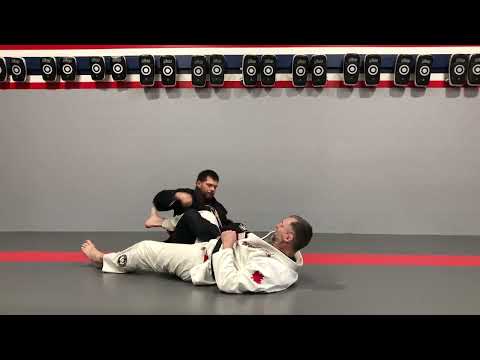
X Guard 7 Submissions
0
X-Guard·Arashi Do North Edmonton
X Guard Submissions can be a little tricky but they are there and most times people aren't thinking of defending submiss…
Translation: X-guard
The X-Guard family covers the guard position where the guard player places both legs between the opponent's legs in an X-configuration, with one hook behind the knee and one on the hip, creating a powerful sweeping platform under the opponent's base. [1] The X-guard provides extraordinary off-balancing leverage because the dual leg positioning completely controls the opponent's base on one side, making them extremely vulnerable to sweeps. [1],[2] The X-guard includes the full X-guard (both hooks between the legs) and the single leg X-guard (hooks on one leg from the outside). [2],[3]
The X-guard was developed and popularised by Marcelo Garcia, who debuted the position at ADCC 2003 and used it as a cornerstone of his legendary competition career. [1] Garcia's X-guard became one of the most influential guard innovations in modern grappling, inspiring the development of the single leg X variation. [2],[3]
The X-guard is one of the most powerful sweeping positions in grappling, providing near-irresistible off-balancing force by positioning both legs between the opponent's legs in an X-formation. [1] Marcelo Garcia describes the X-guard as a position where the sweep is almost inevitable once it is properly established, because the guard player controls the opponent's entire base. [1]
No images yet for this technique.
Sign in to suggest an image.
X Guard Submissions can be a little tricky but they are there and most times people aren't thinking of defending submiss…
No instructional courses yet for this technique.
Sign in to suggest a course.
Risk of injury to the person this technique is applied to
Guard positions are defensive; injury risk comes from transitions, not the position itself
Skill level needed to execute this technique reliably
Whether this technique is allowed under major competition rule sets
Advanced Brazilian Jiu-Jitsu Techniques (Marcelo Garcia, 2011)
Alias sources — [1] X-Guard (Garcia, 2008) [2] X-Guard (Garcia, 2008)
Effectiveness sources — [1] X-Guard (Garcia, 2008)
Standard katakana transliteration of Western martial arts terminology (外来語) — used in Japanese MMA, boxing, and BJJ communities
Alias sources — [1] X-Guard (Garcia, 2008) [2] X-Guard (Garcia, 2008)
Effectiveness sources — [1] X-Guard (Garcia, 2008)
hip flexibility, active legs, grip management
long legs for distance control and guard retention
hip flexors, adductors, quadriceps, core, grip
Every move, in any martial art, shares a few universal traits. Mix and match below to pinpoint the right tool — or compare equivalents across styles.
The Single Leg X-Guard subfamily covers the guard variation where the guard player hooks both legs on the outside of one of the opponent's legs — one foot on the hip and one behind the knee — controlling a single leg. [1] Single leg X (also called ashi garami or outside ashi) has become one of the most important guard positions in modern grappling because it serves as both a sweeping position and the primary entry to leg attacks. [1,2] The position provides powerful off-balancing control on one leg while keeping the guard player's feet on the outside, making it safer from leg entanglements. [2,3]
The Standard X-Guard subfamily covers the classic X-guard position with both legs inserted between the opponent's legs, one hook behind the knee and one on the hip, creating a strong X-configuration that completely controls the opponent's base on one side. [1] The standard X-guard is the original X-guard configuration developed by Marcelo Garcia, providing maximum sweeping leverage through the dual hook system. [1,2] From standard X-guard, the guard player can sweep via technical standup, ankle pick, or direct elevation. [2,3]
The X-guard was popularized by Marcelo Garcia in the early 2000s. The guard uses both legs in an X-configuration under the opponent to control their base and set up sweeps and leg lock entries. (Garcia, Advanced Brazilian Jiu-Jitsu Techniques)
From X-Guard you have multiple submission options including arm bars, knee bars, and leg lock variations. According to Arashi Do North Edmonton, you can hold onto the leg during an arm bar to make it harder for your opponent to escape, and you can transition into a knee bar using the underhook position.
To set up a knee bar from X-Guard, use the underhook position and be aware that your partner may fall backward as they get knee barred, so control the descent carefully to avoid injury.
Keep tension on your opponent's shin and maintain a broken posture by stretching them out. Use your foot in the pocket of their knee as an anchor to help lift your hips and generate leverage for the sweep.
The X-Guard family covers the guard position where the guard player places both legs between the opponent's legs in an X-configuration, with one hook behind the knee and one on the hip, creating a powerful sweeping platform under the opponent's base. The X-guard provides extraordinary off-balancing leverage because the dual leg positioning completely controls the opponent's base on one side, making them extremely vulnerable to sweeps.
The X-guard was developed and popularised by Marcelo Garcia, who debuted the position at ADCC 2003 and used it as a cornerstone of his legendary competition career. Garcia's X-guard became one of the most influential guard innovations in modern grappling, inspiring the development of the single leg X variation.
IBJJF: legal — Legal — guard is fundamental to BJJ, sweeps from guard score 2 points; IJF: restricted — Guard pulling penalized as non-combativity — groundwork from guard permitted …; ADCC: legal — Legal, guard pull penalized -1 point in points portion; Unified MMA: legal — Legal — no penalty for playing guard; FIAS Sport Sambo: legal — Legal
Danger rating 2/10. Low — guard positions are defensive; injury risk comes from transitions, not the position itself
The standard setup chain: Achieve Guard Contact → Control Grips → Manage Distance → Threaten Submissions/Sweeps.
Standard counters include: Guard Pass — systematically work to clear the legs and establish a dominant position / Leg Pin — control one or both legs to neutralize guard retention / Pressure Passing — use heavy chest pressure to flatten and immobilize the guard player.
Common variants: Standard guard (primary leg and grip configuration for control and attack…); Offensive guard (configured for sweeps and submissions); Defensive guard (prioritising distance management and preventing passes); Transition guard (moving between guard types to adjust to the opponent's pa…).
Marcelo Garcia used the X-guard as a cornerstone of his competition system en route to four ADCC gold medals (2003, 2005, 2007, 2009) and multiple IBJJF World Championship titles. The position has since been adopted by competitors across all levels of grappling competition.
Top errors to watch for: Entering X-guard without controlling the opponent's upper body — wrist or ankle grips are needed to prevent the oppon… / Not crossing the legs in the X-pattern — the cross creates the structural leverage for sweeps / Using X-guard against a kneeling opponent — X-guard requires the opponent to be standing / Staying in X-guard without sweeping — the position is for sweeping; do it immediately.
The X-Guard is also known as X Gādo, X Guard, Marcelo Guard.