Strike & defenceLocksClose rangeFighting multiple people
Distance
CloseMiddleLong
Overview
The tornado guard is an inverted guard position played from half guard where the practitioner rolls underneath the opponent using a twisting inversion to create sweeps and submission entries. [1] While Roberto 'Roleta' Magalhaes originally created the inverted guard concept in the 1990s, Roberto 'Cyborg' Abreu developed his own distinct version starting as a blue belt, specifically originating from half guard with both shoulder blades on the ground. [2] Cyborg rode this technique to 5 IBJJF Ultra Heavyweight World Championship titles and the ADCC 2013 Absolute Championship, making it one of the most effective guard innovations of the modern era. The twisting motion resembles a tornado — hence the name.
The inverted guard concept was originally created by Roberto 'Roleta' Magalhaes in the 1990s. [1] Roberto 'Cyborg' Abreu developed his distinct tornado guard version starting as a blue belt, specifically from half guard. He rode it to 5 IBJJF Ultra Heavyweight World Championship titles and ADCC 2013 Absolute Championship. [2]
Country of origin· shown in random order
🇧🇷BrazilBJJ, Submission Grappling
🇯🇵JapanBJJ, Submission Grappling
🇺🇸USASubmission Grappling
Effectiveness
The tornado guard carried Roberto 'Cyborg' Abreu to 5 IBJJF Ultra Heavyweight World Championships and the ADCC 2013 Absolute Championship, demonstrating its effectiveness at the highest levels of competition. [1] It is particularly effective for practitioners with good flexibility and hip mobility, and works well against larger opponents due to its leverage-based mechanics.
Lineage
Inverted guard concept created by Roberto 'Roleta' Magalhaes (1990s). Tornado guard variant developed by Roberto 'Cyborg' Abreu. Cyborg: 5x IBJJF Ultra Heavyweight World Champion, ADCC 2013 Absolute Champion.
Competition Record
Roberto 'Cyborg' Abreu: 5x IBJJF Ultra Heavyweight World Champion, ADCC 2013 Absolute Champion — tornado guard as signature technique throughout his career.
Images
No images yet for this technique.
Sign in to suggest an image.
Biomechanical Mechanism
Primary Action — Push-and-pull mechanism from half guard — the top leg rotates over the opponent's arm while the practitioner inverts underneath
Inversion Mechanic — Roll on the shoulder to invert, creating a twisting motion that destabilizes the opponent's base
Sweep Principle — Pistol grip on opponent's trapped pant leg provides control; hips elevate and lift the opponent while the free leg acts as a pendulum for momentum
Critical Factor — Success depends on positioning rather than raw strength — heavier opponents can stack you if positioning is poor
Position & Entry
From knee shield half guard — Establish knee shield, grip opponent's pant leg with pistol grip, begin the inversion by rolling on the shoulder
From Z-guard — Use the knee shield frame to create space, then rotate the top leg over opponent's arm and invert
From deep half guard — Transition from deep half to tornado by inverting under the opponent's base
Variants
Classic tornado sweep — from half guard with lapel grip and pistol grip on pant leg
Inverted tornado sweep — different grips using cross-grip on opponent's sleeve plus same-side collar grip
No-gi tornado guard — Cyborg has a dedicated instructional for the no-gi version
Tornado to leg lock entries — inverting into saddle/411 for heel hook attacks
Tornado to triangle choke — transitioning the inversion to isolate the head and arm
Helicopter sweep — the most common sweep from the broader inverted guard family
✓Roberto 'Cyborg' Abreu developed the tornado guard starting as a blue belt. He earned his nickname in 2000 after a severe car accident (300 stitches, shattered arm) from which he returned to competition within 4 months. He went on to become a 5x IBJJF Ultra Heavyweight World Champion and ADCC 2013 Absolute Champion using the tornado guard as a signature weapon. The key distinction from Roleta's original inverted guard is that the tornado guard specifically starts from half guard and is played with both shoulder blades on the ground. The technique requires significant hip mobility and shoulder flexibility, and comfort being inverted is essential. Solo drills such as wall shoulder rolls are recommended preparation. Primary risks are to the practitioner's own neck and spine — thorough warm-up is essential, and the technique is not recommended for those with cervical spine issues. The pistol grip on the opponent's pant leg is critical for controlling the sweep — without it, the opponent can simply back away during the inversion.
Common Mistakes
!Not securing the pant grip before inverting — without the grip, the opponent escapes the sweep
!Inverting too slowly — the rotation must be committed and explosive
!Not elevating the hips enough — insufficient hip elevation fails to off-balance the opponent
!Allowing the opponent to stack — if positioning is off, heavier opponents can flatten you
!Not transitioning when the sweep fails — must have backup attacks (triangle, leg locks) when the primary sweep is defended
1Establish Half Guard — secure half guard with knee shield or Z-guard configuration
2Grip the Pant Leg — pistol grip on opponent's trapped leg pant material
3Begin Inversion — rotate top leg over opponent's arm, roll on shoulder to invert underneath
4Elevate Hips — use hips and free leg as pendulum to lift and off-balance opponent
5Complete the Sweep — drive through the rotation to come up on top
6Transition to Attack — establish top position or transition to submission (triangle, leg locks)
Sources & References
Primary Source
BJJ Heroes — Inverted Guard and Tornado Guard History
1OtherJapanese Martial Arts Community Terminology
BJJ Heroes — Inverted Guard and Tornado Guard (bjjheroes.com) || Evolve MMA — What Is The Tornado Guard In BJJ? (evolve-mma.com) || BJJ World — Tornado Guard Sweeps And Submissions (bjj-world.com)
2OtherJapanese Combat Sports Katakana Convention
Standard katakana transliteration of Western martial arts terminology (外来語) — used in Japanese MMA, boxing, and BJJ communities
3CitationBJJ Heroes — Inverted Guard and Tornado Guard (bjjheroes.com)[link]
Historical distinction — [1] BJJ Heroes — documenting the difference between Roleta's inverted guard and Cyborg's tornado guard
4CitationEvolve MMA — What Is The Tornado Guard In BJJ? (evolve-mma.com)[link]
5CitationBJJ World — Tornado Guard Sweeps And Submissions (bjj-world.com)
Community
Athletics
Requires
significant hip mobility, shoulder flexibility, comfort being inverted
Favours
flexible practitioners with strong core
Key muscles
hip flexors, core stabilizers, shoulders, neck
Frequently Asked Questions
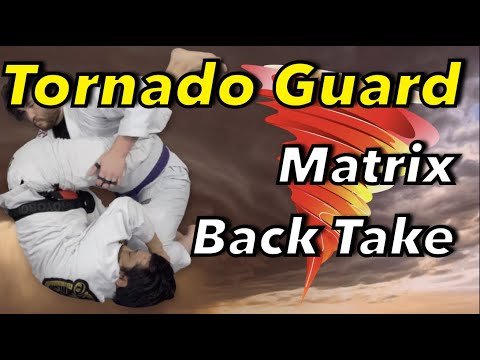
What's the most important thing to focus on when taking the back from Tornado Guard?
Keep your opponent's shoulder (on the side you're attacking) away from you at all times. Without maintaining this distance, you will get smashed and won't be able to get upside down for the back take.
How do I control my opponent's legs in Tornado Guard?
Grab your opponent's pants on the far side, then grab the near side as well to get their knees close to you. You can use your heel to slightly push their knee and work to keep them on the ground.
What's the key movement to execute the back take from this position?
Swing your leg while pushing your opponent's knee towards their chest to gain leverage, then lift them up slightly before switching your legs to fall on the opposite side and complete the back take.
How does the Tornado Guard work?
The tornado guard is an inverted guard position played from half guard where the practitioner rolls underneath the opponent using a twisting inversion to create sweeps and submission entries. While Roberto 'Roleta' Magalhaes originally created the inverted guard concept in the 1990s, Roberto 'Cyborg' Abreu developed his own distinct version starting as a blue belt, specifically originating from half guard with both shoulder blades on the ground.
Where does the Tornado Guard come from?
The inverted guard concept was originally created by Roberto 'Roleta' Magalhaes in the 1990s. Roberto 'Cyborg' Abreu developed his distinct tornado guard version starting as a blue belt, specifically from half guard.
Is the Tornado Guard legal in competition?
IBJJF: legal — Legal — guard is fundamental to BJJ, sweeps from guard score 2 points; IJF: restricted — Guard pulling penalized as non-combativity — groundwork from guard permitted …; ADCC: legal — Legal, guard pull penalized -1 point in points portion; Unified MMA: legal — Legal — no penalty for playing guard; FIAS Sport Sambo: legal — Legal
How dangerous is the Tornado Guard?
Danger rating 3/10. Low danger to the opponent — primarily a sweeping position; moderate risk to the practitioner from neck and spine strain during the inversion
How do I set up the Tornado Guard?
The standard setup chain: Establish Half Guard → Grip the Pant Leg → Begin Inversion → Elevate Hips → Complete the Sweep → Transition to Attack.
How do I defend against the Tornado Guard?
Standard counters include: Stack the Inverting Player — drive weight downward to prevent the inversion from completing / Back Away — release the half guard and disengage before the sweep develops / Crossface Pressure — heavy crossface prevents the initial rotation / Underhook Control — maintain a strong underhook to prevent the leg from swinging over.
What are the variants of the Tornado Guard?
Common variants: Classic tornado sweep (from half guard with lapel grip and pistol grip on pant leg); Inverted tornado sweep (different grips using cross-grip on opponent's sleeve plu…); No-gi tornado guard (Cyborg has a dedicated instructional for the no-gi version); Tornado to leg lock entries (inverting into saddle/411 for heel hook attacks); Tornado to triangle choke (transitioning the inversion to isolate the head and arm); Helicopter sweep (the most common sweep from the broader inverted guard family).
How effective is the Tornado Guard in competition?
Roberto 'Cyborg' Abreu: 5x IBJJF Ultra Heavyweight World Champion, ADCC 2013 Absolute Champion — tornado guard as signature technique throughout his career.
What are common mistakes when doing the Tornado Guard?
Top errors to watch for: Not securing the pant grip before inverting — without the grip, the opponent escapes the sweep / Inverting too slowly — the rotation must be committed and explosive / Not elevating the hips enough — insufficient hip elevation fails to off-balance the opponent / Allowing the opponent to stack — if positioning is off, heavier opponents can flatten you.
What are other names for the Tornado Guard?
The Tornado Guard is also known as Torunēdo Gādo, Tornado Guard, Cyborg Guard, Inverted Half Guard Sweep.