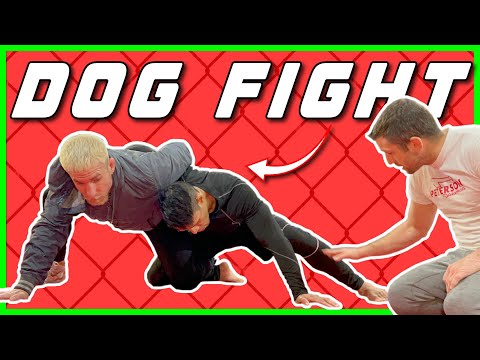
BASICS of the Dog Fight Position!
0
Standard Dogfight·TeachMeGrappling Coach Brian·Added by Admin
This video I breakdown the "dog fight" position. Check out the details and you are sure to find something useful! Enjo…
Translation: dogfight
The dogfight is a 50/50 kneeling position where both grapplers are on their knees, one with an underhook and the opponent with a whizzer (overhook), occurring at the terminal stages of half guard sweeps or single leg takedowns. [1] A natural transitional position that has existed in wrestling for as long as wrestling has existed, it gained recognition as a named position through the half guard revolution of the 2000s. [2] Lachlan Giles released a dedicated 'Dogfight' course on SUBMETA, and the position is central to Lucas Leite's half guard system. The key battle is head position — whichever fighter gets their head to the inside tends to win.
A critical scramble position that occurs frequently in both BJJ and wrestling. Winning the dogfight often determines who achieves the dominant position. [1]
Wrestling tradition adapted into BJJ through the half guard system. Systematized by Lachlan Giles and Lucas Leite.
Occurs in virtually every BJJ and wrestling match that involves half guard or single leg exchanges.
No images yet for this technique.
Sign in to suggest an image.
This video I breakdown the "dog fight" position. Check out the details and you are sure to find something useful! Enjo…
No instructional courses yet for this technique.
Sign in to suggest a course.
Risk of injury to the person this technique is applied to
Scramble position with potential for neck pressure and awkward landings during transitions
Skill level needed to execute this technique reliably
Whether this technique is allowed under major competition rule sets
Dogfight (Giles, SUBMETA)
[1] Evolve MMA — dogfight position analysis
Dogfight (Giles, SUBMETA instructional) || Evolve MMA — Understanding The Dogfight Position In BJJ (evolve-mma.com) || BJJ World — Dogfight Position Blueprint (bjj-world.com)
Standard katakana transliteration of Western martial arts terminology (外来語) — used in Japanese MMA, boxing, and BJJ communities
[1] Evolve MMA — dogfight position analysis
[2] Giles — comprehensive dogfight instructional on SUBMETA
strong base, head control awareness, explosive transitions
neck, shoulders, core, hips
Coach Brian explains that if your opponent reaches for your head, you should immediately tackle or hook their far knee, which will cause them to fall over and give you control of that leg.
Stand up your leg to create torque on the wizard grip—even if one knee is down, standing the other leg up and driving into your opponent can neutralize their pressure.
Coach Brian emphasizes that you must bring your hooking leg close to your body; if your leg is not close, you won't have the leverage to lift your opponent's leg and will just be trying to lift their body weight.
The main move is outside leg up—sit your opponent back towards their heels while driving into them to capture and control the position.
The dogfight is a 50/50 kneeling position where both grapplers are on their knees, one with an underhook and the opponent with a whizzer (overhook), occurring at the terminal stages of half guard sweeps or single leg takedowns. A natural transitional position that has existed in wrestling for as long as wrestling has existed, it gained recognition as a named position through the half guard revolution of the 2000s.
Natural transitional position existing in wrestling for centuries. Gained specific recognition as a named position in BJJ through the half guard revolution of the 2000s.
IBJJF: legal — Legal — guard is fundamental to BJJ, sweeps from guard score 2 points; IJF: restricted — Guard pulling penalized as non-combativity — groundwork from guard permitted …; ADCC: legal — Legal, guard pull penalized -1 point in points portion; Unified MMA: legal — Legal — no penalty for playing guard; FIAS Sport Sambo: legal — Legal
Danger rating 3/10. Moderate — scramble position with potential for neck pressure and awkward landings during transitions
The standard setup chain: From half guard bottom: come up for sweep → Opponent bases → Both reach knees → Win the underhook → Drive head to inside → Attack: knee tap, back take, or roll-over sweep.
Standard counters include: Win head position to the inside — this is the primary battle / Hip switch from whizzer side — counter-attack when opponent commits to underhook / Front headlock transition — from the whizzer, snap opponent down / Rewind to guard — if losing the dogfight, drop back to guard.
Common variants: Underhook dogfight (the fighter with the underhook has the advantage); Whizzer dogfight (the fighter with the overhook has specific counter-attacks); Dogfight from half guard (the most common BJJ context); Dogfight from single leg (the most common wrestling context).
Occurs in virtually every BJJ and wrestling match that involves half guard or single leg exchanges.
Top errors to watch for: Not winning the head position battle — head inside is critical / Settling for the whizzer without counter-attacking — the whizzer is the inferior control / Not transitioning quickly — the dogfight is a transitional position, not a resting place / Overcommitting to the underhook without base — getting swept by the whizzer player's hip switch.
The Standard Dogfight is also known as Doggu Faito, Dogfight, Dogfight Position, Whizzer-Seatbelt Position, Kneeling Battle.