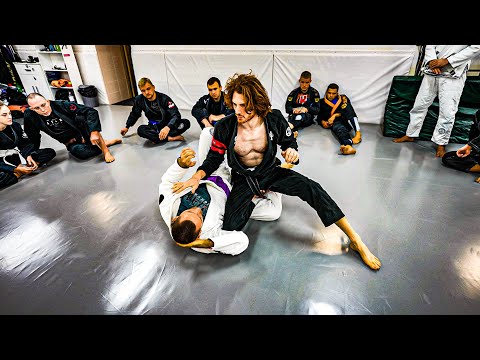
How to Correctly Set Up The Knee Cut Pass
0
Standard Knee Slice Pass·JonThomasBJJ·Added by Admin
This video I go through one of my favorite ways to set up the knee cut pass. A lot of people focus on the details to fi…
Translation: knee slice pass
The knee slice pass is the single most common guard pass in modern competitive BJJ, where the passer's shin acts as a wedge splitting the opponent's legs at a 45-degree diagonal angle while upper body control (underhook and crossface) prevents the guard player from recovering. [1] Popularized at the highest levels by Romulo Barral (5x IBJJF World Champion) and Lucas Lepri (5x IBJJF World Champion), the knee slice has roots in judo newaza but became dominant in competitive BJJ from the mid-2000s onward. [2] At the 2022 IBJJF Mundials, the knee cut was the number-one method of passing among black belt competitors.
The knee slice pass has roots in judo newaza predating modern BJJ but became truly dominant in competition from the mid-2000s onward. Romulo Barral (5x IBJJF World Champion, medium-heavy; ADCC 2008 gold) developed what is described as 'perhaps the most devastating pass in the history of Brazilian Jiu-Jitsu.' [1] Lucas Lepri (5x IBJJF World Champion) is widely considered one of the greatest guard passers ever, building his system around precision knee cuts. [2]
The knee slice is the single most common guard pass at IBJJF World Championships year after year. At the 2022 Mundials (190 matches, adult male black belt), the knee cut was the most dominant way to pass the guard. Guard passing itself is rare — the average match sees only ~0.2 passes — but when a pass IS completed, the passer wins approximately 99.6% of the time. [1][2]
The knee slice pass evolved from judo newaza fundamentals through decades of BJJ competition refinement. Romulo Barral and Lucas Lepri elevated it to the dominant guard pass of the modern era through systematic development and repeated world championship success.
No images yet for this technique.
Sign in to suggest an image.
This video I go through one of my favorite ways to set up the knee cut pass. A lot of people focus on the details to fi…
No instructional courses yet for this technique.
Sign in to suggest a course.
Risk of injury to the person this technique is applied to
Very low danger — positional advancement technique with no joint manipulation, choke, or impact; minor knee pressure on the thigh is the only discomfort
Skill level needed to execute this technique reliably
Whether this technique is allowed under major competition rule sets
Jiu-Jitsu University (Ribeiro, 2008) — Guard Passing
Competition statistics — [1] BJJ Heroes — 2022 IBJJF World Championships statistics and guard passing analysis
Technique instruction — [2] Jiu-Jitsu University (Ribeiro, 2008) — brown belt guard passing chapter
System instructionals — Death by a Thousand Knee Cuts (Barral), Master the Move: Knee Cut (Danaher), Precision Knee Cut Passes (Lepri)
Standard katakana transliteration of Western martial arts terminology (外来語) — used in Japanese MMA, boxing, and BJJ communities
Competition statistics — [1] BJJ Heroes — 2022 IBJJF World Championships statistics and guard passing analysis
Technique instruction — [2] Jiu-Jitsu University (Ribeiro, 2008) — brown belt guard passing chapter
System instructionals — Death by a Thousand Knee Cuts (Barral), Master the Move: Knee Cut (Danaher), Precision Knee Cut Passes (Lepri)
good base and balance, hip mobility for diagonal drive
medium build — not too tall or short for optimal angle mechanics
quadriceps, hip flexors, core stabilizers, neck muscles (for head pressure)
According to Jon Thomas, timing is critical—you need to choose the right moment based on your opponent's positioning. Specifically, when you see wide leg positioning from your opponent, that's an ideal time to attack the knee slice. You can't force the technique; instead, you have to read what your opponent gives you.
Jon Thomas emphasizes that most people don't pay attention to their opponent's leg positioning before attempting the pass. They rush in and get caught in a knee shield, which shuts down the technique before it starts.
Jon Thomas teaches that you should aim for the lapel or shoulder while dropping your body weight onto the opponent's knee or thigh to create a 'wishbone effect' that pries the hips open. Your weight should be positioned so it can drop down and prevent them from re-establishing an underhook.
The knee slice pass is the single most common guard pass in modern competitive BJJ, where the passer's shin acts as a wedge splitting the opponent's legs at a 45-degree diagonal angle while upper body control (underhook and crossface) prevents the guard player from recovering. Popularized at the highest levels by Romulo Barral (5x IBJJF World Champion) and Lucas Lepri (5x IBJJF World Champion), the knee slice has roots in judo newaza but became dominant in competitive BJJ from the mid-2000s onward.
The knee slice pass has roots in judo newaza predating modern BJJ but became truly dominant in competition from the mid-2000s onward. Romulo Barral (5x IBJJF World Champion, medium-heavy; ADCC 2008 gold) developed what is described as 'perhaps the most devastating pass in the history of Brazilian Jiu-Jitsu.
IBJJF: legal — Legal, guard pass scores 3 points; IJF: legal — Legal — transitioning past opponent's legs is part of newaza; ADCC: legal — Legal, guard pass scores 3 points; Unified MMA: legal — Legal; FIAS Sport Sambo: legal — Legal
Danger rating 2/10. Very low danger — positional advancement technique with no joint manipulation, choke, or impact; minor knee pressure on the thigh is the only discomfort
The standard setup chain: Establish Top Position → Win the Underhook → Establish Crossface or Collar Grip → Drive Knee at 45 Degrees → Pin Bottom Leg to Mat → Slide Hips Through.
Standard counters include: Knee Shield — top knee placed sideways across passer's hip, creating a structural barrier / Underhook Fight — winning the far-side underhook prevents the pass from completing / Deep Half Guard Entry — reach under own leg to secure passer's ankle, transition to deep half guard / Leg Lasso — loop outside leg onto passer's biceps or shoulder, reset to spider guard.
Common variants: Standard knee slice with underhook and crossface (the fundamental version from half guard); Knee slice with collar grip (Romulo Barral's signature, thumb-in collar grip instead o…); Flying knee cut (Lucas Lepri's dynamic version launched from standing with…); Long step knee slice (combining a long step backward to clear the bottom leg be…); Knee slice from open guard (applied against De La Riva, Reverse DLR, Spider, and Butt…); Knee slice to mount (continuing the slide past side control directly into moun…).
The most frequently completed guard pass at IBJJF World Championships. Romulo Barral: 5x IBJJF World Champion (medium-heavy), ADCC 2008 gold.
Top errors to watch for: Not winning the underhook — without it, pass success drops dramatically and the opponent can take the back / Knee not past the hip line — the pass is incomplete and reversible until the knee clears the opponent's hip / Not using head pressure — without driving the head into the far shoulder, the opponent can turn in and reguard / Hips too high — passer should keep hips low for proper weight distribution through the wedge.
The Standard Knee Slice Pass is also known as Nī Suraisu Pasu, Knee Slice Pass, Knee Cut Pass, Knee Slide Pass, Flecha.
Data from IBJJF World Championships shows the knee slice as the number one method of passing guard at black belt level. It works because: (1) The shin acts as a wedge that is mechanically difficult to stop. (2) It chains naturally with other passes — if they defend, you can backstep, leg drag, or switch to toreando. (3) It works from half guard, open guard, and De La Riva guard — the most common guards you will face.
Critical — approximately 90% of knee slice passes succeed when the passer wins the far-side underhook. Without the underhook, the bottom player can take your back when you slice through. The underhook battle IS the knee slice battle. If you cannot win the underhook, consider switching to a different pass (backstep, toreando, or body lock).
The knee shield is the first line of defense — place your top knee sideways across the passer's hip to create a structural barrier. If that fails, fight for the underhook on the far side — winning the underhook prevents the pass and opens up back takes. For a more aggressive counter, enter deep half guard by reaching under the passing leg. At high levels, inverting to reguard or counter-attacking with leg locks are also common.