Strike & defenceLocksClose rangeFighting multiple people
Distance
CloseMiddleLong
Overview
The Standard Crucifix establishes the full crucifix position by trapping one of the opponent's arms between the legs (using a figure-four leg configuration) and controlling the other arm with both hands, spreading the arms apart in a cruciform shape. [1] The controlling fighter typically achieves this from a back control position, threading the legs around one arm while maintaining upper body control of the other arm. [1],[2] Once established, the defender is completely immobilised with both arms trapped and unable to defend against attacks. [2],[3]
Also known as
Full Crucifix[1]Crucifix Pin[2]Jūmonji Gatame (十文字固)JP[3]
The standard crucifix is the fundamental version of this dominant control position, used across both grappling competition and MMA as one of the most controlling positions available. [1] Its effectiveness has been demonstrated at the highest levels of competition in both sports. [2],[3]
Country of origin· shown in random order
🇧🇷BrazilBJJ, MMA, Submission Grappling
🇯🇵JapanBJJ, Submission Grappling
🇺🇸USAMMA, Submission Grappling, Catch Wrestling
🇬🇧EnglandCatch Wrestling
Effectiveness
The standard crucifix traps one arm between the legs and controls the other with the hands, exposing the opponent's neck for chokes and strikes. [1]
Lineage
The standard crucifix is the fundamental version of this position, drawn from catch wrestling and adapted in BJJ. [1]
Competition Record
The crucifix is scored as a dominant position in BJJ and is used in MMA. [1]
Images
No images yet for this technique.
Sign in to suggest an image.
Biomechanical Mechanism
Primary Action — Controlling the opponent from behind — seatbelt grip and hooks restrict movement while exposing the neck
Joints Involved — Attacker's hooks (inside the opponent's thighs), seatbelt arm (over-under chest control), hips (body triangle or hooks)
Force Vector — Rearward control — opponent cannot see or effectively counter attacks from behind
Positional Mechanic — Back control is the highest-value position — direct access to rear chokes with minimal defensive options for the opponent
Position & Entry
From arm drag or duck under — Create an angle behind the opponent, secure seatbelt grip, insert hooks to establish back control
From turtle (opponent turtles) — When the opponent turtles to avoid guard pass, take the back by inserting hooks and securing the seatbelt
From sweep (taking the back during the sweep) — During a sweep, circle behind and establish back control instead of ending on top
Variants
Back control with hooks — both feet hooked inside the opponent's thighs
Body triangle back control — legs locked in a figure-four around the torso
Rear mount — mounted on the back with both hooks, opponent face-down
Chair sit back control — sitting behind the opponent with hooks, upright position
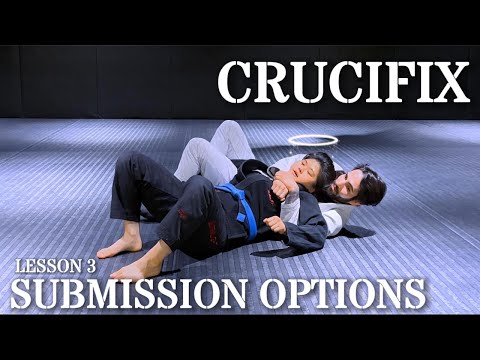
The Crucifix is such a dominant position, but I get lots of questions about submission options from there, particularly …
1 / 2
3 videos
What Instructors Say
The Standard Crucifix is a back-control position where the attacker controls both of the opponent's arms, creating a highly constrained defensive situation that facilitates submission attacks. BJJMindmap emphasizes that solid control setup is prerequisite to any submission attempt, cautioning that submissions will fail without proper foundational control. The position enables multiple high-percentage submissions: the cross-collar choke (most famous but requiring opposite-side collar grip and shoulder positioning to prevent escape), armlock (using knee pressure toward the armpit with bridging), head-and-arm triangle (using Kimura grip with a shrimp to elevate the body), and a shoulder lock variation executed by shooting the arm through for a biceps-deep grip before going flat to load weight on the shoulder. BJJMindmap also introduces a lapel control system where the attacker grabs the opponent's lapel (or belt) and passes it to the wrist as a handcuff, freeing the other hand for choke attacks. Knight Jiu-Jitsu presents alternative submission sequences accessible from crucifix, including short armlock via ankle cross, one-arm choke (emphasizing trap grab with elbow pull toward the lap rather than squeezing), compression choke using leg reach-through, and a north-south choke transition. Bernardo Faria and John Danaher discuss the related Side Crucifix variant, which pins both elbows outward from side control via underhook and shin/leg pinning, establishing chancery control that enables kimura and other submissions with superior breaking mechanics due to complete head-and-shoulder trapping. All three instructors agree that elbow control and arm immobilization are central to the position's effectiveness.
Synthesized from 3 instructors
BJJMindmap — Master the Crucifix: Ultimate Submission & Lapel Trap System | BJJ Mindmap (Lesson 3): Comprehensive submission taxonomy including cross-collar choke with control details, armlock with knee pressure and bridging, head-and-arm triangle using Kimura grip, shoulder lock bailout variation, and lapel/belt handcuff system; emphasizes control setup as prerequisite.
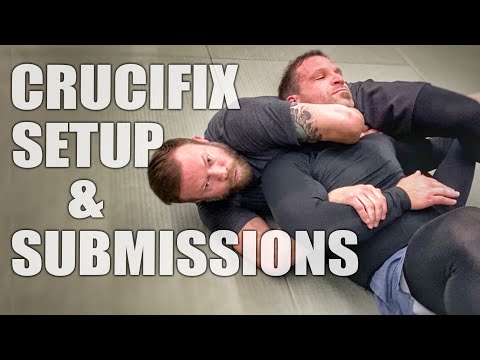
Knight Jiu-Jitsu — Crucifix Submission Options | Jiu-Jitsu Submissions: Alternative submission sequences from crucifix including short armlock via ankle cross, one-arm choke with trap-grab and elbow-pull mechanics, compression choke with leg reach-through, guillotine-style head-and-arm choke, and north-south choke transition; offers unorthodox approaches particularly effective in no-gi.
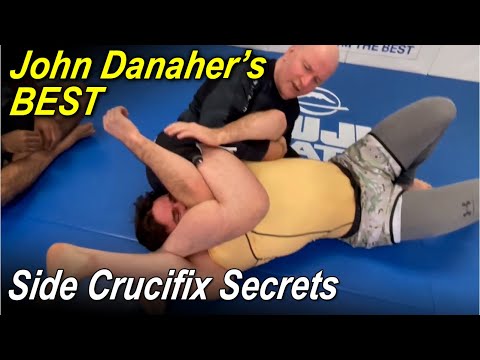
Bernardo Faria BJJ Fanatics — Mastering the Side Crucifix Jiu Jitsu Move with John Danaher: Introduces Side Crucifix variant from side control with underhook and elbow pinning via shin or leg scissor; emphasizes chancery control principle and superior kimura mechanics when head-shoulders are trapped by legs; positions crucifix as pure submission technique independent of point-scoring tactics.
Learn This Technique
No instructional courses yet for this technique.
Sign in to suggest a course.
Ratings
Danger Rating
Risk of injury to the person this technique is applied to
4
Moderate4/10
Back control is dominant position; enables rear chokes (Danaher 2021)
Difficulty
Skill level needed to execute this technique reliably
Intermediate
Competition Legality
Whether this technique is allowed under major competition rule sets
— IBJJF — Legal, back control with hooks or body triangle s...
✓The standard crucifix position: one arm trapped between the attacker's legs in a figure-four, the other arm controlled by the seatbelt grip, opponent's neck exposed for attacks (Danaher, Back Attacks, 2018)
✓The leg trap: triangle one of the opponent's arms between your legs — your top leg crosses over the arm and locks with the bottom leg
✓The hand control: the seatbelt grip controls the second arm — the over-shoulder arm pins it against the opponent's body
✓With both arms controlled, the opponent has zero hand defence — the neck is completely exposed
✓Attack options: reach the free hand under the chin for the RNC, or use the gi collar for chokes
✓The standard crucifix is entered from: back control (trap one arm with legs), turtle (pull one arm between legs while controlling the other), or side control
✓Maintaining the crucifix requires active leg squeezing and seatbelt tension — any loosening allows the opponent to free an arm
✓The standard crucifix is both a position and a submission setup — it's the gateway to the highest-percentage finishes
Common Mistakes
!Loose leg triangle on the trapped arm — the legs must squeeze tightly to prevent the arm from being extracted
!Not controlling the second arm with the seatbelt — both arms must be neutralized for the crucifix to work
!Attempting the choke before both arms are secured — rushing the attack leads to losing the position
!Allowing the opponent to roll out — maintain hip control and back connection to prevent rolls
!Not attacking from the crucifix — the position is too dominant to hold passively; attack the neck immediately
!Losing the position by reaching too far — keep the attacks tight and close
!Not drilling the crucifix entry — the transition into the crucifix is the hardest part
hook control, seatbelt grip endurance, hip connection
Favours
long legs for deep hooks, strong grip for seatbelt
Key muscles
hip adductors, biceps, forearms, core
Frequently Asked Questions
Why is control so important before attempting crucifix submissions?
BJJ Mindmap emphasizes that you must master the control part of the crucifix before attempting submissions, otherwise 'things will go horribly wrong.' Without solid control, your submission attempts will likely fail.
What's the most common submission from the crucifix and why is it risky?
The collar choke is the most famous crucifix submission, but BJJ Mindmap notes it's a 'double-edged sword' because releasing your palm-to-palm grip to attack the choke allows your opponent to turn in and escape. You must secure the cross-collar on the opposite side to maintain control while attacking.
What does BJJ Mindmap recommend as the best crucifix submission?
BJJ Mindmap identifies the armlock as the 'golden move' of crucifix submissions, describing it as having 'a higher rate of submission' than the collar choke. It's performed by keeping your grip and sliding your knee toward the armpit.
How do you finish a one-arm choke from the crucifix?
Knight Jiu-Jitsu explains that the key detail is grabbing the trap and pulling your elbow back, rather than simply squeezing to finish the choke.
How does the Standard Crucifix work?
The Standard Crucifix establishes the full crucifix position by trapping one of the opponent's arms between the legs (using a figure-four leg configuration) and controlling the other arm with both hands, spreading the arms apart in a cruciform shape. The controlling fighter typically achieves this from a back control position, threading the legs around one arm while maintaining upper body control of the other arm.
Where does the Standard Crucifix come from?
The standard crucifix is the fundamental version of this dominant control position, used across both grappling competition and MMA as one of the most controlling positions available. Its effectiveness has been demonstrated at the highest levels of competition in both sports.
Is the Standard Crucifix legal in competition?
IBJJF: legal — Legal, back control with hooks or body triangle scores 4 points; IJF: legal — Legal — back control leads to pin or submission opportunities; ADCC: legal — Legal, back mount scores 3 points (4 from sweep); Unified MMA: legal — Legal — dominant position for ground-and-pound and rear naked choke; UWW: legal — Legal — back exposure is the primary scoring mechanism in wrestling; FIAS Sport Sambo: legal — Legal
How dangerous is the Standard Crucifix?
Danger rating 4/10. Moderate — back control is dominant position; enables rear chokes (Danaher 2021)
How do I set up the Standard Crucifix?
The standard setup chain: Achieve Position → Stabilize → Maintain → Attack.
How do I defend against the Standard Crucifix?
Standard counters include: Hand Fight — grip-fight the choking hand to prevent the rear naked choke / Shoulder Walk — walk shoulders to the mat to escape back control / Turn into Guard — rotate to face the attacker and recover guard position.
What are the variants of the Standard Crucifix?
Common variants: Back control with hooks (both feet hooked inside the opponent's thighs); Body triangle back control (legs locked in a figure-four around the torso); Rear mount (mounted on the back with both hooks, opponent face-down); Chair sit back control (sitting behind the opponent with hooks, upright position).
How effective is the Standard Crucifix in competition?
The crucifix is scored as a dominant position in BJJ and is used in MMA.
What are common mistakes when doing the Standard Crucifix?
Top errors to watch for: Loose leg triangle on the trapped arm — the legs must squeeze tightly to prevent the arm from being extracted / Not controlling the second arm with the seatbelt — both arms must be neutralized for the crucifix to work / Attempting the choke before both arms are secured — rushing the attack leads to losing the position / Allowing the opponent to roll out — maintain hip control and back connection to prevent rolls.
What are other names for the Standard Crucifix?
The Standard Crucifix is also known as Sutandādo Kurushifikkusu, Full Crucifix, Crucifix Pin, Jūmonji Gatame (十文字固).