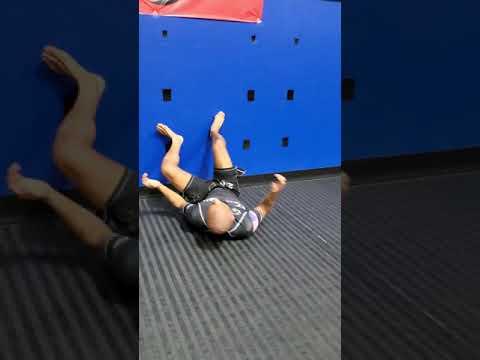
Tornado roll, Granby roll, Berimbolo roll, Inverted Roll drill
0
Standard Granby Roll·Street Jitsu·Added by Admin
Coach Dennis shows you how to do the Tornado roll aka Granby roll, Berimbolo roll, Inverted Roll drill. This is a great …
Translation: standard Granby roll
The Standard Granby Roll executes the fundamental shoulder roll escape from turtle by tucking the chin, dropping the shoulder, and rolling over the shoulder and back to emerge facing the opponent in a guard position. [1] The turtled fighter initiates the roll by dropping one shoulder and inverting over it, using the rolling momentum to carry the body through and emerge on the other side facing the opponent. [1],[2] The smooth, flowing motion of the Granby roll makes it difficult for the opponent to maintain control, as the continuous rotation breaks their grip and creates separation. [2],[3]
The standard Granby roll is the core technique of the Granby wrestling style developed at Granby High School, adapted for BJJ and MMA turtle escapes. [1] Its influence on grappling extends beyond the specific technique to the broader principle of using inversions and rolls from bottom position. [2],[3]
The Granby roll is one of the most effective turtle escapes, using a shoulder roll to create space and emerge facing the opponent in guard. [1] It is especially effective in no-gi grappling where the opponent cannot grip the clothing to prevent the roll, and in wrestling where bottom escapes are essential for scoring. [2]
The Granby roll was developed at Granby High School in Norfolk, Virginia, as part of the Granby wrestling system created by coach Billy Martin in the 1960s-70s. [2] The system emphasized continuous movement and rolling from the bottom position, revolutionizing high school and college wrestling in the United States. [2]
No images yet for this technique.
Sign in to suggest an image.
Coach Dennis shows you how to do the Tornado roll aka Granby roll, Berimbolo roll, Inverted Roll drill. This is a great …
No instructional courses yet for this technique.
Sign in to suggest a course.
Risk of injury to the person this technique is applied to
Turtle escapes involve rolling and granby movements; neck strain risk
Skill level needed to execute this technique reliably
Whether this technique is allowed under major competition rule sets
Jiu-Jitsu University (Saulo Ribeiro, 2008)
Alias sources — [1] Named after Granby High School wrestling system [2] NCAA wrestling terminology
Effectiveness sources — [1] Jiu-Jitsu University (Saulo Ribeiro, 2008) [2] Wrestling for Fighting (Randy Couture, 2007)
Standard katakana transliteration of Western martial arts terminology (外来語) — used in Japanese MMA, boxing, and BJJ communities
Alias sources — [1] Named after Granby High School wrestling system [2] NCAA wrestling terminology
Effectiveness sources — [1] Jiu-Jitsu University (Saulo Ribeiro, 2008) [2] Wrestling for Fighting (Randy Couture, 2007)
hip escape (shrimping) speed, framing strength, timing
flexible hips and quick lateral movement
hip flexors, obliques, triceps (framing), core
Yes, you can practice solo drills on a wall, which helps with guard retention and core strength. You can go at your own pace—as fast or slow as you want—and practice in both directions depending on how much space you have available.
Keep tension in your body throughout the movement, as the right tension level varies from person to person. Bend your knees and come under as you move, adjusting your speed and direction based on your space.
These drills are tremendous ab workouts and help develop guard retention, making them valuable conditioning exercises in addition to technique building.
The Standard Granby Roll executes the fundamental shoulder roll escape from turtle by tucking the chin, dropping the shoulder, and rolling over the shoulder and back to emerge facing the opponent in a guard position. The turtled fighter initiates the roll by dropping one shoulder and inverting over it, using the rolling momentum to carry the body through and emerge on the other side facing the opponent.
The standard Granby roll is the core technique of the Granby wrestling style developed at Granby High School, adapted for BJJ and MMA turtle escapes. Its influence on grappling extends beyond the specific technique to the broader principle of using inversions and rolls from bottom position.
Unified MMA: legal — Legal defensive/transitional technique; IBJJF: legal — Legal; IJF: legal — Legal; ADCC: legal — Legal; UWW: legal — Legal, escape scores 1 point (freestyle), reversal scores 1 point; FIAS Sport Sambo: legal — Legal; NCAA Folkstyle: legal — Legal, escape scores 1 point, reversal scores 2 points
Danger rating 3/10. Moderate — turtle escapes involve rolling and granby movements; neck strain risk
The standard setup chain: Create Space → Disrupt Control → Execute Escape → Recover Position.
Standard counters include: Maintain Pressure — keep consistent weight distribution to limit escape space / Anticipate Direction — read escape attempt direction and block early / Transition — flow to a new position when the current one is threatened.
Common variants: Shrimp to guard (framing and hip-escaping to recover full guard or half guard); Underhook escape (winning the underhook and coming to knees or reversing); Bridge to knees (bridging into the opponent and transitioning to turtle or…); Ghost escape (inverting under the opponent to re-guard from the opposit…).
The Granby wrestling system produced numerous NCAA championship-caliber wrestlers and the Granby roll became one of the most widely adopted bottom wrestling techniques in American folkstyle wrestling. It has since been adopted into BJJ and MMA as a turtle escape technique.
Top errors to watch for: Not tucking the chin — this is the most important safety element; always tuck / Dropping the wrong shoulder — drop the shoulder closest to the opponent / Pausing during the inversion — the roll must be continuous; stopping inverted is vulnerable / Not threading the legs through — the legs must come between you and the opponent.
The Standard Granby Roll is also known as Sutandādo Guranbī Rōru, Basic Granby, Standard Shoulder Roll.