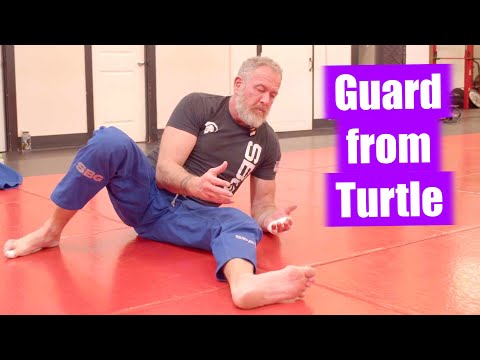
Guard Recovery - Getting To Turtle
0
Guard Pull From Turtle·SBG PDX & Vancouver BJJ and MMA Videos
Try out SBG University for a month for free. Use the code: YOUTUBEFREE https://sbgu.samcart.com/referral/OD1DNOAi/vUiYFZ…
Translation: guard pull from turtle
The Guard Pull From Turtle family covers techniques for transitioning from the turtle position directly into a guard position, typically half guard or full guard. [1] Rather than standing up or rolling away, guard pulls from turtle involve the turtled fighter sitting through to establish a guard, converting a defensive position into an offensive one where sweeps and submissions become available. [1],[2] This approach is particularly popular in BJJ where the guard is a strong offensive position, making the turtle-to-guard transition an efficient escape that immediately creates attacking opportunities. [2],[3]
Guard pulls from turtle developed within BJJ as guard play became increasingly sophisticated and the guard was no longer viewed as an inferior position. [1] Competitors who preferred playing guard found that sitting to guard from turtle was more efficient than standing up, as it kept the fight in their preferred ground fighting context. [2],[3]
Guard pull from turtle transitions directly from turtle to a guard position by sitting through. [1]
Developed in BJJ as a turtle recovery option. [1]
Used in BJJ competition. [1]
No images yet for this technique.
Sign in to suggest an image.
Try out SBG University for a month for free. Use the code: YOUTUBEFREE https://sbgu.samcart.com/referral/OD1DNOAi/vUiYFZ…
No instructional courses yet for this technique.
Sign in to suggest a course.
Risk of injury to the person this technique is applied to
Turtle escapes involve rolling and granby movements; neck strain risk
Skill level needed to execute this technique reliably
Whether this technique is allowed under major competition rule sets
Jiu-Jitsu University (Saulo Ribeiro, 2008)
Alias sources — [1] Jiu-Jitsu University (Ribeiro, 2008) [2] Jiu-Jitsu University (Ribeiro, 2008)
Effectiveness sources — [1] Jiu-Jitsu University (Ribeiro, 2008)
Mixed Japanese-Western terminology — combines traditional Japanese terms with katakana loanwords
Alias sources — [1] Jiu-Jitsu University (Ribeiro, 2008) [2] Jiu-Jitsu University (Ribeiro, 2008)
Effectiveness sources — [1] Jiu-Jitsu University (Ribeiro, 2008)
timing, hip power, off-balancing skill
strong hips and active legs for sweeping leverage
hip flexors, glutes, quadriceps, core rotators
Every move, in any martial art, shares a few universal traits. Mix and match below to pinpoint the right tool — or compare equivalents across styles.
Pulling guard from turtle involves inserting a hook, turning into the opponent, and establishing a guard position. In competition BJJ, this is a common recovery method when the turtle is under attack. In MMA, pulling guard from turtle exposes you to strikes. (BJJ competition strategy)
According to SBG PDX & Vancouver, the mistake most people make is sliding into the guard pull like a baseball slide, which traps your head underneath if your opponent is heavy and has control of your neck. Instead, you should move away from them by keeping your knees vertical, stepping up with one foot, rotating on that knee, and moving your head back—never forward.
The underhook's purpose is shoulder rotation, not lifting—SBG PDX & Vancouver emphasizes retracting your bottom shoulder to create the angle rather than trying to lift into your opponent's weight. Once you achieve this rotational angle, it becomes nearly impossible for them to flatten you out.
SBG PDX & Vancouver teaches that when your opponent is perpendicular at 90 degrees, you would be giving them your back. Instead, always move your hips away to create better positioning before attempting the turtle entry.
SBG PDX & Vancouver recommends keeping your legs in an open position so they can't jump over your legs, and stepping up to block their path as they circle around your head—this forces them to deal with your hands and feet rather than accessing your back.
The Guard Pull From Turtle family covers techniques for transitioning from the turtle position directly into a guard position, typically half guard or full guard. Rather than standing up or rolling away, guard pulls from turtle involve the turtled fighter sitting through to establish a guard, converting a defensive position into an offensive one where sweeps and submissions become available.
Guard pulls from turtle developed within BJJ as guard play became increasingly sophisticated and the guard was no longer viewed as an inferior position. Competitors who preferred playing guard found that sitting to guard from turtle was more efficient than standing up, as it kept the fight in their preferred ground fighting context.
Unified MMA: legal — Legal defensive technique; IBJJF: legal — Legal — escapes and sweeps are fundamental to BJJ, sweep from bottom scores 2…; IJF: legal — Legal; ADCC: legal — Legal, sweep scores 2 points (4 from mount/back); FIAS Sport Sambo: legal — Legal; FIAS Combat Sambo: legal — Legal
Danger rating 3/10. Moderate — turtle escapes involve rolling and granby movements; neck strain risk
The standard setup chain: Create Space → Disrupt Control → Execute Escape → Recover Position.
Standard counters include: Maintain Pressure — keep consistent weight distribution to limit escape space / Anticipate Direction — read escape attempt direction and block early / Transition — flow to a new position when the current one is threatened.
Common variants: Standard sweep (primary off-balancing and reversal technique from the guard); Combination sweep (chaining two sweep directions to catch the opponent's adj…); Counter sweep (sweeping as the opponent initiates a guard pass attempt); Competition sweep (optimised for point-scoring in tournament settings).
Used in BJJ competition.
Top errors to watch for: Pulling guard too slowly — the opponent will take the back if you don't transition quickly / Not using grips to control the opponent during the transition — uncontrolled guard pulls are easily passed / Sitting through without catching the opponent's leg — you end up on your back without guard / Pulling guard and lying flat — sit through to an active guard, not a flat back.
The Guard Pull From Turtle is also known as Kame kara Gādo Puru, Turtle To Guard, Reguard From Turtle.