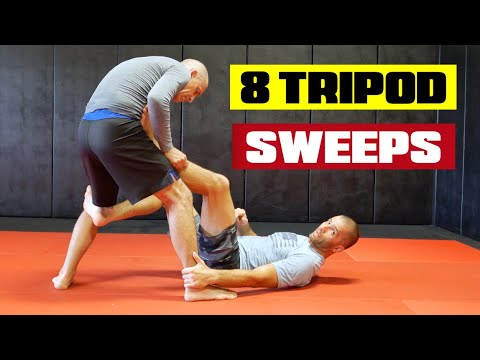
8 Tripod Sweeps That You Should Know
0
Standard Tripod Sweep·MMA Leech
The Tripod Sweep is one of the most fundamental moves in BJJ. You can sweep your opponent from many different guards, us…
Translation: tripod sweep
The tripod sweep is a foundational open guard sweep where the guard player places one foot on the opponent's hip, hooks behind the opponent's ankle with the other foot, and grips the far ankle — simultaneously pushing the hip away while pulling/hooking both ankles to remove the opponent's base. [1] Named for the three-point base created by the two hands and one foot on the hip. One of the first open guard sweeps taught to beginners, commonly paired with the sickle sweep as complementary techniques. [2]
Fundamental BJJ open guard sweep taught across all major lineages. No single inventor. [1]
One of the highest-percentage open guard sweeps at beginner and intermediate levels. The push-pull mechanism makes it highly reliable. [1]
Fundamental BJJ open guard curriculum.
Used at all levels of IBJJF competition as a fundamental open guard sweep.
No images yet for this technique.
Sign in to suggest an image.
The Tripod Sweep is one of the most fundamental moves in BJJ. You can sweep your opponent from many different guards, us…
Make sure to like, comment, and subscribe to access all of the latest jiu jitsu videos! Website: https://www.flograppli…
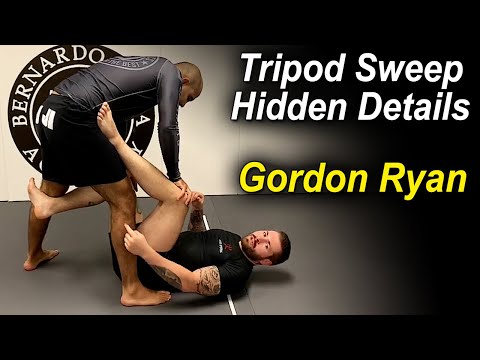
Hidden Details In The BJJ Tripod Sweep (Open Guard) That You Have Never Seen Before by Gordon Ryan - Click Here To Check…
The standard tripod sweep is a fundamental open-guard reversal executed by controlling the opponent's leg(s) while applying hip pressure to topple them forward. All three instructors agree on the core mechanic: foot/ankle control paired with hip or abdominal pressure creates the sweep. Gordon Ryan (via Bernardo Faria BJJ Fanatics) emphasizes critical details for high-level execution: establishing initial "stickiness" by wedging the opponent's ankle between the practitioner's thigh and arm prevents the opponent from rotating out; elevating the opponent's posting foot off the ground is essential, as it prevents them from stepping out and basing on their free leg. Ryan stresses pushing with one leg while pulling the opponent's foot upward rather than purely backward. Adam Wardziński (FloGrappling) prioritizes a far-side sleeve grip for control and balance, combined with a 45-degree angle relative to the opponent; he employs a push-pull motion—folding the arm to drive the opponent backward while actively hooking behind the Achilles and pulling forward. Professor Gustavo (MMA Leech) catalogs multiple entry points and variations: controlling both ankles with hands or feet, pushing the hip with knees, feet, or head depending on opponent distance and posture. All instructors agree timing and active leg control are decisive, though they differ in emphasis: Ryan highlights foot elevation and stickiness, Wardziński stresses angular positioning and the sleeve grip, and Gustavo provides systematic variations across guard types.
Synthesized from 3 instructors
No instructional courses yet for this technique.
Sign in to suggest a course.
Risk of injury to the person this technique is applied to
Very safe — sweeping technique with minimal injury risk
Skill level needed to execute this technique reliably
Whether this technique is allowed under major competition rule sets
Evolve MMA — BJJ Tripod Sweep
[2] BJJ World — tripod and sickle sweep combination
Evolve MMA — Unlocking The Secrets Of The BJJ Tripod Sweep (evolve-mma.com) || BJJ Fanatics — Travis Stevens Teaches the Tripod Sweep || BJJ World — Tripod Sweep And Sickle Sweep As Checkpoint Guards (bjj-world.com)
Mixed Japanese-Western terminology — combines traditional Japanese terms with katakana loanwords
[1] Evolve MMA — tripod sweep mechanics
[2] BJJ World — tripod and sickle sweep combination
basic hip mobility, coordination
hip flexors, core, hamstrings
According to Gordon Ryan, you need to form initial stickiness to your opponent's heel when you grab their ankle, which prevents them from turning and kicking out in that direction.
Gordon Ryan emphasizes that instead of just pushing backwards, you should focus on elevating your opponent's foot off the ground by pushing with your leg and pulling their foot up, which takes away their ability to post.
Yes—MMA Leech demonstrates that you can use your feet to push instead of your knees, keeping your feet in between your opponent's legs and lifting their ankles to prevent them from coming up.
From a seated guard position, you can use a scissors motion with your legs when on your side for power, or transition to a shin-on-shin grip and elevate your opponent's hip with your knee while controlling their far ankle.
The tripod sweep is a foundational open guard sweep where the guard player places one foot on the opponent's hip, hooks behind the opponent's ankle with the other foot, and grips the far ankle — simultaneously pushing the hip away while pulling/hooking both ankles to remove the opponent's base. Named for the three-point base created by the two hands and one foot on the hip.
Fundamental BJJ open guard sweep taught across all major lineages. No single inventor.
Unified MMA: legal — Legal defensive technique; IBJJF: legal — Legal — escapes and sweeps are fundamental to BJJ, sweep from bottom scores 2…; IJF: legal — Legal; ADCC: legal — Legal, sweep scores 2 points (4 from mount/back); FIAS Sport Sambo: legal — Legal; FIAS Combat Sambo: legal — Legal
Danger rating 1/10. Very safe — sweeping technique with minimal injury risk
The standard setup chain: Opponent stands in guard → Open guard → Place foot on opponent's hip → Hook behind near ankle with other foot → Grip far ankle → Simultaneously: push hip away + hook near ankle + pull far ankle → Opponent falls → Come up to top position.
Standard counters include: Step over the hook — remove the ankle hook before the sweep develops / Post the free hand — prevent falling by posting out wide / Squat low — lower center of gravity to resist the push / Back step — step backward to remove the foot from the hip.
Common variants: Standard tripod (foot on hip + far ankle grip + near ankle hook); Sickle sweep (complementary sweep using the hook foot as a sickle to cu…); Collar-sleeve tripod (using collar and sleeve grips for upper body control); Seated tripod (from seated open guard when opponent stands).
Used at all levels of IBJJF competition as a fundamental open guard sweep.
Top errors to watch for: Not pushing the hip strongly enough — the foot on the hip creates the backward force / Not hooking the ankle — without the hook, the opponent can step out / Attempting without controlling the far ankle — the far ankle grip prevents posting / Timing — must be simultaneous push-pull, not sequential.
The Standard Tripod Sweep is also known as Sankyaku Suīpu, Tripod Sweep, Three-Point Sweep, Hook Sweep.