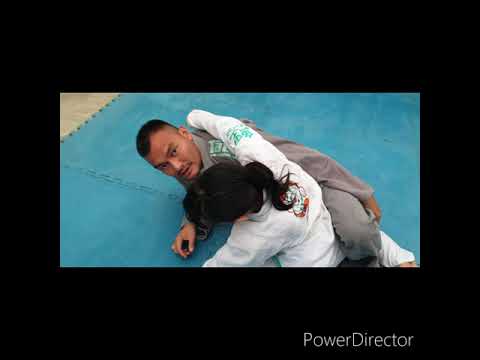
#PatosKids Online Training. Week 18. Plan B
0
Standard Plan B·Niño Castro·Added by Admin
#bjj #jiujitsu #brazilianjiujitsu #kidsjiujitsu #jiujitsukids #kidsbjj #bjjkids #patosbjj #patoskids #cebubjj #cebujiuji…
Translation: standard plan B
The Standard Plan B executes the backup half guard sweep by redirecting the opponent's forward pressure into a sweep, typically involving a change of grip from the underhook to a different control and sweeping the opponent over the back rather than over the shoulder. [1] When the primary underhook sweep is stuffed, the guard player converts the underhook grip to a cross-face or back grip and uses the opponent's forward commitment to roll them over in the new direction. [1],[2] The Plan B's effectiveness lies in using the opponent's own defensive reaction against them — the harder they drive forward to stop the underhook sweep, the more vulnerable they are to the Plan B. [2],[3]
The standard Plan B is the core technique of Lucas Leite's half guard system, developed as the natural complement to the underhook sweep that made Leite one of the most successful half guard players in BJJ history. [1] Leite's success with this sweep in world championship competition proved the effectiveness of pairing primary and secondary sweep options from half guard. [2],[3]
The standard Plan B is the baseline version of this half guard sweep. [1]
Developed by Eddie Bravo. [1]
Used in no-gi competition. [1]
No images yet for this technique.
Sign in to suggest an image.
#bjj #jiujitsu #brazilianjiujitsu #kidsjiujitsu #jiujitsukids #kidsbjj #bjjkids #patosbjj #patoskids #cebubjj #cebujiuji…
No instructional courses yet for this technique.
Sign in to suggest a course.
Risk of injury to the person this technique is applied to
Sweeps reverse position from bottom; moderate impact on landing for top player
Skill level needed to execute this technique reliably
Whether this technique is allowed under major competition rule sets
Jiu-Jitsu University (Saulo Ribeiro, 2008)
Alias sources — [1] Lucas Leite half guard system terminology [2] Modern competition BJJ terminology
Effectiveness sources — [1] Mastering the Rubber Guard (Bravo, 2006)
Standard katakana transliteration of Western martial arts terminology (外来語) — used in Japanese MMA, boxing, and BJJ communities
Alias sources — [1] Lucas Leite half guard system terminology [2] Modern competition BJJ terminology
Effectiveness sources — [1] Mastering the Rubber Guard (Bravo, 2006)
timing, hip power, off-balancing skill
strong hips and active legs for sweeping leverage
hip flexors, glutes, quadriceps, core rotators
Your shoulders need to be positioned under your partner's armpit. If your partner is similar in size or larger, you can reach over and grab their shoulders while keeping the underhook tight.
When your opponent steps and widens their base to defend the old school sweep, you transition to Plan B by going under with a tight underhook. This completes the sequence that connects the lockdown, old school, and Plan B techniques together.
Your head should be positioned down under your opponent's head as you set up the technique and work toward the sweep.
The Standard Plan B executes the backup half guard sweep by redirecting the opponent's forward pressure into a sweep, typically involving a change of grip from the underhook to a different control and sweeping the opponent over the back rather than over the shoulder. When the primary underhook sweep is stuffed, the guard player converts the underhook grip to a cross-face or back grip and uses the opponent's forward commitment to roll them over in the new direction.
The standard Plan B is the core technique of Lucas Leite's half guard system, developed as the natural complement to the underhook sweep that made Leite one of the most successful half guard players in BJJ history. Leite's success with this sweep in world championship competition proved the effectiveness of pairing primary and secondary sweep options from half guard.
Unified MMA: legal — Legal defensive/transitional technique; IBJJF: legal — Legal; IJF: legal — Legal; ADCC: legal — Legal; UWW: legal — Legal; FIAS Sport Sambo: legal — Legal
Danger rating 3/10. Moderate — sweeps reverse position from bottom; moderate impact on landing for top player
The standard setup chain: Create Space → Disrupt Control → Execute Escape → Recover Position.
Standard counters include: Maintain Pressure — keep consistent weight distribution to limit escape space / Anticipate Direction — read escape attempt direction and block early / Transition — flow to a new position when the current one is threatened.
Common variants: Standard sweep (primary off-balancing and reversal technique from the guard); Combination sweep (chaining two sweep directions to catch the opponent's adj…); Counter sweep (sweeping as the opponent initiates a guard pass attempt); Competition sweep (optimised for point-scoring in tournament settings).
Used in no-gi competition.
Top errors to watch for: Cross-gripping the near wrist instead of the far — the far wrist is the one that matters for post prevention / Weak bridge that doesn't generate enough force — the bridge must be explosive / Not pulling the wrist toward you before bridging — the wrist pull breaks the opponent's base / Bridging toward the wrong side — bridge toward the controlled-wrist side.
The Standard Plan B is also known as Sutandādo Puran B, Basic Plan B Sweep, Standard Knee Torque Half Guard Sweep.