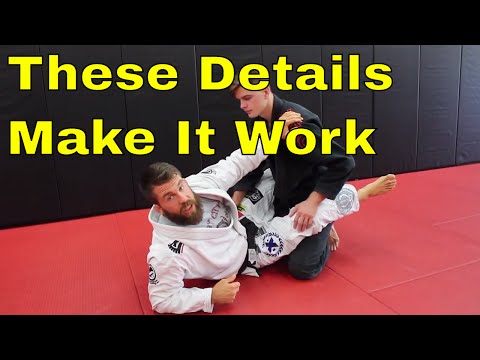
Scissor Sweep for BJJ White Belts (Try These Adjustments)
0
Standard Scissor Sweep·Chewjitsu·Added by Admin
The Scissor Sweep is one of the first Sweeps from Guard that most BJJ White Belts learn. And in a recent video where I c…
Translation: standard scissor sweep
The Standard Scissor Sweep opens the closed guard, places the top knee (shin) across the opponent's chest as a frame, grips the collar and sleeve, then chops the bottom leg across the opponent's far knee while pulling with the collar grip to roll them over. [1] The shin frame prevents the opponent from driving forward while the chopping leg eliminates their base, and the upper body grips direct the sweep. [1],[2] The combined scissoring action of the two legs, coordinated with the grip pull, creates the rotational force that completes the sweep. [2],[3]
The standard scissor sweep is one of the most mechanically efficient sweeps in BJJ, using minimal energy for maximum effect when the opponent's weight is centered. [1] It is particularly effective when chained with the hip bump sweep as a complementary pair — if the opponent posts back to defend the hip bump, they become vulnerable to the scissor sweep, and vice versa. [1],[2]
The scissor sweep uses a knee shield and sleeve grip to sweep the opponent laterally from closed guard. [1]
The scissor sweep is a standard technique in IBJJF competition. [1]
No images yet for this technique.
Sign in to suggest an image.
The Scissor Sweep is one of the first Sweeps from Guard that most BJJ White Belts learn. And in a recent video where I c…
No instructional courses yet for this technique.
Sign in to suggest a course.
Risk of injury to the person this technique is applied to
Sweeps reverse position from bottom; moderate impact on landing for top player
Skill level needed to execute this technique reliably
Whether this technique is allowed under major competition rule sets
The Guard (Joe Moreira & Ed Beneville, 2008)
Alias sources — [1] Gracie Jiu-Jitsu (Gracie & Gracie, 2001) [2] Kodokan Judo (Jigoro Kano, 1986) [3] Jiu-Jitsu University (Saulo Ribeiro, 2008)
Effectiveness sources — [1] Jiu-Jitsu University (Saulo Ribeiro, 2008) [2] Mastering Jujitsu (Renzo Gracie & John Danaher, 2003)
Standard katakana transliteration of Western martial arts terminology (外来語) — used in Japanese MMA, boxing, and BJJ communities
Alias sources — [1] Gracie Jiu-Jitsu (Gracie & Gracie, 2001) [2] Kodokan Judo (Jigoro Kano, 1986) [3] Jiu-Jitsu University (Saulo Ribeiro, 2008)
Effectiveness sources — [1] Jiu-Jitsu University (Saulo Ribeiro, 2008) [2] Mastering Jujitsu (Renzo Gracie & John Danaher, 2003)
timing, hip power, off-balancing skill
strong hips and active legs for sweeping leverage
hip flexors, glutes, quadriceps, core rotators
White belts often get crappy grips early on. Instead, get as deep as possible into the lapel, using your four fingers to touch the tag at the back, and establish a really strong grip before proceeding with the sweep.
Bring your knee at a diagonal angle going from hip up to the chest, not down toward the opponent's waist, because it's very easy for them to crash down on you if positioned there.
Tuck your heels under the opponent's butt rather than keeping your foot flat, as this is more effective and prevents them from escaping easily once you start the sweep.
The Standard Scissor Sweep opens the closed guard, places the top knee (shin) across the opponent's chest as a frame, grips the collar and sleeve, then chops the bottom leg across the opponent's far knee while pulling with the collar grip to roll them over. The shin frame prevents the opponent from driving forward while the chopping leg eliminates their base, and the upper body grips direct the sweep.
The standard scissor sweep is the quintessential introductory BJJ sweep, taught in virtually every BJJ academy as the first sweep new students learn. Its universal inclusion in beginner curricula reflects its effectiveness as both a technique and a teaching tool for sweep mechanics.
Unified MMA: legal — Legal defensive/transitional technique; IBJJF: legal — Legal; IJF: legal — Legal; ADCC: legal — Legal; UWW: legal — Legal; FIAS Sport Sambo: legal — Legal
Danger rating 3/10. Moderate — sweeps reverse position from bottom; moderate impact on landing for top player
The standard setup chain: Control Grips → Off-Balance → Execute Sweep → Follow to Top.
Standard counters include: Base and Posture — maintain wide base and upright posture to resist the sweep / Grip Strip — break controlling grips before the sweep can be loaded / Back Step — retreat the leg being attacked to remove the sweep fulcrum.
Common variants: Standard sweep (primary off-balancing and reversal technique from the guard); Combination sweep (chaining two sweep directions to catch the opponent's adj…); Counter sweep (sweeping as the opponent initiates a guard pass attempt); Competition sweep (optimised for point-scoring in tournament settings).
The scissor sweep is a standard technique in IBJJF competition.
Top errors to watch for: Not pulling the opponent forward with the collar grip — the pull loads them onto the scissor / Placing the knee shield vertically instead of across the body — the shin should be horizontal across the stomach / Chopping too high on the thigh instead of at the knee — the knee is the leverage point / Not following to mount — the sweep naturally transitions to mount; don't stop short.
The Standard Scissor Sweep is also known as Sutandādo Shizā Suīpu, Basic Scissor Sweep, Standard Hasami Gaeshi, Fundamental Scissor.