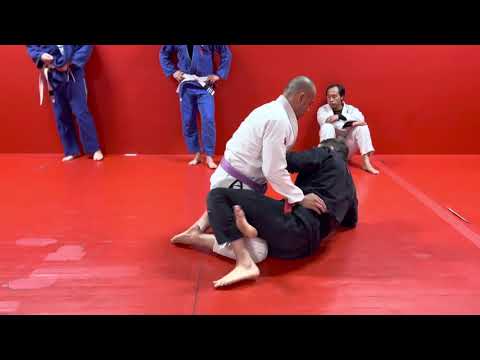
Kimura butterfly sweep
0
Kimura Grip Sweep·BJJ4Breakfast
Kimura butterfly sweep to start 15 point kimura sequence.
Not yet documented
The Kimura Grip Sweep is a closed guard sweep that uses the kimura (figure-four) grip as both a submission threat and a sweeping mechanism — when the opponent defends the kimura by posturing, the attacker uses the kimura grip leverage to sweep them instead, and when they defend the sweep by staying low, the kimura submission becomes available. [1] This is one of the best examples of the sweep-submission chain principle in BJJ. [1],[2]
Developed within the parent martial arts tradition. [1]
Used in relevant competition formats. [1]
No images yet for this technique.
Sign in to suggest an image.
Kimura butterfly sweep to start 15 point kimura sequence.
No instructional courses yet for this technique.
Sign in to suggest a course.
Risk of injury to the person this technique is applied to
Standard technique-level risk appropriate to the category
Skill level needed to execute this technique reliably
Whether this technique is allowed under major competition rule sets
Jiu-Jitsu University (Saulo Ribeiro, 2008)
Description sources — [1] Martial arts curriculum [2] Competition analysis
Standard katakana transliteration of Western martial arts terminology (外来語) — used in Japanese MMA, boxing, and BJJ communities
Description sources — [1] Martial arts curriculum [2] Competition analysis
technique-specific physical attributes
technique-dependent
Every move, in any martial art, shares a few universal traits. Mix and match below to pinpoint the right tool — or compare equivalents across styles.
The Kimura grip from closed guard functions as both a sweep and submission threat — the figure-four grip on the wrist creates a powerful lever for off-balancing. If the sweep fails, the Kimura submission is immediately available. (Jiu-Jitsu University, Ribeiro; Mastering Jujitsu, Gracie & Danaher)
Use your other foot to peel their leg off and continue to side control. BJJ4Breakfast notes that this is a common occurrence—even if they capture your leg as you sweep over, you can simply push it off with your free foot and secure your five points.
After performing a hip escape to prevent your opponent from tucking their hand into their groin, insert your butterfly hook underneath their leg, take your other foot off their leg, and use the butterfly hook to lift and bump them over.
You should land in side control, which scores five points—two for the sweep itself and three for the side control position.
The Kimura Grip Sweep is a closed guard sweep that uses the kimura (figure-four) grip as both a submission threat and a sweeping mechanism — when the opponent defends the kimura by posturing, the attacker uses the kimura grip leverage to sweep them instead, and when they defend the sweep by staying low, the kimura submission becomes available. This is one of the best examples of the sweep-submission chain principle in BJJ.
This technique developed within its parent martial arts tradition and has been refined through competition.
Unified MMA: legal — Legal defensive/transitional technique; IBJJF: legal — Legal; IJF: legal — Legal; ADCC: legal — Legal; UWW: legal — Legal; FIAS Sport Sambo: legal — Legal
Danger rating 4/10. Moderate — standard technique-level risk appropriate to the category
The standard setup chain: Establish Entry Position → Set Up the Technique → Execute → Follow Through → Consolidate or Transition.
Standard counters include: Defensive techniques against this specific technique / Prevention of the entry position.
Common variants: Standard execution (the fundamental version); Modified variation (adapted for specific scenarios).
Used in relevant competition formats.
Top errors to watch for: Poor entry positioning / Incomplete execution / Not chaining with follow-up techniques / Attempting without proper setup.
The Kimura Grip Sweep is also known as Kimura Sweep, Figure-Four Grip Sweep.