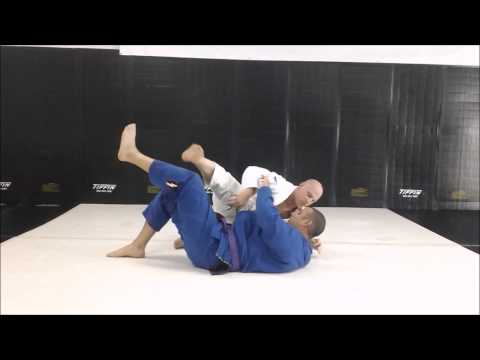
Elevator Sweep From Guard - Lesson Thirteen
0
Standard Elevator Sweep·Gracie NEPA·Added by Admin
In the fight your goal is to achieve the dominant position and finish the fight. The elevator sweep is just one of many …
Translation: standard elevator sweep
The Standard Elevator Sweep opens the closed guard, inserts a butterfly hook inside the opponent's thigh, secures an underhook or collar grip, then falls to one side while elevating with the hook to roll the opponent over. [1] The guard player times the hook insertion when the opponent postures or shifts weight, secures a strong upper body grip, then executes the sweep in one coordinated motion — lifting with the hook and pulling with the arms. [1],[2] The sweep finishes with the guard player in mount or side control on top. [2],[3]
The standard elevator sweep is the fundamental version. [1]
Used in BJJ competition. [1]
No images yet for this technique.
Sign in to suggest an image.
In the fight your goal is to achieve the dominant position and finish the fight. The elevator sweep is just one of many …
No instructional courses yet for this technique.
Sign in to suggest a course.
Risk of injury to the person this technique is applied to
Sweeps reverse position from bottom; moderate impact on landing for top player
Skill level needed to execute this technique reliably
Whether this technique is allowed under major competition rule sets
Jiu-Jitsu University (Saulo Ribeiro, 2008)
Alias sources — [1] Gracie Jiu-Jitsu (Gracie & Gracie, 2001) [2] Jiu-Jitsu University (Saulo Ribeiro, 2008)
Effectiveness sources — [1] Jiu-Jitsu University (Saulo Ribeiro, 2008) [2] Brazilian Jiu-Jitsu: Theory and Technique (Renzo Gracie & Royler Gracie, 2001)
Standard katakana transliteration of Western martial arts terminology (外来語) — used in Japanese MMA, boxing, and BJJ communities
Alias sources — [1] Gracie Jiu-Jitsu (Gracie & Gracie, 2001) [2] Jiu-Jitsu University (Saulo Ribeiro, 2008)
Effectiveness sources — [1] Jiu-Jitsu University (Saulo Ribeiro, 2008) [2] Brazilian Jiu-Jitsu: Theory and Technique (Renzo Gracie & Royler Gracie, 2001)
timing, hip power, off-balancing skill
strong hips and active legs for sweeping leverage
hip flexors, glutes, quadriceps, core rotators
Forgetting to hip escape before setting up the sweep. Gracie NEPA emphasizes that without the hip escape, even if you're flexible enough to get your hooks in place, your hips will be pointed toward the ceiling instead of toward your opponent, making it very difficult to generate the proper angle and power to complete the sweep.
When your opponent steps up with pressure, open your legs and place your calf on the shelf created by their knee. Bring your heel toward your butt and dorsiflex your toes to create a strong, tight hook—not a loose or weak one—that will give you a secure platform to elevate from.
Both hooks elevate at the same time while one leg slides down and removes your opponent's point of contact with the mat at the knee, causing them to fall. Ride the momentum and establish a dominant mount position as they come over.
Your hips need to be facing the direction you want to sweep your opponent. A proper hip escape ensures your hips are pointed in the correct direction for the sweep rather than toward the ceiling, which gives you the proper angle needed to execute the technique effectively.
The Standard Elevator Sweep opens the closed guard, inserts a butterfly hook inside the opponent's thigh, secures an underhook or collar grip, then falls to one side while elevating with the hook to roll the opponent over. The guard player times the hook insertion when the opponent postures or shifts weight, secures a strong upper body grip, then executes the sweep in one coordinated motion — lifting with the hook and pulling with the arms.
The standard elevator sweep is a fundamental closed guard technique taught at all levels of BJJ, combining simplicity with reliable effectiveness. It remains one of the most commonly used closed guard sweeps in competition.
Unified MMA: legal — Legal defensive/transitional technique; IBJJF: legal — Legal; IJF: legal — Legal; ADCC: legal — Legal; UWW: legal — Legal; FIAS Sport Sambo: legal — Legal
Danger rating 3/10. Moderate — sweeps reverse position from bottom; moderate impact on landing for top player
The standard setup chain: Control Grips → Off-Balance → Execute Sweep → Follow to Top.
Standard counters include: Base and Posture — maintain wide base and upright posture to resist the sweep / Grip Strip — break controlling grips before the sweep can be loaded / Back Step — retreat the leg being attacked to remove the sweep fulcrum.
Common variants: Standard sweep (primary off-balancing and reversal technique from the guard); Combination sweep (chaining two sweep directions to catch the opponent's adj…); Counter sweep (sweeping as the opponent initiates a guard pass attempt); Competition sweep (optimised for point-scoring in tournament settings).
Used in BJJ competition.
Top errors to watch for: Overhooking on one side and elevating on the other — they must be on the same side for coordination / Not lifting enough with the hook — the elevator provides the primary sweeping force / Rolling away from the overhook side — always roll toward the overhook / Not extending the non-hooking leg — the extended leg removes the opponent's base on that side.
The Standard Elevator Sweep is also known as Sutandādo Erebētā Suīpu, Basic Elevator Sweep, Standard Hook Elevator.