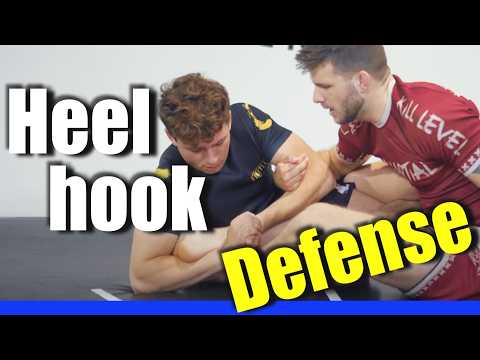
Heel hook defense | How to escape inside HEEL hooks
0
Standard Heel Hook Escape·Energia Martial Arts·Added by Admin
Heel hook defense | How to escape inside HEEL hooks Let's cover how to escape inside heel hooks. In this video we will n…
Translation: standard heel hook escape
The Standard Heel Hook Escape executes the primary defence by counter-rotating the body in the direction of the heel hook's rotation to relieve the twisting force on the knee, then clearing the knee past the attacker's hip line. [1] The defender turns the body to match the direction of the attacker's rotation (turning toward the trapped leg), which neutralises the rotational force. [1],[2] Once the rotation is neutralised, the defender works to pull the knee past the attacker's hip control and extract the leg entirely, typically establishing a guard position. [2],[3]
Heel hook escapes are among the most critical defensive techniques in modern no-gi grappling because the heel hook attacks the knee's rotational ligaments with minimal pain warning before catastrophic injury. [1] The primary defense is to clear the knee line (extracting the knee past the attacker's hip line) rather than trying to resist the rotation. [1] Danaher emphasizes that heel hook defense must be proactive — once the heel is fully captured and rotation begins, escape becomes extremely difficult without risking injury. [2]
Heel hook escapes were relatively underdeveloped until the modern leg lock revolution driven by John Danaher and his students (the 'Danaher Death Squad') beginning around 2015. [2] Danaher's systematic approach to leg entanglements (ashi garami) included equally systematic escape methodology, emphasizing clearing the knee line and the boot concept. [2]
No images yet for this technique.
Sign in to suggest an image.
Heel hook defense | How to escape inside HEEL hooks Let's cover how to escape inside heel hooks. In this video we will n…
No instructional courses yet for this technique.
Sign in to suggest a course.
Risk of injury to the person this technique is applied to
Submission escapes carry risk of injury if executed too late; timing-critical
Skill level needed to execute this technique reliably
Whether this technique is allowed under major competition rule sets
Advanced Brazilian Jiu-Jitsu Techniques (Marcelo Garcia, 2011)
Alias sources — [1] Leg Locks: Enter the System (John Danaher, 2017) [2] Modern competitive BJJ terminology
Effectiveness sources — [1] Mastering Jujitsu (Renzo Gracie & John Danaher, 2003) [2] New Wave Jiu Jitsu instructional series (John Danaher, 2018-2022)
Mixed Japanese-Western terminology — combines traditional Japanese terms with katakana loanwords
Alias sources — [1] Leg Locks: Enter the System (John Danaher, 2017) [2] Modern competitive BJJ terminology
Effectiveness sources — [1] Mastering Jujitsu (Renzo Gracie & John Danaher, 2003) [2] New Wave Jiu Jitsu instructional series (John Danaher, 2018-2022)
hip mobility, explosive bridge/shrimp power, timing
flexible hips and strong glutes for escape movements
glutes, hip flexors, core, triceps (framing)
Point your toes like a ballerina to make your heel smaller and less vulnerable, and constantly turn your heel toward your opponent. Energia Martial Arts emphasizes this preventative positioning is opposite to 'booting' your foot, which you'd use against straight ankle locks.
Energia Martial Arts teaches three primary escapes: heel slipping (sliding your heel inside the opponent's grip), toe slipping (using your second foot to push their shoulder while your toes slide out), and Achilles tendon sliding (placing your foot underneath to slide across your calf and escape). The heel slip technique works especially well if your opponent has a weak grip.
Grab your opponent's thigh with an elbow-deep grip and pull yourself in rather than trying to strip their hands, which helps relieve pressure on your knee. You can also establish your own grip like a figure four to control the position.
The Standard Heel Hook Escape executes the primary defence by counter-rotating the body in the direction of the heel hook's rotation to relieve the twisting force on the knee, then clearing the knee past the attacker's hip line. The defender turns the body to match the direction of the attacker's rotation (turning toward the trapped leg), which neutralises the rotational force.
The standard heel hook escape was developed and codified as the modern leglock game evolved, with John Danaher's systematic approach to leg attacks including comprehensive defensive principles. The counter-rotation principle became the foundational concept of heel hook defence.
Unified MMA: legal — Legal defensive/transitional technique; IBJJF: legal — Legal; IJF: legal — Legal; ADCC: legal — Legal; UWW: legal — Legal; FIAS Sport Sambo: legal — Legal
Danger rating 4/10. Moderate — submission escapes carry risk of injury if executed too late; timing-critical
The standard setup chain: Create Space → Disrupt Control → Execute Escape → Recover Position.
Standard counters include: Maintain Pressure — keep consistent weight distribution to limit escape space / Anticipate Direction — read escape attempt direction and block early / Transition — flow to a new position when the current one is threatened.
Common variants: Standard escape (primary escape mechanic using frames, bridges, or hip mov…); Combination escape (chaining two escape directions or methods); Counter escape (using the opponent's attack attempt to create the escape …); Competition variation (modified for rule-set optimisation).
The importance of heel hook defense was dramatically demonstrated in ADCC competition, where the leg lock game became dominant in the 2017 and 2019 ADCC World Championships. Gordon Ryan, Garry Tonon, and other Danaher students demonstrated both the attack and defense at the highest levels.
Top errors to watch for: Applying only the boot without pummelling — the boot alone degrades over time; pummel for inside position / Pummelling without the boot — the heel is exposed during pummelling without the boot / Not driving hips forward — hip distance gives the opponent rotation space / Attempting to kick free — kicking can expose the heel; use controlled extraction.
The Standard Heel Hook Escape is also known as Sutandādo Hīru Fukku Nige, Basic Heel Hook Defense, Standard Inside Heel Escape.