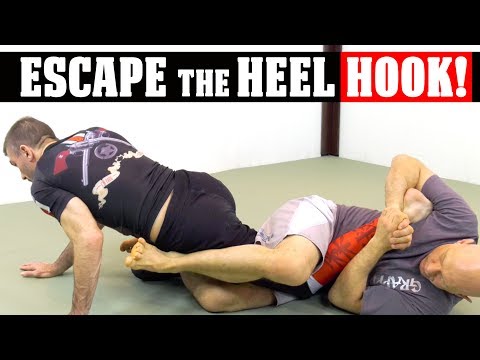
How to Escape from a Heel Hook
0
Heel Hook Escape·Stephan Kesting
Here's how to escape from a heel hook, one of the most feared submission grappling. From the 'Leglock Defense' volume o…
Translation: heel hook escape
The Heel Hook Escape subfamily covers techniques for escaping the heel hook, one of the most dangerous submissions in grappling due to its ability to cause catastrophic knee ligament damage with minimal warning. [1] Heel hook escapes are uniquely critical because the submission attacks the knee ligaments through rotational force on the heel, and the defender may not feel pain before significant damage occurs. [1],[2] Escape strategies focus on clearing the hip line (extracting the knee past the attacker's hip), counter-rotating to relieve the twisting pressure, and never straightening or pulling the leg away, which can worsen the rotation. [2],[3]
Heel hook escapes became a critical area of study as the heel hook rose to prominence in modern no-gi grappling through the influence of Dean Lister, the Danaher Death Squad, and ADCC competition. [1] The technique's potential for catastrophic injury without pain warning made heel hook defence a priority in training. [2],[3]
Heel hook escapes use rotational hip movement to match the twisting force and strip the grip before damage occurs. [1]
Heel hook escapes became critical with the rise of heel hook attacks in no-gi competition. [1]
Heel hook defence is essential in ADCC and no-gi competition. [1]
No images yet for this technique.
Sign in to suggest an image.
Here's how to escape from a heel hook, one of the most feared submission grappling. From the 'Leglock Defense' volume o…
No instructional courses yet for this technique.
Sign in to suggest a course.
Risk of injury to the person this technique is applied to
Submission escapes carry risk of injury if executed too late; timing-critical
Skill level needed to execute this technique reliably
Whether this technique is allowed under major competition rule sets
Advanced Brazilian Jiu-Jitsu Techniques (Marcelo Garcia, 2011)
Alias sources — [1] Leg Locks: Enter the System (John Danaher, 2017) [2] Mastering Jujitsu (Renzo Gracie & John Danaher, 2003) [3] Modern competitive BJJ terminology
Effectiveness sources — [1] Mastering Jujitsu (Gracie & Danaher, 2003)
Mixed Japanese-Western terminology — combines traditional Japanese terms with katakana loanwords
Alias sources — [1] Leg Locks: Enter the System (John Danaher, 2017) [2] Mastering Jujitsu (Renzo Gracie & John Danaher, 2003) [3] Modern competitive BJJ terminology
Effectiveness sources — [1] Mastering Jujitsu (Gracie & Danaher, 2003)
hip mobility, explosive bridge/shrimp power, timing
flexible hips and strong glutes for escape movements
glutes, hip flexors, core, triceps (framing)
Every move, in any martial art, shares a few universal traits. Mix and match below to pinpoint the right tool — or compare equivalents across styles.
Rolling removes your effective contact with the ground and your base, which are essential for a sound escape. Stephan Kesting emphasizes that relying on rolling—a tactic designed around tournament rules—won't work against skilled opponents who have real control of your hip.
Mobilize your hip first, then extract your knee by lifting and rotating your leg rather than rolling, while maintaining your base and contact with the ground. This physical approach to defense works against truly skilled leg-lock practitioners, unlike rolling-based escapes.
It's critical to practice heel hook escapes against training partners who are actually skilled at applying leg locks; otherwise you'll develop a false sense of security and won't understand the true danger of the position.
The Heel Hook Escape subfamily covers techniques for escaping the heel hook, one of the most dangerous submissions in grappling due to its ability to cause catastrophic knee ligament damage with minimal warning. Heel hook escapes are uniquely critical because the submission attacks the knee ligaments through rotational force on the heel, and the defender may not feel pain before significant damage occurs.
Heel hook escapes became a critical area of study as the heel hook rose to prominence in modern no-gi grappling through the influence of Dean Lister, the Danaher Death Squad, and ADCC competition. The technique's potential for catastrophic injury without pain warning made heel hook defence a priority in training.
Unified MMA: legal — Legal defensive/transitional technique; IBJJF: legal — Legal; IJF: legal — Legal; ADCC: legal — Legal; UWW: legal — Legal; FIAS Sport Sambo: legal — Legal
Danger rating 4/10. Moderate — submission escapes carry risk of injury if executed too late; timing-critical
The standard setup chain: Create Space → Disrupt Control → Execute Escape → Recover Position.
Standard counters include: Maintain Pressure — keep consistent weight distribution to limit escape space / Anticipate Direction — read escape attempt direction and block early / Transition — flow to a new position when the current one is threatened.
Common variants: Standard escape (primary escape mechanic using frames, bridges, or hip mov…); Combination escape (chaining two escape directions or methods); Counter escape (using the opponent's attack attempt to create the escape …); Competition variation (modified for rule-set optimisation).
Heel hook defence is essential in ADCC and no-gi competition.
Top errors to watch for: Not booting immediately — the boot must be your first, automatic response to any heel grip / Bending the knee when caught — straighten the leg to reduce rotational leverage / Not fighting for inside position — outside position means the opponent controls the attack / Waiting too long to tap — heel hook damage is sudden and can be permanent; tap early in training.
The Heel Hook Escape is also known as Hīru Fukku Nige, Heel Hook Defense, Inside Heel Hook Escape, Ashi Garami Heel Escape.