How I Escape EVERYONES Ankle Locks
0
Leglock Escape·Ebsayz
For one on one Jiu jitsu coaching and guaranteed results, join my Skool!! https://www.skool.com/ebsayz-online-4305/about…
Translation: leglock escape
The Leglock Escape family covers all techniques for escaping leg-based joint locks and compression holds, including ankle locks, heel hooks, kneebars, and toe holds. [1] Leglock escapes have become one of the most critical defensive skill sets in modern grappling due to the dramatic expansion of leg attack systems in no-gi competition. [1],[2] Leglock escapes require specific knowledge because the mechanics of leg attacks differ fundamentally from upper-body submissions — the attacker controls the leg from a distance with their entire body, and improper escape attempts can worsen the position or cause injury. [2],[3]
Leglock escapes were historically underdeveloped in many grappling systems, where leg attacks were either banned or underutilised. [1] The modern leglock revolution, driven by practitioners like Dean Lister, John Danaher's squad, and the rise of no-gi submission grappling, created urgent demand for comprehensive leglock escape methodology. [2],[3]
Leglock escapes developed alongside the leg lock revolution in no-gi BJJ during the 2010s. [1]
Leglock defence is critical in modern no-gi competition where leg attacks are dominant. [1]
No images yet for this technique.
Sign in to suggest an image.
For one on one Jiu jitsu coaching and guaranteed results, join my Skool!! https://www.skool.com/ebsayz-online-4305/about…
No instructional courses yet for this technique.
Sign in to suggest a course.
Risk of injury to the person this technique is applied to
Submission escapes carry risk of injury if executed too late; timing-critical
Skill level needed to execute this technique reliably
Whether this technique is allowed under major competition rule sets
Advanced Brazilian Jiu-Jitsu Techniques (Marcelo Garcia, 2011)
Alias sources — [1] Enter the System (Danaher, 2018) [2] Jiu-Jitsu University (Ribeiro, 2008)
Effectiveness sources — [1] Mastering Jujitsu (Gracie & Danaher, 2003) [2] Jiu-Jitsu University (Ribeiro, 2008)
Standard Japanese martial arts terminology (kanji/hiragana)
Established Japanese martial arts naming convention — native Japanese term (和語/漢語)
Alias sources — [1] Enter the System (Danaher, 2018) [2] Jiu-Jitsu University (Ribeiro, 2008)
Effectiveness sources — [1] Mastering Jujitsu (Gracie & Danaher, 2003) [2] Jiu-Jitsu University (Ribeiro, 2008)
hip mobility, explosive bridge/shrimp power, timing
flexible hips and strong glutes for escape movements
glutes, hip flexors, core, triceps (framing)
Every move, in any martial art, shares a few universal traits. Mix and match below to pinpoint the right tool — or compare equivalents across styles.
The Ankle Lock Escape subfamily covers techniques for escaping the straight ankle lock (ashi-gatame), where the attacker hyperextends the ankle joint by controlling the foot against the wrist or forearm while applying hip pressure. [1] Ankle lock escapes typically involve clearing the foot from the attacker's grip, straightening the trapped leg to relieve the hyperextension angle, or kicking the foot free while controlling the attacker's body. [1,2] Because the straight ankle lock is legal at all belt levels in most grappling rulesets, ankle lock escapes are among the first submission escapes taught. [2,3]
The Heel Hook Escape subfamily covers techniques for escaping the heel hook, one of the most dangerous submissions in grappling due to its ability to cause catastrophic knee ligament damage with minimal warning. [1] Heel hook escapes are uniquely critical because the submission attacks the knee ligaments through rotational force on the heel, and the defender may not feel pain before significant damage occurs. [1,2] Escape strategies focus on clearing the hip line (extracting the knee past the attacker's hip), counter-rotating to relieve the twisting pressure, and never straightening or pulling the leg away, which can worsen the rotation. [2,3]
The Kneebar Escape subfamily covers techniques for escaping the kneebar (hiza-juji-gatame), where the attacker hyperextends the knee joint by controlling the leg and applying hip pressure against the knee. [1] Kneebar escapes share mechanical principles with armbar escapes — the attacker uses the hips as a fulcrum against the joint — but are applied to the larger and more powerful leg, which provides more escape leverage. [1,2] Escape strategies include bending the trapped knee to prevent hyperextension, rotating the hip to change the angle of attack, and pushing the attacker's hips away to create space. [2,3]
Leg lock escapes follow the Danaher principle: 'clear the knee line first, then address the grip.' If the opponent's hips are above your knee, you are in danger; if below, you can begin to extract. Never spin away from a heel hook — always turn INTO the pressure. (Danaher, Enter the System; Lachlan Giles, instructionals)
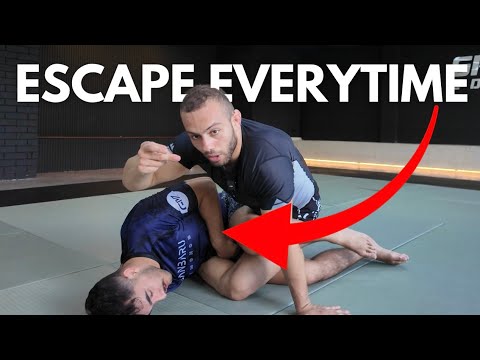
According to Ebsayz, the key is understanding what your opponent needs to break your leg: the ability to keep weight off your foot. Once you understand this conceptually, you can apply techniques around that concept to escape consistently every time.
Ebsayz emphasizes getting 'head over head' with your opponent—position your head over theirs so you can bear weight through your foot. Stuff your leg through the hole and keep your head over their head to prevent them from offbalancing you.
Ebsayz advises that you can't stop the transition if they want to do it, so instead internally rotate your knee, grab their hip to keep it low, and maintain your head over head position. Keep their hips down and your head close to flatten them out and escape to a smash pass.
Ebsayz explains that the closer your opponent's head is to the ground, the more mobile their hips become. If they can turn their hips up toward you, you lose your head-over-head position and become vulnerable to the ankle lock.
The Leglock Escape family covers all techniques for escaping leg-based joint locks and compression holds, including ankle locks, heel hooks, kneebars, and toe holds. Leglock escapes have become one of the most critical defensive skill sets in modern grappling due to the dramatic expansion of leg attack systems in no-gi competition.
Leglock escapes were historically underdeveloped in many grappling systems, where leg attacks were either banned or underutilised. The modern leglock revolution, driven by practitioners like Dean Lister, John Danaher's squad, and the rise of no-gi submission grappling, created urgent demand for comprehensive leglock escape methodology.
Unified MMA: legal — Legal defensive/transitional technique; IBJJF: legal — Legal; IJF: legal — Legal; ADCC: legal — Legal; UWW: legal — Legal, escape scores 1 point (freestyle), reversal scores 1 point; FIAS Sport Sambo: legal — Legal; NCAA Folkstyle: legal — Legal, escape scores 1 point, reversal scores 2 points
Danger rating 4/10. Moderate — submission escapes carry risk of injury if executed too late; timing-critical
The standard setup chain: Create Space → Disrupt Control → Execute Escape → Recover Position.
Standard counters include: Maintain Pressure — keep consistent weight distribution to limit escape space / Anticipate Direction — read escape attempt direction and block early / Transition — flow to a new position when the current one is threatened.
Common variants: Standard escape (primary escape mechanic using frames, bridges, or hip mov…); Combination escape (chaining two escape directions or methods); Counter escape (using the opponent's attack attempt to create the escape …); Competition variation (modified for rule-set optimisation).
Leglock defence is critical in modern no-gi competition where leg attacks are dominant.
Top errors to watch for: Ignoring the entanglement and focusing only on the foot/knee — the entanglement is the root problem / Not understanding inside vs. outside position — outside position means you're being attacked / Crossing the legs when defending — this gives the opponent control of both legs / Bending the knee against a heel hook — straighten or keep neutral; bending gives rotational access.
The Leglock Escape is also known as Ashi Kansetsu-waza Nige, Leg Lock Defense, Lower Body Submission Escape.