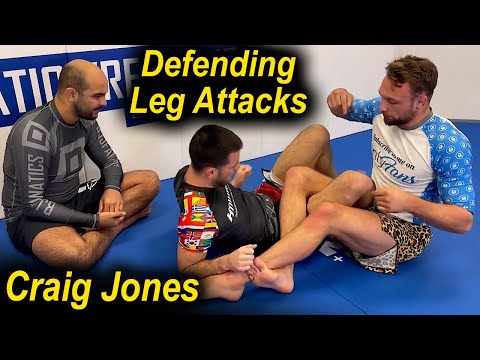
The Secret Grip That Craig Jones Uses To Defend Heel Hooks And Leg Attacks
0
Ankle Lock Escape·Bernardo Faria BJJ Fanatics
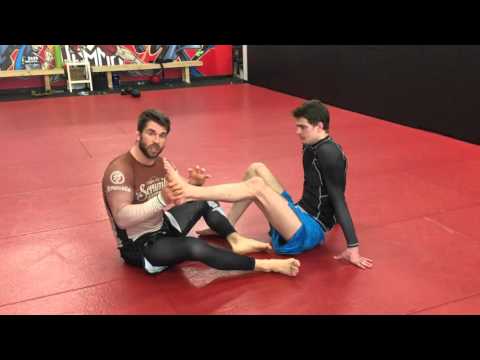
Learn the secret grip that Craig Jones uses to defend Heel Hooks and Leg Attacks - Click Here To Check Out Craig Jones's…
Translation: ankle lock escape
The Ankle Lock Escape subfamily covers techniques for escaping the straight ankle lock (ashi-gatame), where the attacker hyperextends the ankle joint by controlling the foot against the wrist or forearm while applying hip pressure. [1] Ankle lock escapes typically involve clearing the foot from the attacker's grip, straightening the trapped leg to relieve the hyperextension angle, or kicking the foot free while controlling the attacker's body. [1],[2] Because the straight ankle lock is legal at all belt levels in most grappling rulesets, ankle lock escapes are among the first submission escapes taught. [2],[3]
Ankle lock escapes use boot positioning (hiding the foot) and hip movement to strip the grip or escape the entanglement. [1]
Ankle lock escapes are fundamental in BJJ and judo. [1]
Ankle lock defence is essential in BJJ competition. [1]
No images yet for this technique.
Sign in to suggest an image.
Learn the secret grip that Craig Jones uses to defend Heel Hooks and Leg Attacks - Click Here To Check Out Craig Jones's…
www.Chewjitsu.net The straight ankle is a must have for every grappler. It is a fundamental technique that can set the…
No instructional courses yet for this technique.
Sign in to suggest a course.
Risk of injury to the person this technique is applied to
Submission escapes carry risk of injury if executed too late; timing-critical
Skill level needed to execute this technique reliably
Whether this technique is allowed under major competition rule sets
Jiu-Jitsu University (Saulo Ribeiro, 2008)
Alias sources — [1] Jiu-Jitsu University (Saulo Ribeiro, 2008) [2] Kodokan Judo (Jigoro Kano, 1986) [3] Leg Locks: Enter the System (John Danaher, 2017)
Effectiveness sources — [1] Jiu-Jitsu University (Ribeiro, 2008)
Standard Japanese martial arts terminology (kanji/hiragana)
Established Japanese martial arts naming convention — native Japanese term (和語/漢語)
Alias sources — [1] Jiu-Jitsu University (Saulo Ribeiro, 2008) [2] Kodokan Judo (Jigoro Kano, 1986) [3] Leg Locks: Enter the System (John Danaher, 2017)
Effectiveness sources — [1] Jiu-Jitsu University (Ribeiro, 2008)
grip fighting ability, hip mobility for sliding to the mat, chin defence
strong hands for grip fighting, flexible hips
forearms (grip fighting), core, hip flexors, neck
Every move, in any martial art, shares a few universal traits. Mix and match below to pinpoint the right tool — or compare equivalents across styles.
Take a tight waist grip on your opponent's far hip. This grip is essential to control their positioning and prevent them from executing heel hooks or other leg attacks as you work to escape and pass.
You can use a scoop grip under the knee to escape without risk of counter attack, according to Craig Jones's technique demonstrated by Bernardo Faria.
Bring your knee to your chest and post your foot on the hip to maintain control of the ankle lock and prevent the escape, as shown in the Chewjitsu counter-escape technique.
The Ankle Lock Escape subfamily covers techniques for escaping the straight ankle lock (ashi-gatame), where the attacker hyperextends the ankle joint by controlling the foot against the wrist or forearm while applying hip pressure. Ankle lock escapes typically involve clearing the foot from the attacker's grip, straightening the trapped leg to relieve the hyperextension angle, or kicking the foot free while controlling the attacker's body.
Ankle lock escapes have been part of grappling defence since the ankle lock was developed in judo and catch wrestling. Their importance increased as the ankle lock became one of the most commonly applied leglocks in both gi and no-gi competition.
Unified MMA: legal — Legal defensive/transitional technique; IBJJF: legal — Legal; IJF: legal — Legal; ADCC: legal — Legal; UWW: legal — Legal, escape scores 1 point (freestyle), reversal scores 1 point; FIAS Sport Sambo: legal — Legal; NCAA Folkstyle: legal — Legal, escape scores 1 point, reversal scores 2 points
Danger rating 4/10. Moderate — submission escapes carry risk of injury if executed too late; timing-critical
The standard setup chain: Create Space → Disrupt Control → Execute Escape → Recover Position.
Standard counters include: Maintain Pressure — keep consistent weight distribution to limit escape space / Anticipate Direction — read escape attempt direction and block early / Transition — flow to a new position when the current one is threatened.
Common variants: Slide to side (choking-arm side) (fighting hands and sliding hips to the mat on the choking…); Peel-and-turn (stripping the seatbelt grip and turning into the opponent); Trap-arm escape (trapping one arm and rolling to pin the opponent's back); Body triangle escape (addressing the body triangle lock before escaping the hooks).
Ankle lock defence is essential in BJJ competition.
Top errors to watch for: Leaning back when caught in the ankle lock — this tightens the Achilles pressure; sit up instead / Trying to kick the foot free — the opponent's grip combined with their legs makes kicking ineffective / Not pointing the toes toward the opponent — toe position matters for structural ankle defence / Sitting up without addressing the grip — break the grip as you sit up.
The Ankle Lock Escape is also known as Ashikubi-gatame Nige, Straight Ankle Lock Defense, Ashi Garami Escape, Foot Lock Escape.