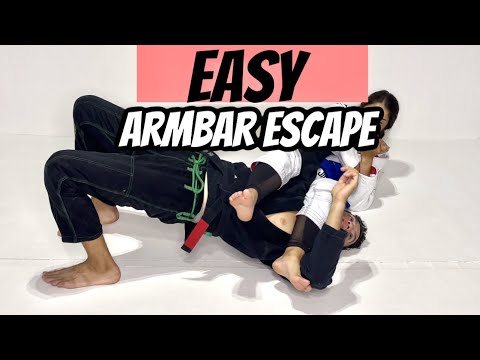
How To Do The Hitch Hiker Escape EASY
0
Standard Hitchhiker Escape·Aaron Benzrihem bjj·Added by Admin
EASY ARMBAR ESCAPE // In this video I go over how to do the "hitch hiker arm bar escape." This is one of the most popul…
Translation: standard hitchhiker escape
The Standard Hitchhiker Escape executes the fundamental hitchhiker defence by rotating the trapped arm thumb-upward while simultaneously turning the body toward the trapped arm, sliding toward the attacker's head. [1] The defender rotates the forearm so the thumb points to the ceiling, then turns the entire body to follow the arm's rotation, which dramatically changes the angle of the armbar and makes it nearly impossible to finish. [1],[2] As the body completes the rotation, the defender slides the arm free and immediately works to pass the attacker's guard or recover position. [2],[3]
The hitchhiker escape is one of the most reliable armbar escapes at the highest levels of competition because it uses rotational mechanics rather than strength to defeat the armbar. [1] By rotating the thumb upward and turning the body, the defender changes the plane of the elbow joint relative to the attacker's hips, making the armbar mechanically unsound. [1],[2]
No images yet for this technique.
Sign in to suggest an image.
EASY ARMBAR ESCAPE // In this video I go over how to do the "hitch hiker arm bar escape." This is one of the most popul…
No instructional courses yet for this technique.
Sign in to suggest a course.
Risk of injury to the person this technique is applied to
Submission escapes carry risk of injury if executed too late; timing-critical
Skill level needed to execute this technique reliably
Whether this technique is allowed under major competition rule sets
Jiu-Jitsu University (Saulo Ribeiro, 2008)
Alias sources — [1] Jiu-Jitsu University (Saulo Ribeiro, 2008) [2] Brazilian Jiu-Jitsu: Theory and Technique (Renzo Gracie & Royler Gracie, 2001)
Effectiveness sources — [1] Jiu-Jitsu University (Saulo Ribeiro, 2008) [2] Mastering Jujitsu (Renzo Gracie & John Danaher, 2003)
Standard katakana transliteration of Western martial arts terminology (外来語) — used in Japanese MMA, boxing, and BJJ communities
Alias sources — [1] Jiu-Jitsu University (Saulo Ribeiro, 2008) [2] Brazilian Jiu-Jitsu: Theory and Technique (Renzo Gracie & Royler Gracie, 2001)
Effectiveness sources — [1] Jiu-Jitsu University (Saulo Ribeiro, 2008) [2] Mastering Jujitsu (Renzo Gracie & John Danaher, 2003)
grip fighting ability, hip mobility for sliding to the mat, chin defence
strong hands for grip fighting, flexible hips
forearms (grip fighting), core, hip flexors, neck
You want to be the one to let go of the grip, not have your opponent break it—even though the end result is the same, maintaining control of when you release is crucial. As Aaron Benzrihem emphasizes, 'I don't want my opponent to break the grip. I wanna be the one to let go.'
The escape involves bending your elbow in an Americana-like fashion while bridging hard and shooting your arm. Timing is critical to the technique's success.
No—Aaron Benzrihem is honest that it's not a foolproof escape, which is why he personally prefers the Roger Gracie escape or combines both techniques in conjunction with each other.
The Standard Hitchhiker Escape executes the fundamental hitchhiker defence by rotating the trapped arm thumb-upward while simultaneously turning the body toward the trapped arm, sliding toward the attacker's head. The defender rotates the forearm so the thumb points to the ceiling, then turns the entire body to follow the arm's rotation, which dramatically changes the angle of the armbar and makes it nearly impossible to finish.
The standard hitchhiker escape became a staple of BJJ competition defence after being widely demonstrated in high-level matches in the 2000s. It is now considered one of the essential armbar defences taught in most competitive BJJ programmes.
Unified MMA: legal — Legal defensive/transitional technique; IBJJF: legal — Legal; IJF: legal — Legal; ADCC: legal — Legal; UWW: legal — Legal; FIAS Sport Sambo: legal — Legal
Danger rating 4/10. Moderate — submission escapes carry risk of injury if executed too late; timing-critical
The standard setup chain: Create Space → Disrupt Control → Execute Escape → Recover Position.
Standard counters include: Maintain Pressure — keep consistent weight distribution to limit escape space / Anticipate Direction — read escape attempt direction and block early / Transition — flow to a new position when the current one is threatened.
Common variants: Slide to side (choking-arm side) (fighting hands and sliding hips to the mat on the choking…); Peel-and-turn (stripping the seatbelt grip and turning into the opponent); Trap-arm escape (trapping one arm and rolling to pin the opponent's back); Body triangle escape (addressing the body triangle lock before escaping the hooks).
The hitchhiker escape is regularly seen in IBJJF World Championship and ADCC matches, used successfully by elite competitors to survive deep armbar attempts. Its adoption across competition BJJ was rapid after high-profile successful uses in the late 2000s.
Top errors to watch for: Performing steps out of order — thumb rotation must be simultaneous with the body turn / Bridging away from the opponent instead of toward their feet — direction matters / Using only arm strength — the hitchhiker is a whole-body rotation / Not coming to the knees after escaping — staying flat invites re-attack.
The Standard Hitchhiker Escape is also known as Sutandādo Hitchihaikā Esukēpu, Basic Hitchhiker, Standard Thumb Up Escape.