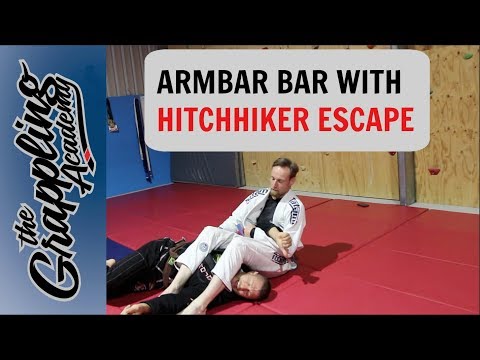
Armbar To Hitchhiker Escape
0
Hitchhiker Armbar Escape·The Grappling Academy
SALE SALE SALE OVER 50% OFF – BOX SET – ALL 4 COURSES 50% OFF CLICK HERE – https://bit.ly/2lAOHmp • The Blue Belt Sup…
Translation: hitchhiker armbar escape
The Hitchhiker Armbar Escape subfamily covers escapes that use a hitchhiker-like thumb-up rotation of the trapped arm to change the angle of the hyperextension and create space to pull the arm free. [1] By rotating the arm so the thumb points upward (like a hitchhiker's gesture), the defender changes the plane of the elbow joint relative to the attacker's hips, making the armbar mechanically much harder to finish. [1],[2] This rotation is combined with a turning motion of the body that further changes the angle and allows the defender to extract the arm. [2],[3]
The hitchhiker armbar escape was popularised in BJJ competition in the mid-2000s and became one of the most commonly used armbar defences at the highest levels. [1] Its mechanical elegance — using rotation rather than strength to defeat the armbar — made it a revolutionary addition to the armbar escape curriculum. [2],[3]
The hitchhiker escape rotates the body and thumbs-up the trapped hand to relieve armbar pressure and escape. [1]
The hitchhiker escape was developed in competitive BJJ. [1]
The hitchhiker is a common armbar escape in BJJ competition. [1]
No images yet for this technique.
Sign in to suggest an image.
SALE SALE SALE OVER 50% OFF – BOX SET – ALL 4 COURSES 50% OFF CLICK HERE – https://bit.ly/2lAOHmp • The Blue Belt Sup…
No instructional courses yet for this technique.
Sign in to suggest a course.
Risk of injury to the person this technique is applied to
Submission escapes carry risk of injury if executed too late; timing-critical
Skill level needed to execute this technique reliably
Whether this technique is allowed under major competition rule sets
Jiu-Jitsu University (Saulo Ribeiro, 2008)
Alias sources — [1] Jiu-Jitsu University (Saulo Ribeiro, 2008) [2] Brazilian Jiu-Jitsu: Theory and Technique (Renzo Gracie & Royler Gracie, 2001) [3] Mastering Jujitsu (Renzo Gracie & John Danaher, 2003)
Effectiveness sources — [1] Jiu-Jitsu University (Ribeiro, 2008)
Standard katakana transliteration of Western martial arts terminology (外来語) — used in Japanese MMA, boxing, and BJJ communities
Alias sources — [1] Jiu-Jitsu University (Saulo Ribeiro, 2008) [2] Brazilian Jiu-Jitsu: Theory and Technique (Renzo Gracie & Royler Gracie, 2001) [3] Mastering Jujitsu (Renzo Gracie & John Danaher, 2003)
Effectiveness sources — [1] Jiu-Jitsu University (Ribeiro, 2008)
hip mobility, explosive bridge/shrimp power, timing
flexible hips and strong glutes for escape movements
glutes, hip flexors, core, triceps (framing)
Every move, in any martial art, shares a few universal traits. Mix and match below to pinpoint the right tool — or compare equivalents across styles.
You need to encapsulate the arm with your foot on the opposite side while staying tight—there should be no space between your groin and their shoulder, or they will start rolling out. The Grappling Academy emphasizes this is critical to the escape working properly.
According to The Grappling Academy, if you master this escape you can reduce your armbar taps to about one in four compared to your usual rate, meaning you'll tap significantly less often to submissions you would normally have to concede.
The Grappling Academy explains that a successful hitchhiker escape often leaves you with inside control or side control, allowing you to reverse the position and attack your opponent instead of having to tap.
The Grappling Academy notes the technique has two names—some call it the 'runny man' and others call it 'hitchhiker' because of the arm position and movement used to wriggle out of the armbar.
The Hitchhiker Armbar Escape subfamily covers escapes that use a hitchhiker-like thumb-up rotation of the trapped arm to change the angle of the hyperextension and create space to pull the arm free. By rotating the arm so the thumb points upward (like a hitchhiker's gesture), the defender changes the plane of the elbow joint relative to the attacker's hips, making the armbar mechanically much harder to finish.
The hitchhiker armbar escape was popularised in BJJ competition in the mid-2000s and became one of the most commonly used armbar defences at the highest levels. Its mechanical elegance — using rotation rather than strength to defeat the armbar — made it a revolutionary addition to the armbar escape curriculum.
Unified MMA: legal — Legal defensive/transitional technique; IBJJF: legal — Legal; IJF: legal — Legal; ADCC: legal — Legal; UWW: legal — Legal; FIAS Sport Sambo: legal — Legal
Danger rating 4/10. Moderate — submission escapes carry risk of injury if executed too late; timing-critical
The standard setup chain: Create Space → Disrupt Control → Execute Escape → Recover Position.
Standard counters include: Maintain Pressure — keep consistent weight distribution to limit escape space / Anticipate Direction — read escape attempt direction and block early / Transition — flow to a new position when the current one is threatened.
Common variants: Standard escape (primary escape mechanic using frames, bridges, or hip mov…); Combination escape (chaining two escape directions or methods); Counter escape (using the opponent's attack attempt to create the escape …); Competition variation (modified for rule-set optimisation).
The hitchhiker is a common armbar escape in BJJ competition.
Top errors to watch for: Rotating only the arm without turning the body — body and arm must rotate together / Starting too late when the arm is fully extended — begin early while there's still bend in the elbow / Pointing the thumb sideways instead of straight up — the thumb must point to the ceiling / Forgetting to post with the free hand — the post provides leverage for the body turn.
The Hitchhiker Armbar Escape is also known as Hitchihaikā Āmubā Esukēpu, Hitchhiker Escape, Thumb Up Armbar Escape, Spinning Armbar Escape.