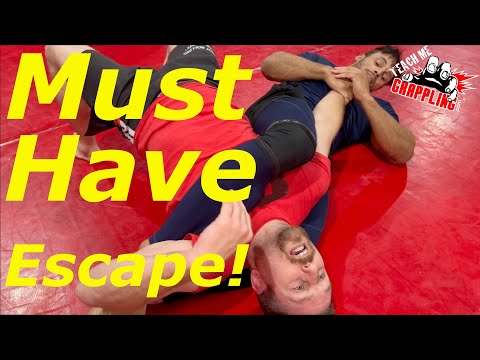
Do You USE This Bridging Armbar ESCAPE?
0
Armbar Escape·TeachMeGrappling Coach Brian
This video I teach an armbar escape that works great if done correctly. Check out the details and you are sure to find …
Translation: armbar escape
The Armbar Escape family covers all techniques for escaping the juji-gatame (cross-body armbar) and its variants once the attack has been initiated. [1] The armbar is one of the most common and highest-finishing submissions in grappling and MMA, making armbar escapes among the most trained defensive techniques. [1],[2] Armbar escape strategies are categorised by their primary mechanic: stacking (driving forward to compress the attacker), hitchhiker (rotating the arm to relieve the hyperextension angle), and rolling (using rotational momentum to extract the arm). [2],[3]
Armbar escapes have existed since the armbar itself was codified in judo as juji-gatame. [1] BJJ's competitive focus on the armbar as a primary finishing technique drove the development of increasingly sophisticated armbar defence methodology, including the hitchhiker escape popularised in the 2000s. [2],[3]
Armbar escape techniques were developed in judo and BJJ as fundamental defensive skills. [1]
Armbar defence is essential in BJJ and MMA competition. [1]
No images yet for this technique.
Sign in to suggest an image.
This video I teach an armbar escape that works great if done correctly. Check out the details and you are sure to find …
No instructional courses yet for this technique.
Sign in to suggest a course.
Risk of injury to the person this technique is applied to
Submission escapes carry risk of injury if executed too late; timing-critical
Skill level needed to execute this technique reliably
Whether this technique is allowed under major competition rule sets
Jiu-Jitsu University (Saulo Ribeiro, 2008)
Alias sources — [1] Kodokan Judo (Kano, 1986) [2] Jiu-Jitsu University (Ribeiro, 2008)
Effectiveness sources — [1] Mastering Jujitsu (Gracie & Danaher, 2003) [2] Jiu-Jitsu University (Ribeiro, 2008)
Standard Japanese martial arts terminology (kanji/hiragana)
Established Japanese martial arts naming convention — native Japanese term (和語/漢語)
Alias sources — [1] Kodokan Judo (Kano, 1986) [2] Jiu-Jitsu University (Ribeiro, 2008)
Effectiveness sources — [1] Mastering Jujitsu (Gracie & Danaher, 2003) [2] Jiu-Jitsu University (Ribeiro, 2008)
hip mobility, explosive bridge/shrimp power, timing
flexible hips and strong glutes for escape movements
glutes, hip flexors, core, triceps (framing)
Every move, in any martial art, shares a few universal traits. Mix and match below to pinpoint the right tool — or compare equivalents across styles.
The Hitchhiker Armbar Escape subfamily covers escapes that use a hitchhiker-like thumb-up rotation of the trapped arm to change the angle of the hyperextension and create space to pull the arm free. [1] By rotating the arm so the thumb points upward (like a hitchhiker's gesture), the defender changes the plane of the elbow joint relative to the attacker's hips, making the armbar mechanically much harder to finish. [1,2] This rotation is combined with a turning motion of the body that further changes the angle and allows the defender to extract the arm. [2,3]
The Roll Armbar Escape subfamily covers escapes that use a forward or lateral roll to extract the trapped arm from the armbar, using rotational momentum to overcome the attacker's grip and hip control. [1] Roll escapes are particularly effective when the attacker's hips are not fully secured and there is enough space to initiate the rolling motion. [1,2] The roll typically carries the defender over the attacker or around to the side, extracting the arm through centrifugal force and body momentum. [2,3]
The Stacking Armbar Escape subfamily covers escapes that use forward pressure (stacking) to compress the attacker and relieve the hyperextension on the trapped arm. [1] By driving forward and putting the body's weight on top of the attacker, the defender changes the armbar angle, takes away the attacker's hip leverage, and creates the space to extract the arm. [1,2] Stacking is one of the most instinctive and effective armbar defences because it uses posture and pressure rather than requiring fine technical movement. [2,3]
Armbar escapes require addressing the position BEFORE the arm is fully extended — once the arm is straight and hips are elevated, escape is nearly impossible. The primary defense is clasping the hands together (Gable grip) and stacking the attacker to relieve hip pressure. (Ribeiro, Jiu-Jitsu University; Gracie & Danaher, Mastering Jujitsu)
Coach Brian emphasizes that you need to control your opponent's arm so it can't come back over your head. After popping your head through and escaping, hold their arm down to prevent them from re-establishing the lock.
Coach Brian advises against immediately taking weight off your opponent's leg by standing up, as this can allow them to get on their elbow and maintain pressure. Instead, lay on their leg with your elbows to the mat and walk away while turning belly-down.
Coach Brian's technique involves bridging to create space, then popping your head through the hole while turning. As you bridge and turn, keep your hand controlling their arm so it doesn't come back over your head, and lay on their leg as you transition to belly-down.
The Armbar Escape family covers all techniques for escaping the juji-gatame (cross-body armbar) and its variants once the attack has been initiated. The armbar is one of the most common and highest-finishing submissions in grappling and MMA, making armbar escapes among the most trained defensive techniques.
Armbar escapes have existed since the armbar itself was codified in judo as juji-gatame. BJJ's competitive focus on the armbar as a primary finishing technique drove the development of increasingly sophisticated armbar defence methodology, including the hitchhiker escape popularised in the 2000s.
Unified MMA: legal — Legal defensive/transitional technique; IBJJF: legal — Legal; IJF: legal — Legal; ADCC: legal — Legal; UWW: legal — Legal; FIAS Sport Sambo: legal — Legal
Danger rating 4/10. Moderate — submission escapes carry risk of injury if executed too late; timing-critical
The standard setup chain: Create Space → Disrupt Control → Execute Escape → Recover Position.
Standard counters include: Maintain Pressure — keep consistent weight distribution to limit escape space / Anticipate Direction — read escape attempt direction and block early / Transition — flow to a new position when the current one is threatened.
Common variants: Standard escape (primary escape mechanic using frames, bridges, or hip mov…); Combination escape (chaining two escape directions or methods); Counter escape (using the opponent's attack attempt to create the escape …); Competition variation (modified for rule-set optimisation).
Armbar defence is essential in BJJ and MMA competition.
Top errors to watch for: Waiting until the arm is fully extended — fight the grip and angle long before the extension / Pulling the arm straight back — the opponent's hip bridge is stronger than your straight pull; use angles / Using strength to resist the extension — the armbar has superior leverage; use technical escapes instead / Escaping the armbar but remaining in mount bottom — the escape must improve your position.
The Armbar Escape is also known as Ude-hishigi-juji-gatame Nige, Juji Gatame Escape, Arm Lock Escape.