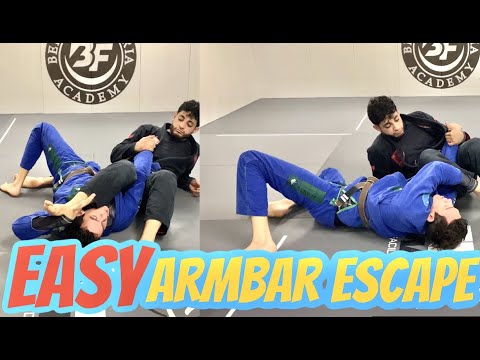
EASY Armbar Escape Chain
0
Roll Armbar Escape·Aaron Benzrihem bjj
EASY ARMBAR ESCPAE CHAIN // In this video I am going over a simple way to escape the armbar. The armbar can be a powerf…
Translation: roll armbar escape
The Roll Armbar Escape subfamily covers escapes that use a forward or lateral roll to extract the trapped arm from the armbar, using rotational momentum to overcome the attacker's grip and hip control. [1] Roll escapes are particularly effective when the attacker's hips are not fully secured and there is enough space to initiate the rolling motion. [1],[2] The roll typically carries the defender over the attacker or around to the side, extracting the arm through centrifugal force and body momentum. [2],[3]
The roll escape from armbar uses a forward roll to stack and escape the armbar position. [1]
Developed in BJJ as an armbar escape. [1]
Used in BJJ competition. [1]
No images yet for this technique.
Sign in to suggest an image.
EASY ARMBAR ESCPAE CHAIN // In this video I am going over a simple way to escape the armbar. The armbar can be a powerf…
No instructional courses yet for this technique.
Sign in to suggest a course.
Risk of injury to the person this technique is applied to
Submission escapes carry risk of injury if executed too late; timing-critical
Skill level needed to execute this technique reliably
Whether this technique is allowed under major competition rule sets
Jiu-Jitsu University (Saulo Ribeiro, 2008)
Alias sources — [1] Kodokan Judo (Jigoro Kano, 1986) [2] Jiu-Jitsu University (Saulo Ribeiro, 2008)
Effectiveness sources — [1] Jiu-Jitsu University (Ribeiro, 2008)
Standard katakana transliteration of Western martial arts terminology (外来語) — used in Japanese MMA, boxing, and BJJ communities
Alias sources — [1] Kodokan Judo (Jigoro Kano, 1986) [2] Jiu-Jitsu University (Saulo Ribeiro, 2008)
Effectiveness sources — [1] Jiu-Jitsu University (Ribeiro, 2008)
hip escape (shrimping) speed, framing strength, timing
flexible hips and quick lateral movement
hip flexors, obliques, triceps (framing), core
Every move, in any martial art, shares a few universal traits. Mix and match below to pinpoint the right tool — or compare equivalents across styles.
According to Aaron Benzrihem, the most effective approach is to chain two escapes together rather than rely on a single technique. By using two escapes in unison—such as the hitchhiker escape combined with a hand-underneath escape where you push your opponent down and turn your thumb—you can escape the armbar much more effectively.
Aaron Benzrihem recommends that as soon as you feel your opponent is going to break your grip, push them back at an angle to prevent them from trapping your hand. You need to get your hand free so you can get your head to the other side of their foot, turning the situation into what he calls a 'dog fight.'
Aaron Benzrihem emphasizes that understanding the conceptual application of using two escapes in unison is more important than mastering a single technique in isolation. Chaining escapes gives you better options when your opponent defends against the first escape, making your overall defense more robust.
The Roll Armbar Escape subfamily covers escapes that use a forward or lateral roll to extract the trapped arm from the armbar, using rotational momentum to overcome the attacker's grip and hip control. Roll escapes are particularly effective when the attacker's hips are not fully secured and there is enough space to initiate the rolling motion.
Rolling armbar escapes have been part of grappling defence since the armbar's development in judo, where rolling out of ne-waza submissions was a standard escape strategy. BJJ refined the mechanics of the roll escape to work against increasingly tight armbar control.
Unified MMA: legal — Legal defensive/transitional technique; IBJJF: legal — Legal; IJF: legal — Legal; ADCC: legal — Legal; UWW: legal — Legal; FIAS Sport Sambo: legal — Legal
Danger rating 4/10. Moderate — submission escapes carry risk of injury if executed too late; timing-critical
The standard setup chain: Create Space → Disrupt Control → Execute Escape → Recover Position.
Standard counters include: Maintain Pressure — keep consistent weight distribution to limit escape space / Anticipate Direction — read escape attempt direction and block early / Transition — flow to a new position when the current one is threatened.
Common variants: Shrimp to guard (framing and hip-escaping to recover full guard or half guard); Underhook escape (winning the underhook and coming to knees or reversing); Bridge to knees (bridging into the opponent and transitioning to turtle or…); Ghost escape (inverting under the opponent to re-guard from the opposit…).
Used in BJJ competition.
Top errors to watch for: Rolling without commitment — a half-roll is worse than no roll; commit fully / Rolling over the wrong shoulder — roll over the trapped arm's shoulder / Rolling when the opponent has very tight legs — tight legs prevent the roll; hitchhiker or stack instead / Not tucking the chin — protect the neck during the forward somersault.
The Roll Armbar Escape is also known as Rōringu Āmubā Esukēpu, Rolling Juji Gatame Escape, Armbar Roll Defense.