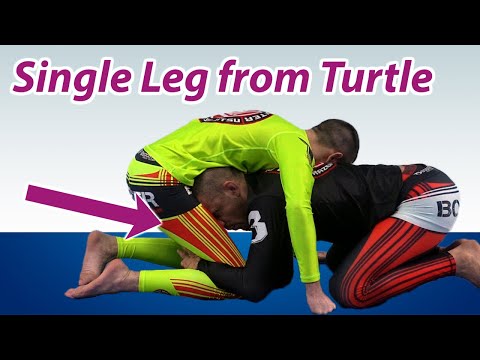
Single Leg From Turtle (3 options)
0
Single Leg Wrestle-Up·Wim Deputter BJJ
Single Leg From Turtle - In today's video I will share my ideas about the single leg from turtle. You can use it setup t…
Translation: single leg wrestle-up
The Single Leg Wrestle-Up subfamily covers standing techniques where the bottom fighter attacks one of the opponent's legs from the ground, using a single-leg takedown entry to stand up and attack simultaneously. [1] The single leg wrestle-up is the most common wrestle-up variation because it requires controlling only one leg, which is often available from bottom positions like half guard and butterfly guard. [1],[2] The technique transitions seamlessly from guard to single-leg attack to standing. [2],[3]
The single leg wrestle-up stands up from bottom while securing a single leg on the opponent. [1]
Combines wrestling single leg with BJJ guard recovery. [1]
Used in MMA and no-gi competition. [1]
No images yet for this technique.
Sign in to suggest an image.
Single Leg From Turtle - In today's video I will share my ideas about the single leg from turtle. You can use it setup t…
No instructional courses yet for this technique.
Sign in to suggest a course.
Risk of injury to the person this technique is applied to
Standing escapes from clinch/holds; involves explosive disengagement
Skill level needed to execute this technique reliably
Whether this technique is allowed under major competition rule sets
Advanced Brazilian Jiu-Jitsu Techniques (Marcelo Garcia, 2011)
Alias sources — [1] Wrestling Physical Conditioning Encyclopedia (John Jesse, 1974) [2] Mastering Jujitsu (Renzo Gracie & John Danaher, 2003)
Effectiveness sources — [1] Wrestling Physical Conditioning Encyclopedia (Petrov, 1977)
Standard katakana transliteration of Western martial arts terminology (外来語) — used in Japanese MMA, boxing, and BJJ communities
Alias sources — [1] Wrestling Physical Conditioning Encyclopedia (John Jesse, 1974) [2] Mastering Jujitsu (Renzo Gracie & John Danaher, 2003)
Effectiveness sources — [1] Wrestling Physical Conditioning Encyclopedia (Petrov, 1977)
hip mobility, explosive bridge/shrimp power, timing
flexible hips and strong glutes for escape movements
glutes, hip flexors, core, triceps (framing)
Every move, in any martial art, shares a few universal traits. Mix and match below to pinpoint the right tool — or compare equivalents across styles.
No—Wim Deputter emphasizes that you should never yank the leg. Instead, apply static pressure to control it and prevent it from moving away, then walk your body closer to improve your position.
According to Wim Deputter, placing your head on your opponent's hip gives you better control and makes it harder for them to move, compared to just driving your head down with less structural support.
Wim Deputter notes that if the single leg fails, you ideally end up in half guard, which he describes as a valuable late-game position when attacking the single leg.
Wim Deputter recommends counter-rotating with your opponent—keep your head moving inside and maintain alignment of your shoulders, knees, and toes as you follow their rotation.
The Single Leg Wrestle-Up subfamily covers standing techniques where the bottom fighter attacks one of the opponent's legs from the ground, using a single-leg takedown entry to stand up and attack simultaneously. The single leg wrestle-up is the most common wrestle-up variation because it requires controlling only one leg, which is often available from bottom positions like half guard and butterfly guard.
The single leg wrestle-up is one of the most versatile transitions in modern grappling, developed through the integration of wrestling with BJJ bottom-position strategy. Its utility has made it a standard technique in both BJJ and MMA training.
Unified MMA: legal — Legal defensive/transitional technique; IBJJF: legal — Legal; IJF: legal — Legal; ADCC: legal — Legal; UWW: legal — Legal, escape scores 1 point (freestyle), reversal scores 1 point; FIAS Sport Sambo: legal — Legal; NCAA Folkstyle: legal — Legal, escape scores 1 point, reversal scores 2 points
Danger rating 3/10. Moderate — standing escapes from clinch/holds; involves explosive disengagement
The standard setup chain: Create Space → Disrupt Control → Execute Escape → Recover Position.
Standard counters include: Maintain Pressure — keep consistent weight distribution to limit escape space / Anticipate Direction — read escape attempt direction and block early / Transition — flow to a new position when the current one is threatened.
Common variants: Standard escape (primary escape mechanic using frames, bridges, or hip mov…); Combination escape (chaining two escape directions or methods); Counter escape (using the opponent's attack attempt to create the escape …); Competition variation (modified for rule-set optimisation).
Used in MMA and no-gi competition.
Top errors to watch for: Standing fully before attacking the leg — the simultaneous rise-and-shoot is what makes the wrestle-up effective / Not using the arm drag or collar tie to create the angle — shooting straight at the leg from guard is easily defended / Rising to both feet before engaging the leg — drive from one knee first, then stand with the single leg / Not finishing the single leg — the entry from the wrestle-up is easier than a standing shot; commit to the finish.
The Single Leg Wrestle-Up is also known as Shinguru Reggu Resuru Appu, Single Leg Stand-Up, One Leg Wrestle-Up.