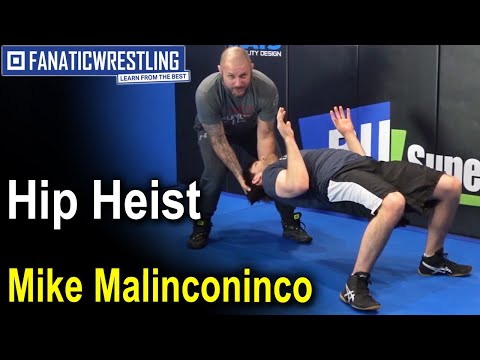
How to Hip Heist by Mike Malinconinco
0
Standard Hip Heist·FANATIC WRESTLING·Added by Admin
How to Hip Heist by Mike Malinconinco In this Wrestling Training video, Mike Malinconinco teaches how to hip heist. Whe…
Translation: hip heist
The hip heist is a fundamental wrestling escape movement where the bottom wrestler flips their hips 180 degrees (from pointing down to pointing up) while simultaneously spinning the body, creating explosive separation from the top wrestler's control. [1] One of the oldest and most fundamental wrestling movements, deeply embedded in American folkstyle wrestling tradition, taught at every level from youth to NCAA. [2] Cary Kolat (two-time NCAA champion, Olympic Trials finalist) has a well-known instructional series on the hip heist.
One of the most fundamental and effective escapes from bottom position in wrestling. Used at every level of competition worldwide. [1]
Fundamental wrestling tradition. Documented by Cary Kolat (two-time NCAA champion, Olympic Trials finalist).
Used at every level of wrestling competition from youth through NCAA and Olympic.
No images yet for this technique.
Sign in to suggest an image.
How to Hip Heist by Mike Malinconinco In this Wrestling Training video, Mike Malinconinco teaches how to hip heist. Whe…
No instructional courses yet for this technique.
Sign in to suggest a course.
Risk of injury to the person this technique is applied to
Very low — pure escape movement with no submission or impact risk
Skill level needed to execute this technique reliably
Whether this technique is allowed under major competition rule sets
Hip Heist Level 1 (Kolat, kolat.com)
Hip Heist Level 1 (Kolat, kolat.com) || Human Kinetics — Plan of attack for bottom wrestlers (us.humankinetics.com) || USA Wrestling Coaches Education curriculum
Standard katakana transliteration of Western martial arts terminology (外来語) — used in Japanese MMA, boxing, and BJJ communities
[1] Kolat — Hip Heist instructional series
[2] Human Kinetics — bottom wrestling strategy guide
explosiveness, hip mobility
hip flexors, glutes, obliques, core rotators
According to Mike Malinconnico at Fanatic Wrestling, the biggest mistake is occupying too much space when turning your hips over, which makes it harder to hold someone down. Instead, you should stay in the same lateral space throughout the movement.
Mike Malinconnico explains that you start on your butt with heels dug into the mat, then one foot goes under while one foot goes over as your hips come up, allowing you to end up in the exact same spot without rolling sideways.
Staying on the same line and not occupying excess lateral space makes it easier to maintain control and position, and also helps you create separation and escape opportunities without giving your opponent room to circle around you.
The hip heist is a fundamental wrestling escape movement where the bottom wrestler flips their hips 180 degrees (from pointing down to pointing up) while simultaneously spinning the body, creating explosive separation from the top wrestler's control. One of the oldest and most fundamental wrestling movements, deeply embedded in American folkstyle wrestling tradition, taught at every level from youth to NCAA.
Fundamental wrestling movement existing for centuries. Part of American folkstyle wrestling tradition at every level.
Unified MMA: legal — Legal defensive/transitional technique; IBJJF: legal — Legal; IJF: legal — Legal; ADCC: legal — Legal; UWW: legal — Legal, escape scores 1 point (freestyle), reversal scores 1 point; FIAS Sport Sambo: legal — Legal; NCAA Folkstyle: legal — Legal, escape scores 1 point, reversal scores 2 points
Danger rating 1/10. Very low — pure escape movement with no submission or impact risk
The standard setup chain: From bottom position → Create space between hips → Explosive 180-degree hip rotation → Far hip hits mat first → Spin body to face opponent → Stand up or recover to neutral position.
Standard counters include: Maintain tight hip control — don't allow space for the rotation / Heavy cross-body pressure — make the rotation more difficult / Follow the hips — stay connected as the bottom wrestler rotates / Underhook control — maintain hooks to prevent the separation.
Common variants: Standard hip heist (classic wrestling bottom escape); Sit-out to hip heist (combine sit-out with the hip rotation); BJJ hip heist (adapted for bottom side control or turtle escapes); Standing hip heist (used to escape clinch control).
Used at every level of wrestling competition from youth through NCAA and Olympic.
Top errors to watch for: Not creating space before the rotation — the hips must separate from the top player first / Rotating too slowly — the movement must be explosive / Not committing to the full 180-degree rotation / Telegraphing the escape — must be sudden.
The Standard Hip Heist is also known as Hippu Haisuto, Hip Heist, Wrestling Hip Heist, Hip Switch Escape, Bottom Escape.