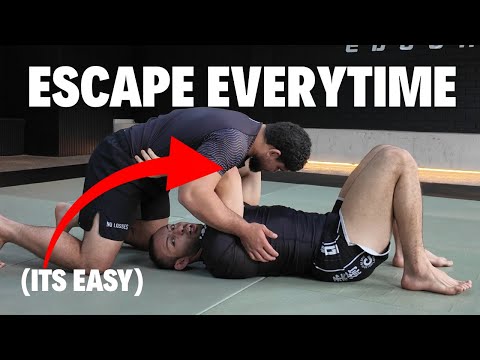
How I Escape North South EVERYTIME
0
Inversion North-South Escape·Ebsayz
Join Ebsayz Jiu Jitsu for 1 on 1 coaching to accelerate your progress and guaranteed results! https://www.skool.com/ebsa…
Translation: inversion north-south escape
The Inversion North-South Escape uses an inversion — rolling onto the upper back and elevating the hips — to recover guard from the north-south position. [1] The inversion exploits the fact that the opponent's weight is on the chest, which means the defender's hips have relatively more freedom to elevate. [1],[2] By inverting and bringing the legs over, the defender can hook the opponent's body or arms with the legs and recover a guard position. [2],[3]
The inversion escape from north-south uses an inverting motion to reguard or create a leg entanglement. [1]
Developed in modern BJJ as a dynamic escape option. [1]
Used in BJJ competition. [1]
No images yet for this technique.
Sign in to suggest an image.
Join Ebsayz Jiu Jitsu for 1 on 1 coaching to accelerate your progress and guaranteed results! https://www.skool.com/ebsa…
No instructional courses yet for this technique.
Sign in to suggest a course.
Risk of injury to the person this technique is applied to
Bottom escapes from mount/side control; bridge and hip escape mechanics (Ribeiro 2008)
Skill level needed to execute this technique reliably
Whether this technique is allowed under major competition rule sets
Jiu-Jitsu University (Saulo Ribeiro, 2008)
Alias sources — [1] Jiu-Jitsu University (Saulo Ribeiro, 2008) [2] Advanced Brazilian Jiu-Jitsu Techniques (Marcelo Garcia, 2007)
Effectiveness sources — [1] Jiu-Jitsu University (Ribeiro, 2008)
Mixed Japanese-Western terminology — combines traditional Japanese terms with katakana loanwords
Alias sources — [1] Jiu-Jitsu University (Saulo Ribeiro, 2008) [2] Advanced Brazilian Jiu-Jitsu Techniques (Marcelo Garcia, 2007)
Effectiveness sources — [1] Jiu-Jitsu University (Ribeiro, 2008)
grip fighting ability, hip mobility for sliding to the mat, chin defence
strong hands for grip fighting, flexible hips
forearms (grip fighting), core, hip flexors, neck
Every move, in any martial art, shares a few universal traits. Mix and match below to pinpoint the right tool — or compare equivalents across styles.
According to Ebsayz, keeping your hands hugging your opponent is a disaster—you need to have your hands out with inside position. The key is not letting your opponent dominate the space between your elbows, as this leaves you finished.
Ebsayz emphasizes that you must first get one of your shoulders off the mat by posting on your opponent's ribs and turning to face them, which lifts your shoulder higher off the ground and prevents both shoulders from being pinned.
Ebsayz explains that in real escaping, you try one escape, it doesn't work, try a second, it doesn't work, then try a third and it works—you don't need to be a legend at all three escapes, just know how they work together to be successful.
Ebsayz stresses that getting inside elbow position is crucial—once you cut an elbow inside and stack your opponent onto your elbows, it becomes very easy to lift them up when they try to apply weight, making this position strong enough to facilitate your escape.
The Inversion North-South Escape uses an inversion — rolling onto the upper back and elevating the hips — to recover guard from the north-south position. The inversion exploits the fact that the opponent's weight is on the chest, which means the defender's hips have relatively more freedom to elevate.
The inversion escape from north-south was developed as an advanced escape option in BJJ, associated with the modern guard retention movement that emphasises inversions for guard recovery. It provides an athletic escape option for flexible practitioners.
Unified MMA: legal — Legal defensive/transitional technique; IBJJF: legal — Legal; IJF: legal — Legal; ADCC: legal — Legal; UWW: legal — Legal; FIAS Sport Sambo: legal — Legal
Danger rating 3/10. Moderate — bottom escapes from mount/side control; bridge and hip escape mechanics (Ribeiro 2008)
The standard setup chain: Create Space → Disrupt Control → Execute Escape → Recover Position.
Standard counters include: Maintain Pressure — keep consistent weight distribution to limit escape space / Anticipate Direction — read escape attempt direction and block early / Transition — flow to a new position when the current one is threatened.
Common variants: Slide to side (choking-arm side) (fighting hands and sliding hips to the mat on the choking…); Peel-and-turn (stripping the seatbelt grip and turning into the opponent); Trap-arm escape (trapping one arm and rolling to pin the opponent's back); Body triangle escape (addressing the body triangle lock before escaping the hooks).
Used in BJJ competition.
Top errors to watch for: Attempting the inversion against very heavy, tight north-south control — the inversion requires some space; if the co… / Inverting without protecting the neck — the inversion can expose the neck; tuck the chin throughout / Not rolling over the correct shoulder — choose the shoulder that allows you to invert toward the opponent / Inverting too far and ending past the opponent — control the rotation to end facing them.
The Inversion North-South Escape is also known as Inbājon Nanboku Nige, Inversion Escape, Rolling Guard Recovery.