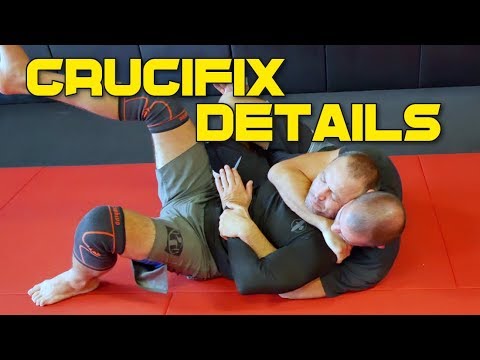
Rolling crucifix from turtle position. #crucifix#brazilianjiujitsu #chokes
0
Standard Crucifix Roll·Sickness Ferro·Added by Admin
Rolling crucifix from turtle. Please hit the red subscribe button!! Thank you Instagram: Sickness81 Instagram: Ferroac…
Translation: standard crucifix roll
The Standard Crucifix Roll executes the fundamental crucifix escape by bridging explosively and rolling toward the side where the arm is trapped by the opponent's legs, using the rolling momentum to dislodge the leg control and free the arm. [1] The defender bridges high, then commits to a sharp lateral roll, using the body's rotational force to break the attacker's leg grip on the trapped arm. [1],[2] As the arm comes free, the defender immediately works to turn into the attacker and recover a guard or neutral position. [2],[3]
The standard crucifix roll is the fundamental rolling escape from the crucifix position. [1]
A standard BJJ crucifix escape. [1]
Used in BJJ competition. [1]
No images yet for this technique.
Sign in to suggest an image.
Rolling crucifix from turtle. Please hit the red subscribe button!! Thank you Instagram: Sickness81 Instagram: Ferroac…
Got Crucifix Choke? If you want to spice things up when in top Turtle position, then take a look at this video where I e…
The standard crucifix roll is a back-escape reversal executed from turtle position, initiated when an opponent has trapped or controlled one of the defender's arms. MMA Leech's Professor Gustavo emphasizes precise arm control before entry: the defender must chop and isolate the opponent's arm using a gable grip, then walk the knee between the opponent's elbow and knee to create space for leg entanglement. He details two roll directions—forward (more common) and to the side—with the forward roll requiring the defender to roll over the opponent's shoulder while controlling the wrist and tucking the opponent's hand toward the belly to disable base. Sickness Ferro's Professor Ray Ferrell teaches a similar entry but focuses on seatbelt control and ankle crossing to tighten the squeeze before rolling. Both instructors agree the roll concludes in a dominant position enabling choke attacks; Gustavo emphasizes the figure-four grip and elbow positioning for the crucifix choke, while Ferrell details multiple finishing options including the basic back choke, paper cutter, and Ezekiel choke. Ferrell additionally notes armbar and collar control variations available after the roll completes. Both stress timing and preventing the opponent's arm escape during the transition.
Synthesized from 2 instructors
No instructional courses yet for this technique.
Sign in to suggest a course.
Risk of injury to the person this technique is applied to
Back escapes must address choke threat while escaping; urgency increases injury risk
Skill level needed to execute this technique reliably
Whether this technique is allowed under major competition rule sets
Jiu-Jitsu University (Saulo Ribeiro, 2008)
Alias sources — [1] Mastering Jujitsu (Renzo Gracie & John Danaher, 2003) [2] Advanced Brazilian Jiu-Jitsu Techniques (Marcelo Garcia, 2007)
Effectiveness sources — [1] Mastering Jujitsu (Gracie & Danaher, 2003)
Standard katakana transliteration of Western martial arts terminology (外来語) — used in Japanese MMA, boxing, and BJJ communities
Alias sources — [1] Mastering Jujitsu (Renzo Gracie & John Danaher, 2003) [2] Advanced Brazilian Jiu-Jitsu Techniques (Marcelo Garcia, 2007)
Effectiveness sources — [1] Mastering Jujitsu (Gracie & Danaher, 2003)
hip escape (shrimping) speed, framing strength, timing
flexible hips and quick lateral movement
hip flexors, obliques, triceps (framing), core
Sickness Ferro emphasizes using a seatbelt grip with your hand grabbing the opponent's wrist while squeezing your knees together tightly. You want to avoid staying in this position too long before rolling, as it gives your opponent time to escape the trapped arm.
According to Sickness Ferro, you should be on your tippy toes and use that positioning to roll over, then scoop underneath your opponent while maintaining your grip. As you roll, push your arm out to lock their arm in place, then transition to a basic back choke by grabbing the opposite collar.
Sickness Ferro explains that after rolling, grab the opposite collar with one hand and pull down while pushing your other arm in behind their head. Keep your arm positioned close to their head rather than stretching for space, and you can make a fist to curl the arm down as you apply pressure.
MMA Leech notes that you don't want your arm too deep initially, as the opponent can track and walk you out. When your leg gets behind their arm, be prepared for them to try controlling your other leg or taking you down.
The Standard Crucifix Roll executes the fundamental crucifix escape by bridging explosively and rolling toward the side where the arm is trapped by the opponent's legs, using the rolling momentum to dislodge the leg control and free the arm. The defender bridges high, then commits to a sharp lateral roll, using the body's rotational force to break the attacker's leg grip on the trapped arm.
The standard crucifix roll is the primary escape taught for the crucifix position, developed through competitive grappling as fighters encountered this position more frequently. It remains the most commonly taught crucifix escape in BJJ and MMA.
Unified MMA: legal — Legal defensive/transitional technique; IBJJF: legal — Legal; IJF: legal — Legal; ADCC: legal — Legal; UWW: legal — Legal, escape scores 1 point (freestyle), reversal scores 1 point; FIAS Sport Sambo: legal — Legal; NCAA Folkstyle: legal — Legal, escape scores 1 point, reversal scores 2 points
Danger rating 4/10. Moderate — back escapes must address choke threat while escaping; urgency increases injury risk
The standard setup chain: Create Space → Disrupt Control → Execute Escape → Recover Position.
Standard counters include: Heavy Hips — maintain low hip pressure and wide base to absorb the bridge / Grapevine — hook legs inside opponent's thighs to neutralize hip movement / Post Hand — post arm on the mat in the direction of the bridge to maintain balance.
Common variants: Shrimp to guard (framing and hip-escaping to recover full guard or half guard); Underhook escape (winning the underhook and coming to knees or reversing); Bridge to knees (bridging into the opponent and transitioning to turtle or…); Ghost escape (inverting under the opponent to re-guard from the opposit…).
Used in BJJ competition.
Top errors to watch for: Rolling over the wrong shoulder (trapped-arm side) — always roll over the free-arm shoulder / Not driving with the legs to generate rolling momentum — the legs provide the power; don't rely on upper body alone / Leaving the chin exposed during the roll — tuck the chin to protect the neck throughout the rotation / Not extracting the arm as you roll — the arm must be pulled free during the rotation, not after.
The Standard Crucifix Roll is also known as Sutandādo Kurushifikkusu Rōru, Basic Crucifix Roll, Crucifix Escape Roll.