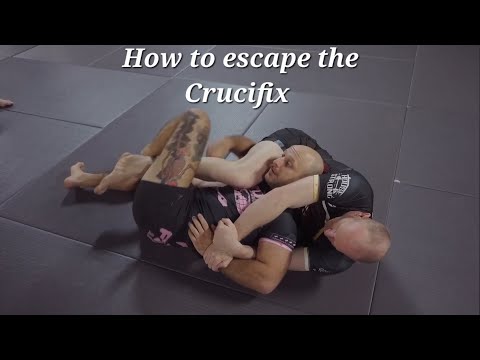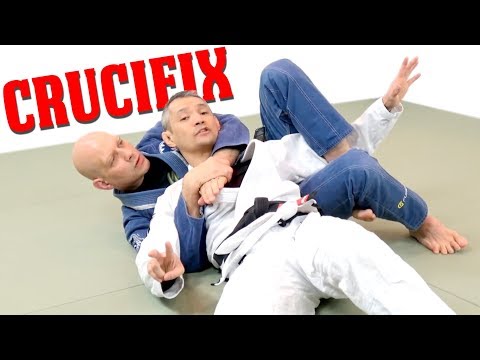
How to Escape the Crucifix in BJJ
0
Crucifix Escape·Stephan Kesting
How to escape the crucifix is something you need to know if you're doing BJJ, otherwise you're going to get armlocked, c…
Translation: crucifix escape
The Crucifix Escape family covers techniques for escaping the crucifix position, where the opponent controls the back while trapping one arm with the legs and the other arm with their arms, leaving the defender completely immobilised. [1] The crucifix is one of the most dominant control positions in grappling because the defender has both arms trapped and cannot defend against strikes or chokes. [1],[2] Crucifix escapes focus on freeing one arm to begin the escape sequence, typically through rolling or hip movement that disrupts the attacker's leg control. [2],[3]
Crucifix escape techniques were developed in BJJ and MMA in response to the crucifix position. [1]
Crucifix escapes are critical in MMA where the position leads to undefended strikes. [1]
No images yet for this technique.
Sign in to suggest an image.
How to escape the crucifix is something you need to know if you're doing BJJ, otherwise you're going to get armlocked, c…
Jahred shows how to escape the crucifix in this shorter 'How To' voice-over video. The crucifix can be an extremely cha…
No instructional courses yet for this technique.
Sign in to suggest a course.
Risk of injury to the person this technique is applied to
Back escapes must address choke threat while escaping; urgency increases injury risk
Skill level needed to execute this technique reliably
Whether this technique is allowed under major competition rule sets
Jiu-Jitsu University (Saulo Ribeiro, 2008)
Alias sources — [1] Jiu-Jitsu University (Ribeiro, 2008)
Effectiveness sources — [1] Mastering Jujitsu (Gracie & Danaher, 2003)
Standard katakana transliteration of Western martial arts terminology (外来語) — used in Japanese MMA, boxing, and BJJ communities
Alias sources — [1] Jiu-Jitsu University (Ribeiro, 2008)
Effectiveness sources — [1] Mastering Jujitsu (Gracie & Danaher, 2003)
grip fighting ability, hip mobility for sliding to the mat, chin defence
strong hands for grip fighting, flexible hips
forearms (grip fighting), core, hip flexors, neck
Every move, in any martial art, shares a few universal traits. Mix and match below to pinpoint the right tool — or compare equivalents across styles.
Escaping the crucifix is one of the most difficult escapes in grappling — both arms are trapped, leaving the neck completely exposed. The primary defense is preventing the crucifix from being established rather than escaping once caught. Rolling toward the attacker's legs is the standard escape. (BJJ instructionals; competition analysis)
The crucifix position traps both of your arms, and if you can't get at least one arm free, you cannot defend strangles or prevent your opponent from controlling your back. According to Jahred Dell, this leaves you extremely vulnerable to neck attacks.
Jahred Dell emphasizes that if your thumb is pointing upwards, there's no way to get your leg-trapped arm free, leaving your neck completely open to attack. You must turn your thumb down—similar to an armbar escape—to move your hips toward your opponent's legs and unravel them.
The overall objective is to unravel your opponent's legs so you can get your bottom arm (the one trapped by the legs) free, according to Jahred Dell. Once you achieve this, you can grab behind their head and transition to a safer position like north-south.
According to Jahred Dell, it is far more likely that you'll be able to peel your opponent's legs off your arm than to peel their arms off, making leg control the key focus of your escape.
Stephan Kesting recommends placing your thumb on the inside of your neck area right away to buy yourself time before your opponent can start squeezing, giving you a few critical moments to begin your escape.
The Crucifix Escape family covers techniques for escaping the crucifix position, where the opponent controls the back while trapping one arm with the legs and the other arm with their arms, leaving the defender completely immobilised. The crucifix is one of the most dominant control positions in grappling because the defender has both arms trapped and cannot defend against strikes or chokes.
Crucifix escapes developed as the crucifix position gained recognition as a devastating control position in both BJJ and MMA. The position's increasing use in competition, particularly for ground-and-pound in MMA, drove the development of specific escape techniques.
Unified MMA: legal — Legal defensive/transitional technique; IBJJF: legal — Legal; IJF: legal — Legal; ADCC: legal — Legal; UWW: legal — Legal, escape scores 1 point (freestyle), reversal scores 1 point; FIAS Sport Sambo: legal — Legal; NCAA Folkstyle: legal — Legal, escape scores 1 point, reversal scores 2 points
Danger rating 4/10. Moderate — back escapes must address choke threat while escaping; urgency increases injury risk
The standard setup chain: Create Space → Disrupt Control → Execute Escape → Recover Position.
Standard counters include: Maintain Pressure — keep consistent weight distribution to limit escape space / Anticipate Direction — read escape attempt direction and block early / Transition — flow to a new position when the current one is threatened.
Common variants: Slide to side (choking-arm side) (fighting hands and sliding hips to the mat on the choking…); Peel-and-turn (stripping the seatbelt grip and turning into the opponent); Trap-arm escape (trapping one arm and rolling to pin the opponent's back); Body triangle escape (addressing the body triangle lock before escaping the hooks).
Crucifix escapes are critical in MMA where the position leads to undefended strikes.
Top errors to watch for: Trying to pull the trapped arm out with strength — the mechanical lock of the crucifix is too strong for a straight p… / Exposing the neck while focusing on freeing the arm — the opponent will choke you while you work the arm; protect the… / Not recognizing the crucifix entry from turtle — by the time both arms are trapped, you're already in deep trouble; f… / Panicking in the crucifix — the position feels helpless, but technical escapes exist; stay calm and execute.
The Crucifix Escape is also known as Kurushifikkusu Esukēpu, Crucifix Position Escape.