![Knife Self Defense [You Will Get Cut]](https://img.youtube.com/vi/_b_Yj5NuqWU/hqdefault.jpg)
Knife Self Defense [You Will Get Cut]
0
Defence Against Knife Stab·Budo Brothers
Translation: defence against knife stab
Developed from real military and security experience; continuously refined based on actual incident reports. [1]
Imi Lichtenfeld → Krav Maga worldwide; Lichtenstein 9th Dan lineage. [1]
Self-defence system — not used in sport competition
No images yet for this technique.
Sign in to suggest an image.
Could you survive a life-or-death attack? Build your survival combat skills with a FREE custom 14-day training plan – ta…
Follow Me on Instagram: https://www.instagram.com/gn_funkertactical Business Inquiries: [email protected] Notice: …
▶ Gun Law Map (FREE): https://uscca.co/oOyA ▶ Join USCCA: https://uscca.co/Bn62 Thousands of USCCA Members have acted i…
Let's go over essential basics and develop safety skills for the every day non-ninja, non-commando regular average perso…
How to defend yourself against a knife attack? In this video, I show you how you can properly disarm and defend yoursel…
Knife attacks happen fast and sometimes with little time to react. Too often do I see "knife defense" techniques for di…
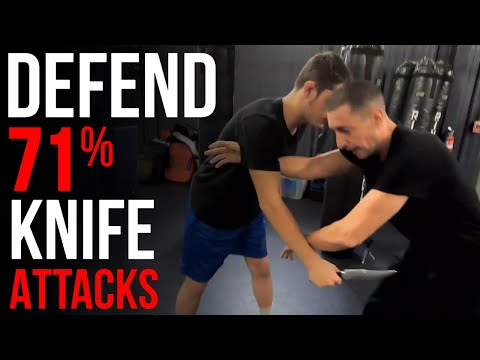
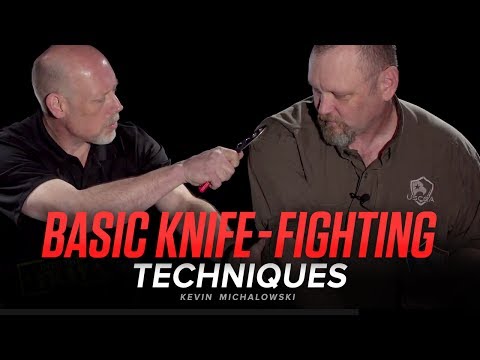
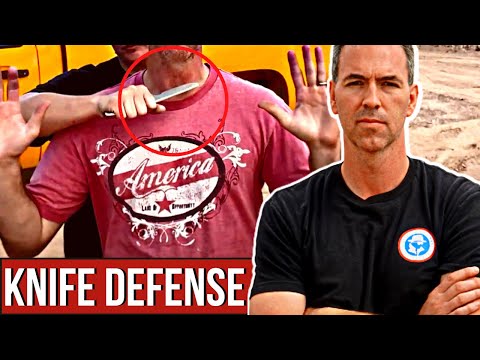
Defence against knife stab attacks emphasizes a hierarchy of priorities grounded in realistic threat assessment. Funker Tactical and Budo Brothers both stress that disengagement and distance management are the primary objectives—leaving the scene or maintaining a buffer beyond the attacker's effective range (arm's reach plus blade length and lunging extension) significantly reduces injury likelihood. When disengagement is impossible, defenders must monitor pre-attack indicators such as weapon indexing, blading of the body, and environmental scanning. Funker Tactical provides detailed guidance on positional advantages: standing on the outside of a weapon-bearing limb (typically the right side) encourages backhand trajectories, while inside positioning invites forehand thrusts and slashes. Both Funker Tactical and the 2-1-1 control drills emphasize initial interception through parrying and gross motor blocks rather than precision techniques, accepting calculated risk and vulnerability trade-offs—a high block exposes low lines and vice versa. Budo Brothers reinforces the reality that cuts are likely and should be accepted as a cost of survival. Jason Hanson demonstrates a specific high-threat scenario (knife-to-throat control) using rapid weapon containment against the chest combined with stepping through the attacker's arm structure to create positional advantage and potential counter-options. All instructors acknowledge that knife defence is context-dependent, variable, and requires pressure-tested, in-person training with qualified practitioners rather than reliance on tutorial videos alone.
Synthesized from 4 instructors
No instructional courses yet for this technique.
Sign in to suggest a course.
Risk of injury to the person this technique is applied to
Defensive technique
Skill level needed to execute this technique reliably
Whether this technique is allowed under major competition rule sets
The Book of Krav-Maga: The Bible (Lichtenstein, 2007)
description, historyOrigin: sourced from Lichtenstein, Y
description, historyOrigin: sourced from Lichtenstein, Y
Quick reactions
Aggression
Awareness
Knife stab defense appears in 13 passages across 5 books. The straight stab is the most dangerous knife attack — the defender must redirect the stabbing hand offline while simultaneously counter-attacking. Krav Maga trains this with stress inoculation drills. (5 books; Complete Krav Maga)
TRITAC Martial Arts emphasizes that blocking requires coordinating multiple joints with precision and speed, which consumes too much of your limited cognitive ability in a high-stress situation. Instead, you should create a simple, stationary wall with your arm that requires minimal thought, preserving your mental resources to survive and develop strategy.
TRITAC Martial Arts notes that real-world knife attacks typically involve repeated stabbing motions, with fatal cases showing an average of 27 stab wounds, making this the primary attack pattern worth training against rather than traditional techniques.
Funker Tactical advises that priority one is not to be there—disengage, leave, or run if possible, and maneuver to a safer position before engaging with the weapon.
TRITAC Martial Arts stresses that your ability to think drops to nearly zero when your life is in danger, leaving you with only about one percent of your normal cognitive capacity, which is why defenses must be simple and automatic.
The Defence Against Knife Stab redirects the stabbing arm using a burst of movement off the line of attack, combined with immediate counter-strikes and weapon control.
Krav Maga was developed by Imi Lichtenfeld for the Israeli Defence Forces and refined for civilian self-defence. Defence Against Knife Stab addresses real-world attack scenarios.
Unified MMA: legal — Legal defensive technique; IBJJF: legal — Legal; IJF: legal — Legal defensive action; WBC/Boxing: legal — Legal; WKF: legal — Legal; WT: legal — Legal
Danger rating 3/10. Defensive technique
The standard setup chain: Threat detected → Defence Against Knife Stab → Counter-attack → Disengage or control.
Standard counters include: N/A — these are defensive responses to attacks.
Common variants: Against right-handed attacker; Against left-handed attacker; Multiple attackers.
Self-defence system — not used in sport competition
Top errors to watch for: Freezing instead of acting / Insufficient aggression in counter-attacks / Poor footwork.
The Defence Against Knife Stab is also known as Defence Against Knife Stab, Knife Stab Defence, Ice Pick Defence.