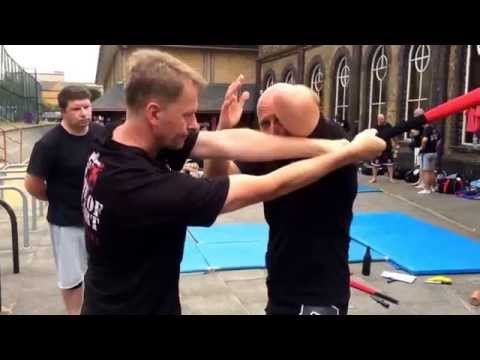
Baseball Bat Defence with Ricky Manetta - MMA Krav Maga
0
Krav Maga Defence·MMA Krav Maga
What we are all about is, does it work? Here a few baseball bat defences that do. Website: http://www.mmakravmaga.co…
Translation: Krav Maga defence
The Krav Maga Weapon Defence family covers techniques for defending against armed attacks — knife threats, gun threats, stick attacks, and other weapons — designed for life-or-death self-defence scenarios where disengagement is not possible. [1] Krav Maga weapon defences follow a strict protocol: (1) redirect the weapon away from the body, (2) control the weapon arm, (3) deliver aggressive counter-strikes to neutralise the attacker, and (4) disarm if possible. [1],[2] Unlike martial arts that teach weapon 'sparring' or 'matching' (fighting weapon vs weapon), Krav Maga assumes the defender is unarmed against an armed attacker — the worst-case scenario — and provides techniques designed to survive this encounter. [2],[3] These techniques are the most dangerous to train and the most critical to know, as armed attacks are among the most lethal threats civilians and military personnel face. [3]
Krav Maga weapon defence was a core component of Imi Lichtenfeld's original system developed for the IDF in the 1940s–1950s, addressing the practical reality that soldiers and civilians face armed threats. [1] The system was refined through decades of real-world military and security use by the IDF, Israeli Border Police, and Shin Bet (Israeli security service). [1],[2] Civilian weapon defence instruction was developed by Lichtenfeld and his senior students (particularly Eyal Yanilov and Darren Levine) starting in the 1980s, adapting military techniques for civilian self-defence contexts. [2],[3]
Krav Maga weapon defence techniques are among the most widely taught weapon defence systems worldwide, used by military and law enforcement agencies in over 30 countries. [1] The system's effectiveness has been validated through documented real-world uses by IDF soldiers and Israeli security personnel. [2] However, weapon defence of any kind carries inherent risk — no technique guarantees safety against an armed attacker, and Krav Maga instructors emphasise that avoidance and escape are always preferable to physical defence. [3]
Not applicable — weapon defence is a self-defence skill, not a competitive technique. Effectiveness is validated through military and security use rather than sporting competition. [1]
No images yet for this technique.
Sign in to suggest an image.
What we are all about is, does it work? Here a few baseball bat defences that do. Website: http://www.mmakravmaga.co…
No instructional courses yet for this technique.
Sign in to suggest a course.
Risk of injury to the person this technique is applied to
Maximum — weapon defence is inherently the most dangerous situation in combat; even with perfect technique, there is significant risk of being cut, stabbed, shot, or struck; Krav Maga acknowledges that weapon defence carries a high probability of injury even when successful; the goal is survival, not winning cleanly
Skill level needed to execute this technique reliably
Whether this technique is allowed under major competition rule sets
Krav Maga: How to Defend Yourself Against Armed Assault (Imi Lichtenfeld & Eyal Yanilov, 2001)
Description sources — [1] Krav Maga: How to Defend Yourself (Lichtenfeld & Yanilov, 2001) [2] Complete Krav Maga (Levine & Whitman, 2007) [3] Krav Maga Weapon Defenses (Kahn, 2012)
History sources — [1] Imi Lichtenfeld and IDF history [2] Israeli security service adoption [3] Civilian instruction development
Description sources — [1] Krav Maga: How to Defend Yourself (Lichtenfeld & Yanilov, 2001) [2] Complete Krav Maga (Levine & Whitman, 2007) [3] Krav Maga Weapon Defenses (Kahn, 2012)
History sources — [1] Imi Lichtenfeld and IDF history [2] Israeli security service adoption [3] Civilian instruction development
explosive speed (the redirect must happen before the attacker can fire/stab), grip strength (controlling the weapon arm), aggression (overwhelming counter-attacks), mental toughness (remaining functional under the extreme stress of an armed threat)
quick reactions, strong grip, willingness to commit fully to the defence
forearms (grip and control), legs (bursting forward), core (power for counter-strikes), shoulders (redirecting the weapon)
Every move, in any martial art, shares a few universal traits. Mix and match below to pinpoint the right tool — or compare equivalents across styles.
The Bus Defence Technique addresses the specific challenges of fighting in the confined space of a bus or public transport vehicle, including seated defence against weapons. [1] This is an advanced technique developed from Israeli anti-terrorism experience. [1]
The Defence Against Bear Hug from Behind drops the base, creates space through hip movement, and delivers strikes to the attacker's groin and face. [1]
The Defence Against Choke from Behind uses a plucking motion on the attacker's hands combined with a simultaneous turn and counter-strike. [1]
The Defence Against Gun Threat from the Front redirects the weapon off-line using a sharp hand movement, followed by immediate weapon control and counter-attacks. [1] This is one of the most critical Krav Maga techniques, developed from real military and security scenarios. [1]
The Defence Against Gun Threat from the Rear involves a simultaneous body turn and arm redirection to move out of the weapon's line while gaining control. [1]
The Defence Against Headlock uses leverage on the attacker's chin and throat combined with strikes to escape the standing headlock position. [1]
The Defence Against Knife Slash uses a two-handed forearm block to intercept the slashing arm while immediately moving to control the weapon hand. [1]
The Defence Against Knife Stab redirects the stabbing arm using a burst of movement off the line of attack, combined with immediate counter-strikes and weapon control. [1]
The Subway Defence Technique adapts Krav Maga principles for the unique environment of subway cars and platforms, addressing confined spaces and crowd dynamics. [1]
Krav Maga weapon defenses are the most widely taught civilian self-defense system for weapon threats — knife, gun, and stick. Developed by Imi Lichtenfeld for the IDF and adapted for civilian use. The system prioritizes aggressive counter-attack simultaneous with the defense. (Lichtenfeld system; Krav Maga manuals)
Yes. Ricky Manetta emphasizes that what matters is what works effectively—there are four or five different baseball bat defence techniques within the Krav Maga syllabus, and variation in approach is acceptable as long as the core objective is achieved.
Once you've gained control of the bat, there are multiple follow-up options available: you can take it back from the attacker's hands or transition into striking their groin area. The key is maintaining control and then executing whichever technique is available given your position.
The Krav Maga Weapon Defence family covers techniques for defending against armed attacks — knife threats, gun threats, stick attacks, and other weapons — designed for life-or-death self-defence scenarios where disengagement is not possible. Krav Maga weapon defences follow a strict protocol: (1) redirect the weapon away from the body, (2) control the weapon arm, (3) deliver aggressive counter-strikes to neutralise the attacker, and (4) disarm if possible.
Krav Maga weapon defence was a core component of Imi Lichtenfeld's original system developed for the IDF in the 1940s–1950s, addressing the practical reality that soldiers and civilians face armed threats. The system was refined through decades of real-world military and security use by the IDF, Israeli Border Police, and Shin Bet (Israeli security service).
Unified MMA: legal — Legal defensive technique; IBJJF: legal — Legal; IJF: legal — Legal defensive action; WBC/Boxing: legal — Legal; WKF: legal — Legal; WT: legal — Legal
Danger rating 10/10. Maximum — weapon defence is inherently the most dangerous situation in combat; even with perfect technique, there is significant risk of being cut, stabbed, shot, or struck; Krav Maga acknowledges that weapon defence carries a high probability of injury even when successful; the goal is survival, not winning cleanly
The standard setup chain: Recognise Threat → Decide → Redirect → Control → Counter-Attack → Disarm → Scan.
Standard counters include: As the DEFENDER against weapons, the 'counter-techniques' are the weapon defences themselves / From the ATTACKER's perspective, counters include: maintaining distance (staying beyond grab range), multiple weapons… / Note: This family teaches defence against weapons, not the use of weapons.
Common variants: Gun defence (front threat) (redirecting a pistol pointed at the defender from the fro…); Gun defence (side/rear threat) (redirecting a pistol from the side or behind the defender); Knife defence (straight stab) (deflecting a straight stabbing attack); Knife defence (slash) (360-degree defence against slashing/circular knife attacks); Knife defence (threat at throat) (specific defence against a knife held to the throat); Stick defence (overhead) (blocking and entering against overhead stick attacks); Stick defence (horizontal) (defence against horizontal stick swings); Long gun defence (specific techniques for defence against rifles and shotguns); Multiple weapon threats (principles for dealing with multiple armed attackers).
Not applicable — weapon defence is a self-defence skill, not a competitive technique. Effectiveness is validated through military and security use rather than sporting competition.
Top errors to watch for: Reaching for the weapon instead of the arm — controlling the weapon arm is more reliable than grabbing at the weapon … / Trying to disarm before incapacitating — the disarm should come after the attacker has been struck and is incapacitat… / Not moving off the weapon's line — the very first action must be redirecting the weapon AND moving your body; standin… / Under-committing to counter-attacks — weapon defence requires maximum aggression; gentle counter-strikes do not incap….
The Krav Maga Defence is also known as Kuravu Maga Difensu, Krav Maga Weapon Defence, KM Weapon Disarm, Armed Attack Defence.