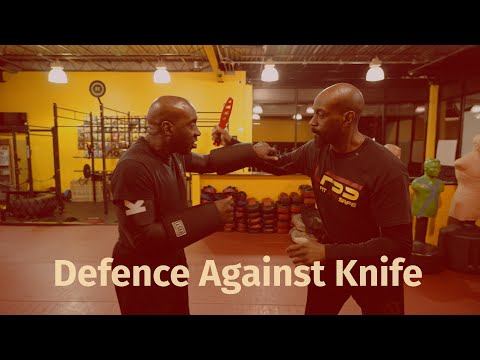
Defence Against Knife - Self Defence Techniques
0
Knife Defence·Vee AJ Jitsu
Join this channel to get access to perks: https://www.youtube.com/channel/UC5UHXD7eSL8MGe06z-_dtYw/join 👊 Self Defense…
Translation: knife defence
The Knife Defence family covers defensive techniques against edged weapon attacks, including slashing and stabbing attacks with knives, blades, and other edged weapons. [1] Knife defence is extremely challenging because edged weapons require minimal skill to inflict serious injury, the attacker can change angles rapidly, and the defender is likely to sustain cuts even in a successful defence. [1],[2] Knife defence techniques focus on controlling the weapon hand, redirecting the blade, and creating distance or executing a disarm when escape is not possible. [2],[3]
Knife defence has been taught in martial arts for centuries, with Filipino martial arts (Kali/Escrima), Japanese jujutsu, and Indonesian Silat developing the most comprehensive edged-weapon defence systems. [1] Modern reality-based self-defence systems emphasise that knife defence is extremely dangerous and should only be attempted when escape is impossible. [2],[3]
Knife defence is a self-defence discipline. [1]
No images yet for this technique.
Sign in to suggest an image.
Join this channel to get access to perks: https://www.youtube.com/channel/UC5UHXD7eSL8MGe06z-_dtYw/join 👊 Self Defense…
No instructional courses yet for this technique.
Sign in to suggest a course.
Risk of injury to the person this technique is applied to
Weapon defence scenarios involve lethal threats; failure risk is catastrophic
Skill level needed to execute this technique reliably
Whether this technique is allowed under major competition rule sets
Boxing (Edwin Haislet, 1940)
Alias sources — [1] MMA Instruction Manual (UFC, 2008) [2] MMA Instruction Manual (UFC, 2008) [3] MMA Instruction Manual (UFC, 2008)
Effectiveness sources — [1] Krav Maga: How to Defend Yourself Against Armed Assault (Lichtenfeld & Yanilov, 2001) [2] Filipino Martial Arts (Wiley, 1997)
Standard katakana transliteration of Western martial arts terminology (外来語) — used in Japanese MMA, boxing, and BJJ communities
Alias sources — [1] MMA Instruction Manual (UFC, 2008) [2] MMA Instruction Manual (UFC, 2008) [3] MMA Instruction Manual (UFC, 2008)
Effectiveness sources — [1] Krav Maga: How to Defend Yourself Against Armed Assault (Lichtenfeld & Yanilov, 2001) [2] Filipino Martial Arts (Wiley, 1997)
reaction speed, structural body mechanics, defensive awareness
quick reflexes and conditioned defensive surfaces
varies — forearms (blocking), legs (movement), core (stability)
Every move, in any martial art, shares a few universal traits. Mix and match below to pinpoint the right tool — or compare equivalents across styles.
The Knife Disarm subfamily covers techniques for removing a knife from an attacker's hand, typically through wrist locks, leverage strips, or impact techniques that force the hand open. [1] Knife disarms are among the most difficult and dangerous techniques in self-defence because they require the defender to maintain control of the weapon hand while executing a precise mechanical action to strip the weapon. [1,2] All knife disarm techniques accept that the defender may sustain cuts during the engagement, and prioritise securing the weapon hand above all else. [2,3]
The Knife Redirect subfamily covers defensive techniques that redirect the trajectory of a knife attack without attempting an immediate disarm, using hand deflections and body movement to guide the blade past the body. [1] Knife redirects are based on the principle of deflection rather than direct blocking — the defender uses a parrying motion to change the blade's path rather than stopping its force head-on. [1,2] Redirects are often the first defensive action in a knife defence sequence, followed by control of the weapon hand and either escape or disarm. [2,3]
Knife defense appears in 261 passages across 39 books. The universal expert consensus: the best knife defense is to run. When escape is impossible, the defender must control the weapon hand above all else. Filipino martial arts (Kali/Eskrima) have the most developed knife defense systems. (39 books; FMA manuals; Krav Maga texts)
No—Vee AJ Jitsu emphasizes that grabbing the arm directly is ineffective because the knife wielder will simply move the blade like a snake's head, rotating and whipping it around to cut you. Instead, use your forearms to block and control the blade without relying on hand grabs.
Vee AJ Jitsu teaches that using your forearms to block allows you to control and move the blade safely without it sliding down toward you, whereas grabbing with your hands gives the attacker leverage to drive the blade downward into your body.
According to Vee AJ Jitsu, people without blade training rely entirely on the weapon for confidence and aggression—remove the knife and they lose their advantage, since they lack the fundamental understanding of how to actually control and move an edge weapon effectively.
The Knife Defence family covers defensive techniques against edged weapon attacks, including slashing and stabbing attacks with knives, blades, and other edged weapons. Knife defence is extremely challenging because edged weapons require minimal skill to inflict serious injury, the attacker can change angles rapidly, and the defender is likely to sustain cuts even in a successful defence.
Knife defence has been taught in martial arts for centuries, with Filipino martial arts (Kali/Escrima), Japanese jujutsu, and Indonesian Silat developing the most comprehensive edged-weapon defence systems. Modern reality-based self-defence systems emphasise that knife defence is extremely dangerous and should only be attempted when escape is impossible.
Unified MMA: legal — Legal defensive technique; IBJJF: legal — Legal; IJF: legal — Legal defensive action; WBC/Boxing: legal — Legal; WKF: legal — Legal; WT: legal — Legal
Danger rating 9/10. Extreme — weapon defence scenarios involve lethal threats; failure risk is catastrophic
The standard setup chain: Anticipate the Attack → Execute Defence → Recover Stance → Counter or Disengage.
Standard counters include: Timing — attack when the defence is recovering or between movements / Feint — use deception to create openings in the defensive structure / Angle Change — attack from an unexpected angle that the defence does not cover.
Common variants: Standard defence (primary defensive technique from the most common position); Reactive defence (triggered by the opponent's attack, minimal movement for …); Proactive defence (anticipating the attack and positioning to neutralise it …); Counter defence (using the defensive movement to create an immediate count…).
Knife defence is a self-defence discipline.
Top errors to watch for: Believing knife defence techniques work reliably in real situations — real knife attacks are chaotic, fast, and often… / Training only against single-strike knife attacks — real attackers use rapid, repeated thrusting ('sewing machine' at… / Attempting techniques without first controlling the weapon hand — the hand must be secured before any counter or disarm / Not training under realistic pressure with protective equipment — adrenaline and speed change everything.
The Knife Defence is also known as Naifu Difensu, Blade Defence, Edged Weapon Defence, Anti-Knife.