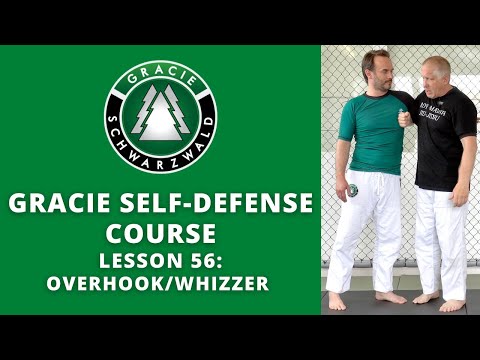
BJJ Self-Defense Course | Lesson 56: The Overhook
0
Standard Overhook Counter·Gracie Schwarzwald Jiu-Jitsu·Added by Admin
We hope everyone is enjoying our Gracie Jiu-Jitsu Self-Defense Course. We are offering these lessons for free, but If y…
Translation: standard overhook counter
The Standard Overhook Counter hooks the arm over the opponent's attacking arm at shoulder depth, drives the hip forward on the overhook side, and uses the combined arm-and-hip pressure to redirect the opponent's takedown attempt. [1] The defender simultaneously sprawls the opposite hip back while driving the overhook hip forward, creating a rotational force that turns the attacker's shoulders and breaks their alignment. [1],[2] From the standard overhook counter, the defender can transition to a go-behind by circling toward the overhook side as the attacker is turned. [2],[3]
The overhook (whizzer) is one of the most reliable takedown defences when the opponent secures an underhook, as it controls the opponent's arm and shoulder, preventing them from using the underhook to drive into a takedown. [1] The overhook can be used defensively to stall a takedown or offensively to set up throws, sweeps, and submissions. [2]
Khabib Nurmagomedov's opponents frequently resorted to the whizzer as a primary defence against his takedowns, with fighters like Conor McGregor and Dustin Poirier using the overhook to delay (though not prevent) Nurmagomedov's relentless pressure wrestling. [1]
No images yet for this technique.
Sign in to suggest an image.
We hope everyone is enjoying our Gracie Jiu-Jitsu Self-Defense Course. We are offering these lessons for free, but If y…
No instructional courses yet for this technique.
Sign in to suggest a course.
Risk of injury to the person this technique is applied to
Sprawls and stuffs involve sudden body weight displacement; knee/hip strain risk
Skill level needed to execute this technique reliably
Whether this technique is allowed under major competition rule sets
Freestyle Wrestling: A Complete Guide for Coaches and Wrestlers (Petrov, 1977)
Alias sources — [1] Wrestling Coaching Manual (USA Wrestling, 2015) [2] MMA Instruction Manual (Ryan & Snowden, 2010) [3] MMA Instruction Manual (Ryan & Snowden, 2010)
Effectiveness sources — [1] Wrestling Coaching Manual (USA Wrestling, 2015) [2] MMA Instruction Manual (Ryan & Snowden, 2010)
Standard katakana transliteration of Western martial arts terminology (外来語) — used in Japanese MMA, boxing, and BJJ communities
Alias sources — [1] Wrestling Coaching Manual (USA Wrestling, 2015) [2] MMA Instruction Manual (Ryan & Snowden, 2010) [3] MMA Instruction Manual (Ryan & Snowden, 2010)
Effectiveness sources — [1] Wrestling Coaching Manual (USA Wrestling, 2015) [2] MMA Instruction Manual (Ryan & Snowden, 2010)
reaction speed, explosive hip extension, downward driving force
long legs for quick sprawl, heavy upper body
hip extensors, glutes, core, shoulders (dead weight)
According to Gracie Schwarzwald Jiu-Jitsu, the overhook serves to keep your opponent away and create distance, whereas the underhook is used to control and hold them. The overhook is effective when you're not worried about keeping the person—just preventing them from getting their body too close to you.
Gracie Schwarzwald Jiu-Jitsu explains that when you get in tight to your opponent, there's not a lot of space for them to build structures to break your hold, similar to side control positioning. This proximity gives you control.
Gracie Schwarzwald Jiu-Jitsu emphasizes that understanding clinch work with overhooks will help tremendously on the ground, improving your pins, holds, and overall ground positioning.
Gracie Schwarzwald Jiu-Jitsu recommends creating spacers with your hands early—framing on your opponent's body to prevent them from getting in close in the first place.
The Standard Overhook Counter hooks the arm over the opponent's attacking arm at shoulder depth, drives the hip forward on the overhook side, and uses the combined arm-and-hip pressure to redirect the opponent's takedown attempt. The defender simultaneously sprawls the opposite hip back while driving the overhook hip forward, creating a rotational force that turns the attacker's shoulders and breaks their alignment.
The standard overhook counter is a fundamental wrestling defensive technique taught at all competitive levels. Its simplicity and effectiveness have made it one of the most widely practised takedown defences in combat sports.
Unified MMA: legal — Legal defensive technique; IBJJF: legal — Legal — defensive techniques are fundamental to grappling; IJF: legal — Legal defensive action; ADCC: legal — Legal; UWW: legal — Legal defensive technique; FIAS Sport Sambo: legal — Legal
Danger rating 3/10. Moderate — sprawls and stuffs involve sudden body weight displacement; knee/hip strain risk
The standard setup chain: Anticipate the Attack → Execute Defence → Recover Stance → Counter or Disengage.
Standard counters include: Timing — attack when the defence is recovering or between movements / Feint — use deception to create openings in the defensive structure / Angle Change — attack from an unexpected angle that the defence does not cover.
Common variants: Full sprawl (both legs kicked back, hips dropped to the mat); Half sprawl (one leg back while the other posts for balance); Sprawl to front headlock (sprawling and immediately securing head control).
Khabib Nurmagomedov's opponents frequently resorted to the whizzer as a primary defence against his takedowns, with fighters like Conor McGregor and Dustin Poirier using the overhook to delay (though not prevent) Nurmagomedov's relentless pressure wrestling.
Top errors to watch for: Attempting counters without the collar tie — the overhook alone doesn't provide enough control for most counters / Choosing the wrong counter for the situation — the hip throw works against forward pressure, the lateral drop against… / Telegraphing the counter by adjusting your grip — the transition from overhook-hold to counter should be sudden / Not stepping deep enough for the back-take counter — a shallow step lets the opponent follow and re-face you.
The Standard Overhook Counter is also known as Sutandādo Ōbāfukku Kauntā, Basic Overhook Counter, Standard Whizzer Counter, Overhook Hip Toss.