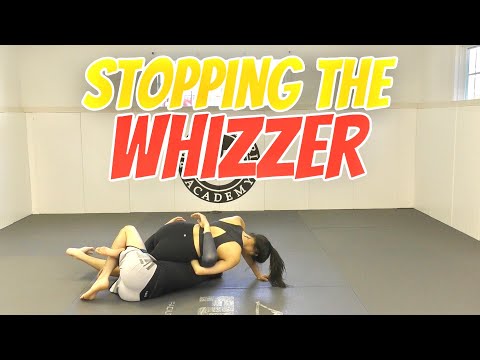
Stopping The WHIZZER
0
Whizzer Defence·Aaron Benzrihem bjj
STOPPING THE WHIZZER // This is a question I always get, how do I stop the whizzer from half guard or takedowns. These …
Translation: whizzer defence
The Whizzer Defence family covers defensive techniques that use the overhook with hip pressure (whizzer) to counter takedown attempts, particularly single-leg takedowns and underhook drives. [1] The whizzer is one of the most important reactive takedown defences because it can be applied immediately when the opponent secures an underhook, using the overhook and hip drive to neutralise the opponent's forward pressure. [1],[2] This family includes the standard overhook counter and the whizzer-to-kimura transition, which converts the defensive whizzer into an offensive submission. [2],[3]
The whizzer as takedown defence is a distinctly American wrestling contribution, developed in folkstyle wrestling as the primary counter to the single-leg takedown. [1] The technique was further developed in MMA and BJJ, where the whizzer-to-kimura transition became a powerful defensive weapon. [2],[3]
The whizzer is a fundamental wrestling defensive technique. [1]
The whizzer is used in wrestling and MMA. [1]
No images yet for this technique.
Sign in to suggest an image.
STOPPING THE WHIZZER // This is a question I always get, how do I stop the whizzer from half guard or takedowns. These …
No instructional courses yet for this technique.
Sign in to suggest a course.
Risk of injury to the person this technique is applied to
Sprawls and stuffs involve sudden body weight displacement; knee/hip strain risk
Skill level needed to execute this technique reliably
Whether this technique is allowed under major competition rule sets
Boxing (Edwin Haislet, 1940)
Alias sources — [1] Wrestling Physical Conditioning Encyclopedia (Welker, 2010) [2] Wrestling Physical Conditioning Encyclopedia (Welker, 2010) [3] NCAA Wrestling Rules and Interpretations
Effectiveness sources — [1] Wrestling Physical Conditioning Encyclopedia (Petrov, 1977) [2] Mastering Jujitsu (Gracie & Danaher, 2003)
Standard katakana transliteration of Western martial arts terminology (外来語) — used in Japanese MMA, boxing, and BJJ communities
Alias sources — [1] Wrestling Physical Conditioning Encyclopedia (Welker, 2010) [2] Wrestling Physical Conditioning Encyclopedia (Welker, 2010) [3] NCAA Wrestling Rules and Interpretations
Effectiveness sources — [1] Wrestling Physical Conditioning Encyclopedia (Petrov, 1977) [2] Mastering Jujitsu (Gracie & Danaher, 2003)
reaction speed, structural body mechanics, defensive awareness
quick reflexes and conditioned defensive surfaces
varies — forearms (blocking), legs (movement), core (stability)
Every move, in any martial art, shares a few universal traits. Mix and match below to pinpoint the right tool — or compare equivalents across styles.
The Overhook Counter subfamily covers the use of the overhook (whizzer) to counter takedown attempts by hooking over the opponent's attacking arm and driving the hip forward, stopping the forward momentum of the takedown. [1] The overhook counter hooks deep over the opponent's arm at the shoulder level, then uses an aggressive hip drive on the overhook side to push the opponent's shoulder down and redirect their force. [1,2] The overhook counter can transition to a go-behind, hip throw, or front headlock depending on the angle achieved. [2,3]
The Whizzer To Kimura subfamily covers the transition from a defensive whizzer position into an offensive kimura (double wrist lock) submission, converting a defensive position into an attacking opportunity. [1] The transition is natural because the whizzer's overhook position already controls the opponent's arm — by grabbing the opponent's wrist with the free hand, the defender converts the overhook into a figure-four grip that is the kimura. [1,2] The whizzer-to-kimura transition demonstrates the fundamental grappling principle that defence and offence are seamlessly connected. [2,3]
The whizzer (overhook defense) appears in 82 passages across 13 books. The primary counter to the underhook — wrapping over the opponent's arm and driving the elbow down to deny the underhook advantage. BJ Penn's Closed Guard documents multiple whizzer attacks. (13 books; BJ Penn, Closed Guard)
Aaron Benzrihem teaches the 'limp arm' technique, a basic counter he learned from a D1 Ohio State wrestler. It's performed by relaxing your arm as your opponent drives with the whizzer.
Use the old school whizzer sweep by under-hooking the leg and rolling over your hip, but the key mistake to avoid is not forcing your opponent to defend with pressure first—you must drive forward to create the action-reaction needed for the sweep to work, according to Aaron Benzrihem.
Aaron Benzrihem emphasizes performing a hip scoot to lift their knee off the mat, which shifts their weight and allows you to continue the sweep rather than getting stuck.
The Whizzer Defence family covers defensive techniques that use the overhook with hip pressure (whizzer) to counter takedown attempts, particularly single-leg takedowns and underhook drives. The whizzer is one of the most important reactive takedown defences because it can be applied immediately when the opponent secures an underhook, using the overhook and hip drive to neutralise the opponent's forward pressure.
The whizzer as takedown defence is a distinctly American wrestling contribution, developed in folkstyle wrestling as the primary counter to the single-leg takedown. The technique was further developed in MMA and BJJ, where the whizzer-to-kimura transition became a powerful defensive weapon.
Unified MMA: legal — Legal defensive technique; IBJJF: legal — Legal — defensive techniques are fundamental to grappling; IJF: legal — Legal defensive action; ADCC: legal — Legal; UWW: legal — Legal defensive technique; FIAS Sport Sambo: legal — Legal
Danger rating 3/10. Moderate — sprawls and stuffs involve sudden body weight displacement; knee/hip strain risk
The standard setup chain: Anticipate the Attack → Execute Defence → Recover Stance → Counter or Disengage.
Standard counters include: Timing — attack when the defence is recovering or between movements / Feint — use deception to create openings in the defensive structure / Angle Change — attack from an unexpected angle that the defence does not cover.
Common variants: Standard defence (primary defensive technique from the most common position); Reactive defence (triggered by the opponent's attack, minimal movement for …); Proactive defence (anticipating the attack and positioning to neutralise it …); Counter defence (using the defensive movement to create an immediate count…).
The whizzer is used in wrestling and MMA.
Top errors to watch for: Applying a loose whizzer without clamping the elbow — a loose whizzer provides no control; squeeze tight / Whizzering without hip pressure — the whizzer arm alone is insufficient; drive your hip into the opponent for full ef… / Using the whizzer as a permanent position instead of transitioning — the whizzer buys time; use it to re-pummel or at… / Reaching too far over the opponent's arm — the whizzer wraps at the shoulder/armpit, not the forearm.
The Whizzer Defence is also known as Wizā Difensu, Overhook Defence, Whizzer, Wizzer.