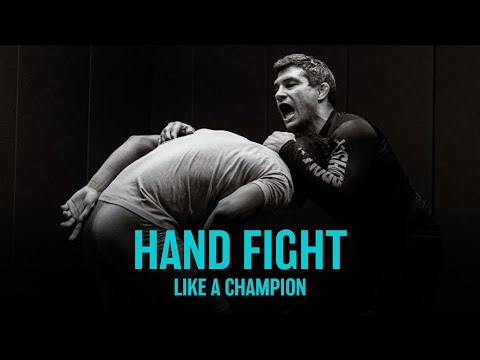
Hand fight and pummel like a pro!
0
Re-Pummel·JFLOJUDO
In this session, I dive into the art of hand fighting - breaking down key concepts that challenge and humble even the mo…
Translation: re-pummel
The Re-Pummel subfamily covers the technique of swimming the arm back inside after the opponent has secured an underhook, re-establishing inside position and denying the opponent their underhook control. [1] Re-pummelling is the fundamental action of the clinch fight — both fighters continuously attempt to establish and re-establish underhooks through pummelling exchanges. [1],[2] The re-pummel uses a swimming motion where the defending arm dips under the opponent's arm and drives back to inside position. [2],[3]
Re-pummeling re-establishes an underhook after losing it, a critical wrestling skill. [1]
Pummeling is fundamental in all wrestling and clinch-based arts. [1]
Used in wrestling, judo, and MMA competition. [1]
No images yet for this technique.
Sign in to suggest an image.
In this session, I dive into the art of hand fighting - breaking down key concepts that challenge and humble even the mo…
No instructional courses yet for this technique.
Sign in to suggest a course.
Risk of injury to the person this technique is applied to
Sprawls and stuffs involve sudden body weight displacement; knee/hip strain risk
Skill level needed to execute this technique reliably
Whether this technique is allowed under major competition rule sets
Boxing (Edwin Haislet, 1940)
Alias sources — [1] Wrestling Coaching Manual (USA Wrestling, 2015) [2] MMA Instruction Manual (Ryan & Snowden, 2010) [3] MMA Instruction Manual (Ryan & Snowden, 2010)
Effectiveness sources — [1] Wrestling Physical Conditioning Encyclopedia (Petrov, 1977)
Standard katakana transliteration of Western martial arts terminology (外来語) — used in Japanese MMA, boxing, and BJJ communities
Alias sources — [1] Wrestling Coaching Manual (USA Wrestling, 2015) [2] MMA Instruction Manual (Ryan & Snowden, 2010) [3] MMA Instruction Manual (Ryan & Snowden, 2010)
Effectiveness sources — [1] Wrestling Physical Conditioning Encyclopedia (Petrov, 1977)
reaction speed, structural body mechanics, defensive awareness
quick reflexes and conditioned defensive surfaces
varies — forearms (blocking), legs (movement), core (stability)
Every move, in any martial art, shares a few universal traits. Mix and match below to pinpoint the right tool — or compare equivalents across styles.
When threading, you're weaving in rather than coming to the outside, creating a different angle and control point in the hand fight.
Keep your front leg (whichever side that is, left or right) and turn in just a little to set up your position.
You can transition to an underhook by switching which hand you use—for example, using your right hand instead of your left hand—to access different control positions and movements.
The Re-Pummel subfamily covers the technique of swimming the arm back inside after the opponent has secured an underhook, re-establishing inside position and denying the opponent their underhook control. Re-pummelling is the fundamental action of the clinch fight — both fighters continuously attempt to establish and re-establish underhooks through pummelling exchanges.
Re-pummelling has been a fundamental wrestling skill since the sport's earliest days, with pummelling drills being among the most commonly practised exercises in wrestling training. The ability to re-pummel efficiently is considered a hallmark of skilled clinch fighters.
Unified MMA: legal — Legal defensive technique; IBJJF: legal — Legal — defensive techniques are fundamental to grappling; IJF: legal — Legal defensive action; ADCC: legal — Legal; UWW: legal — Legal defensive technique; FIAS Sport Sambo: legal — Legal
Danger rating 3/10. Moderate — sprawls and stuffs involve sudden body weight displacement; knee/hip strain risk
The standard setup chain: Anticipate the Attack → Execute Defence → Recover Stance → Counter or Disengage.
Standard counters include: Timing — attack when the defence is recovering or between movements / Feint — use deception to create openings in the defensive structure / Angle Change — attack from an unexpected angle that the defence does not cover.
Common variants: Standard defence (primary defensive technique from the most common position); Reactive defence (triggered by the opponent's attack, minimal movement for …); Proactive defence (anticipating the attack and positioning to neutralise it …); Counter defence (using the defensive movement to create an immediate count…).
Used in wrestling, judo, and MMA competition.
Top errors to watch for: Trying to pummel without dipping the shoulder — the shoulder dip creates the space; without it, the arm can't thread … / Re-pummelling too slowly — the re-pummel must be quick and explosive; slow pummelling lets the opponent consolidate / Pummelling with a stiff arm — the arm should swim fluidly, not push rigidly / Not using the hips during the re-pummel — a slight hip turn creates the space needed for the arm to swim inside.
The Re-Pummel is also known as Ripameru, Pummeling, Inside Fighting, Hand Fighting.