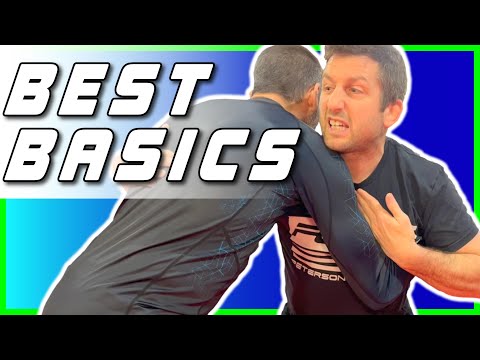
The BASIC Pummeling Drill Done RIGHT!
0
Standard Re-Pummel·TeachMeGrappling Coach Brian·Added by Admin
This video I work with the guys on the basic pummeling drill. Check out the details and you are sure to find something …
Translation: standard re-pummel
The Standard Re-Pummel executes the fundamental pummelling action by swimming the arm inside the opponent's underhook, driving the elbow down and the hand up through the gap between the opponent's arm and body, re-establishing inside position. [1] The re-pummel is performed with a combination of arm movement and body rotation — the defender turns the torso slightly to create space, then drives the arm through the gap while simultaneously pushing the opponent's arm to the outside. [1],[2] The standard re-pummel must be performed quickly and precisely, as the moment of transition creates a brief vulnerability. [2],[3]
Re-pummeling is the primary method of recovering underhook position after the opponent establishes one, and maintaining underhook advantage is considered one of the most important clinch battles in both wrestling and MMA. [1] The fighter who wins the underhook battle typically controls the clinch and determines whether a takedown occurs. [2]
Re-pummeling is a standard wrestling skill. [1]
No images yet for this technique.
Sign in to suggest an image.
This video I work with the guys on the basic pummeling drill. Check out the details and you are sure to find something …
No instructional courses yet for this technique.
Sign in to suggest a course.
Risk of injury to the person this technique is applied to
Sprawls and stuffs involve sudden body weight displacement; knee/hip strain risk
Skill level needed to execute this technique reliably
Whether this technique is allowed under major competition rule sets
Karate-Do Kyohan: The Master Text (Gichin Funakoshi, 1935)
Alias sources — [1] Wrestling Coaching Manual (USA Wrestling, 2015) [2] MMA Instruction Manual (Ryan & Snowden, 2010) [3] MMA Instruction Manual (Ryan & Snowden, 2010)
Effectiveness sources — [1] Wrestling Coaching Manual (USA Wrestling, 2015) [2] MMA Instruction Manual (Ryan & Snowden, 2010)
Standard katakana transliteration of Western martial arts terminology (外来語) — used in Japanese MMA, boxing, and BJJ communities
Alias sources — [1] Wrestling Coaching Manual (USA Wrestling, 2015) [2] MMA Instruction Manual (Ryan & Snowden, 2010) [3] MMA Instruction Manual (Ryan & Snowden, 2010)
Effectiveness sources — [1] Wrestling Coaching Manual (USA Wrestling, 2015) [2] MMA Instruction Manual (Ryan & Snowden, 2010)
reaction speed, structural body mechanics, defensive awareness
quick reflexes and conditioned defensive surfaces
varies — forearms (blocking), legs (movement), core (stability)
According to Coach Brian at TeachMeGrappling, the biggest mistake is taking your arms out during the drill. Instead, you should keep your arms in and swim your hand inside to establish proper contact and create that characteristic clapping sound between your shoulders and chest.
Coach Brian emphasizes listening for a clapping sound as you pummel—this auditory feedback indicates you're making proper contact with your partner's shoulders and chest. You should also keep your elbows from opening too wide and maintain steady pressure without taking your hands out.
Coach Brian teaches that there should be no friction during pummeling—instead, you're pushing into each other from your own feet and transferring energy. The movement comes from your legs and core, not from grinding your arms.
The Standard Re-Pummel executes the fundamental pummelling action by swimming the arm inside the opponent's underhook, driving the elbow down and the hand up through the gap between the opponent's arm and body, re-establishing inside position. The re-pummel is performed with a combination of arm movement and body rotation — the defender turns the torso slightly to create space, then drives the arm through the gap while simultaneously pushing the opponent's arm to the outside.
The standard re-pummel is one of the most fundamental wrestling techniques, practised in pummelling drills at every level of wrestling training from youth through Olympic competition. It is the foundational clinch defensive skill in all grappling arts.
Unified MMA: legal — Legal defensive technique; IBJJF: legal — Legal — defensive techniques are fundamental to grappling; IJF: legal — Legal defensive action; ADCC: legal — Legal; UWW: legal — Legal defensive technique; FIAS Sport Sambo: legal — Legal
Danger rating 3/10. Moderate — sprawls and stuffs involve sudden body weight displacement; knee/hip strain risk
The standard setup chain: Anticipate the Attack → Execute Defence → Recover Stance → Counter or Disengage.
Standard counters include: Timing — attack when the defence is recovering or between movements / Feint — use deception to create openings in the defensive structure / Angle Change — attack from an unexpected angle that the defence does not cover.
Common variants: Standard defence (primary defensive technique from the most common position); Reactive defence (triggered by the opponent's attack, minimal movement for …); Proactive defence (anticipating the attack and positioning to neutralise it …); Counter defence (using the defensive movement to create an immediate count…).
Re-pummeling is a standard wrestling skill.
Top errors to watch for: Threading the arm too high (over the shoulder) instead of under — the arm must go inside, not over / Not driving to depth after re-pummelling — a shallow re-pummel is easily countered; drive to the armpit / Dipping the wrong shoulder — dip the shoulder on the side you're re-pummelling, not the opposite side / Re-pummelling without using the hips — the hip turn aids the swim and makes the re-pummel more effective.
The Standard Re-Pummel is also known as Sutandādo Ripameru, Basic Pummel, Standard Inside Tie, Underhook Re-Entry.