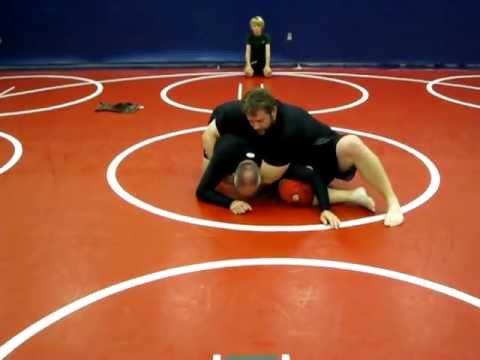
Modesto Grappling Club Instructional #50: Sprawl Control to Crucifix to Mata-Leo; Elbow Push Escape
0
Standard Quarter Sprawl·Modesto Judo Club·Added by Admin
Modesto Grappling Club Instructional #50: Sprawl Control to Crucifix to Mata-Leo
Translation: standard quarter sprawl
The Standard Quarter Sprawl kicks the attacked leg back and away from the opponent's grip while the opposite leg maintains its position for base. [1] The defender simultaneously drives the hip of the attacked leg backward while posting the hands on the attacker's back or shoulders, creating distance between the attacked leg and the opponent's hands. [1],[2] The standard quarter sprawl allows the defender to maintain one leg forward for balance and counter-offensive positioning. [2],[3]
The quarter sprawl defends against low single-leg shots by sprawling only one leg back (the attacked leg) while keeping the other foot planted, allowing the defender to maintain a better base than a full sprawl. [1] It is faster to execute than a full sprawl because only one hip needs to move, making it effective against fast single-leg entries. [2]
The quarter sprawl is a wrestling-specific defensive technique taught as part of the single-leg takedown defence curriculum in American folkstyle and freestyle wrestling. [1]
The quarter sprawl is a standard wrestling defence. [1]
No images yet for this technique.
Sign in to suggest an image.
Modesto Grappling Club Instructional #50: Sprawl Control to Crucifix to Mata-Leo
No instructional courses yet for this technique.
Sign in to suggest a course.
Risk of injury to the person this technique is applied to
Sprawls and stuffs involve sudden body weight displacement; knee/hip strain risk
Skill level needed to execute this technique reliably
Whether this technique is allowed under major competition rule sets
Freestyle Wrestling: A Complete Guide for Coaches and Wrestlers (Petrov, 1977)
Alias sources — [1] Wrestling Coaching Manual (USA Wrestling, 2015) [2] MMA Instruction Manual (Ryan & Snowden, 2010) [3] MMA Instruction Manual (Ryan & Snowden, 2010)
Effectiveness sources — [1] Wrestling Coaching Manual (USA Wrestling, 2015) [2] MMA Instruction Manual (Ryan & Snowden, 2010)
Standard katakana transliteration of Western martial arts terminology (外来語) — used in Japanese MMA, boxing, and BJJ communities
Alias sources — [1] Wrestling Coaching Manual (USA Wrestling, 2015) [2] MMA Instruction Manual (Ryan & Snowden, 2010) [3] MMA Instruction Manual (Ryan & Snowden, 2010)
Effectiveness sources — [1] Wrestling Coaching Manual (USA Wrestling, 2015) [2] MMA Instruction Manual (Ryan & Snowden, 2010)
reaction speed, explosive hip extension, downward driving force
long legs for quick sprawl, heavy upper body
hip extensors, glutes, core, shoulders (dead weight)
You want to control the bicep and shoulder of your opponent. If your opponent locks their arm in, you'll be in the worst position possible, so bicep and shoulder control is critical to maintain the technique.
Make sure your arm positioning is correct—if your arm isn't properly extended, your opponent will be able to continue scooting. The angle and extension of your controlling arm determines whether you can shut down their escape.
Don't let your controlling arm stay back near your hip or you'll lose the technique entirely. Keep your arm extended and active rather than passive or retracted.
The Standard Quarter Sprawl kicks the attacked leg back and away from the opponent's grip while the opposite leg maintains its position for base. The defender simultaneously drives the hip of the attacked leg backward while posting the hands on the attacker's back or shoulders, creating distance between the attacked leg and the opponent's hands.
The standard quarter sprawl is a fundamental wrestling defensive technique taught as the primary single-leg defence at all levels of competition. Its targeted defence of the attacked leg makes it the most common initial response to single-leg takedown attempts.
Unified MMA: legal — Legal defensive technique; IBJJF: legal — Legal — defensive techniques are fundamental to grappling; IJF: legal — Legal defensive action; ADCC: legal — Legal; UWW: legal — Legal defensive technique; FIAS Sport Sambo: legal — Legal
Danger rating 3/10. Moderate — sprawls and stuffs involve sudden body weight displacement; knee/hip strain risk
The standard setup chain: Recognize the Shot → Hips Back → Drive Weight Down → Establish Front Headlock or Scramble.
Standard counters include: Snap Down — use the sprawl momentum to redirect into a front headlock / Fake Shot to Go-Behind — fake the takedown to draw the sprawl then circle behind / Ankle Pick — attack the far ankle while the opponent is sprawled and weight-forward.
Common variants: Full sprawl (both legs kicked back, hips dropped to the mat); Half sprawl (one leg back while the other posts for balance); Sprawl to front headlock (sprawling and immediately securing head control).
The quarter sprawl is a standard wrestling defence.
Top errors to watch for: Dropping both hips for what should be a quarter sprawl — one hip drops, the other stays relatively stable / Not posting the hand on the opponent's head — without hand control, the opponent can re-angle and continue the shot / Quarter-sprawling but stepping backward — the hip drops back, the feet don't retreat; maintain your ground / Using the quarter sprawl against a deep penetration shot — recognize when you need to upgrade to a full sprawl.
The Standard Quarter Sprawl is also known as Sutandādo Kwōtā Supurōru, Basic Quarter Sprawl, Partial Hip Drop, Short Sprawl.