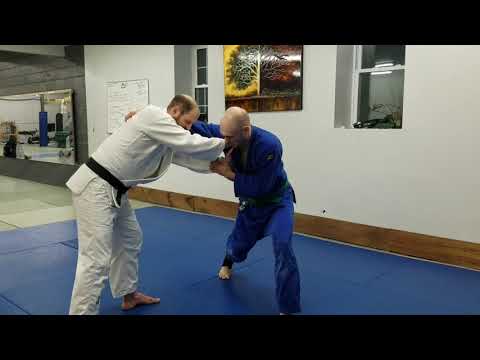
Breaking the two on one grip
0
Standard Two-On-One Grip Break·Rochester Judo·Added by Admin
Translation: standard two-on-one grip break
The Standard Two-On-One Grip Break grips the opponent's wrist with one hand and their fingers with the other, then peels the grip open by pulling the fingers in the direction opposite to their curl while simultaneously pushing the wrist away. [1] The break is performed in a sharp, explosive motion rather than a gradual pull, as the sudden force is more effective at overcoming grip strength. [1],[2] The standard two-on-one break always peels toward the thumb side of the opponent's grip, as the thumb is the weakest point of any grip. [2],[3]
The two-on-one grip break is the most fundamental and reliable grip-breaking method, using both hands to peel one of the opponent's hands off a grip, creating a numerical advantage (2 vs 1) that makes it nearly impossible for the opponent to maintain control. [1] It is effective against both gi and no-gi grips and is the standard grip-breaking methodology in BJJ, judo, and wrestling. [2]
The two-on-one grip break is a universal grappling concept taught across judo (kumi-kata), wrestling, and BJJ, forming the basis of all grip-fighting systems. [1]
The two-on-one grip break is a standard judo technique. [1]
No images yet for this technique.
Sign in to suggest an image.
No instructional courses yet for this technique.
Sign in to suggest a course.
Risk of injury to the person this technique is applied to
Submission defence involves resisting joint locks/chokes; risk of injury if defence fails or is delayed
Skill level needed to execute this technique reliably
Whether this technique is allowed under major competition rule sets
Kodokan Judo (Jigoro Kano, 1986)
Alias sources — [1] Jiu-Jitsu University (Ribeiro, 2008) [2] Fundamentals of Brazilian Jiu-Jitsu (Danaher, 2012) [3] Brazilian Jiu-Jitsu: Theory and Technique (Gracie, 2001)
Effectiveness sources — [1] Jiu-Jitsu University (Ribeiro, 2008) [2] Kodokan Judo (Kano, 1986)
Mixed Japanese-Western terminology — combines traditional Japanese terms with katakana loanwords
Alias sources — [1] Jiu-Jitsu University (Ribeiro, 2008) [2] Fundamentals of Brazilian Jiu-Jitsu (Danaher, 2012) [3] Brazilian Jiu-Jitsu: Theory and Technique (Gracie, 2001)
Effectiveness sources — [1] Jiu-Jitsu University (Ribeiro, 2008) [2] Kodokan Judo (Kano, 1986)
grip fighting technique, forearm endurance, timing
strong hands and forearms, quick stripping motions
forearm flexors/extensors, wrist rotators, biceps
The worst thing you can do is bend over with your opponent as they try to break you down. If you collapse your posture, you lose the ability to create an inside frame with your arms or head, and you'll stay stuck in the position until they throw you.
Speed is critical—as soon as you feel them breaking you down, immediately create an inside frame on their shoulder or head, square up your body, and keep your feet away from them. You must maintain head pressure to prevent them from ducking under for a single-leg takedown.
Don't walk backward in the direction of your opponent's throat, especially if they still have control of your arm—this puts you in danger of a hip throw. Instead, stay square and only move once you're ready to attack yourself.
Maintaining posture allows you to reframe and square up with your opponent; once your posture breaks down, you lose the ability to defend properly and regain control of the position.
The Standard Two-On-One Grip Break grips the opponent's wrist with one hand and their fingers with the other, then peels the grip open by pulling the fingers in the direction opposite to their curl while simultaneously pushing the wrist away. The break is performed in a sharp, explosive motion rather than a gradual pull, as the sudden force is more effective at overcoming grip strength.
The standard two-on-one grip break is a universal grappling technique found in judo, BJJ, wrestling, and MMA, representing the most basic and effective method of manually breaking an opponent's grip. It is one of the first defensive techniques taught in gi-based grappling arts.
Unified MMA: legal — Legal defensive technique; IBJJF: legal — Legal — defensive techniques are fundamental to grappling; IJF: legal — Legal defensive action; ADCC: legal — Legal; UWW: legal — Legal defensive technique; FIAS Sport Sambo: legal — Legal
Danger rating 3/10. Moderate — submission defence involves resisting joint locks/chokes; risk of injury if defence fails or is delayed
The standard setup chain: Anticipate the Attack → Execute Defence → Recover Stance → Counter or Disengage.
Standard counters include: Timing — attack when the defence is recovering or between movements / Feint — use deception to create openings in the defensive structure / Angle Change — attack from an unexpected angle that the defence does not cover.
Common variants: Standard defence (primary defensive technique from the most common position); Reactive defence (triggered by the opponent's attack, minimal movement for …); Proactive defence (anticipating the attack and positioning to neutralise it …); Counter defence (using the defensive movement to create an immediate count…).
The two-on-one grip break is a standard judo technique.
Top errors to watch for: Gripping the forearm instead of the wrist — the wrist is thinner and gives better control for the break / Peeling linearly instead of circularly — circular motion is mechanically stronger against any grip shape / Using both hands on the same spot (stacked) — separate the hands: one on wrist, one on fingers / Not transitioning after breaking — the grip break is not the goal; the positional improvement is.
The Standard Two-On-One Grip Break is also known as Sutandādo Ni-tai-Ichi Kirite, Basic Two-On-One Break, Standard Double Strip, Two-Hand Peel.