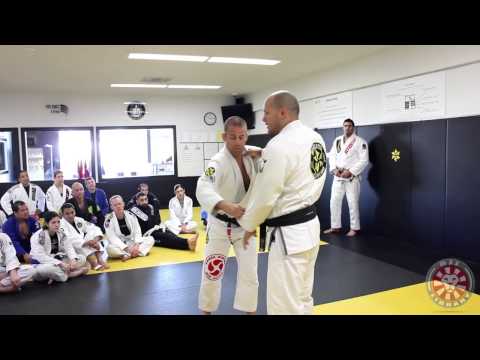
Xande Ribeiro - One Handed Grip Break (Y Grip Break)
0
Two-On-One Grip Break·BJJLibrary
Get instant access to the BJJ Roadmap for White and Blue belts at: http://www.bjjlibrary.com Come train BJJ in San Diego…
Translation: two-on-one grip break
The Two-On-One Grip Break subfamily covers grip breaking techniques where the defender uses both hands against one of the opponent's gripping hands, creating a two-against-one mechanical advantage to strip the grip. [1] The two-on-one grip break is the most reliable manual grip breaking method because it concentrates the defender's full hand and arm strength against a single grip. [1],[2] The technique involves gripping the opponent's wrist with one hand and their fingers with the other, then peeling the grip off in the direction that opposes the finger curl. [2],[3]
The two-on-one grip break uses both hands to strip a single grip. [1]
A fundamental judo and BJJ grip-fighting technique. [1]
Used in judo and BJJ competition. [1]
No images yet for this technique.
Sign in to suggest an image.
Get instant access to the BJJ Roadmap for White and Blue belts at: http://www.bjjlibrary.com Come train BJJ in San Diego…
No instructional courses yet for this technique.
Sign in to suggest a course.
Risk of injury to the person this technique is applied to
Submission defence involves resisting joint locks/chokes; risk of injury if defence fails or is delayed
Skill level needed to execute this technique reliably
Whether this technique is allowed under major competition rule sets
Boxing (Edwin Haislet, 1940)
Alias sources — [1] Jiu-Jitsu University (Ribeiro, 2008) [2] Fundamentals of Brazilian Jiu-Jitsu (Danaher, 2012) [3] Brazilian Jiu-Jitsu: Theory and Technique (Gracie, 2001)
Effectiveness sources — [1] Kodokan Judo (Kano, 1986)
Official karate technique names (和語/漢語)
Established Japanese martial arts naming convention — native Japanese term (和語/漢語)
Alias sources — [1] Jiu-Jitsu University (Ribeiro, 2008) [2] Fundamentals of Brazilian Jiu-Jitsu (Danaher, 2012) [3] Brazilian Jiu-Jitsu: Theory and Technique (Gracie, 2001)
Effectiveness sources — [1] Kodokan Judo (Kano, 1986)
grip fighting technique, forearm endurance, timing
strong hands and forearms, quick stripping motions
forearm flexors/extensors, wrist rotators, biceps
Every move, in any martial art, shares a few universal traits. Mix and match below to pinpoint the right tool — or compare equivalents across styles.
According to Xande Ribeiro, not all grips are equally important to break—focus on breaking the critical grip rather than wasting energy on less threatening ones.
Xande Ribeiro teaches a method using palm placement with elbow in to create a frame, then driving the hip in to generate the break—combining structural framing with body weight pressure.
Once you break the grip, immediately establish your own control by making a grip and pulling to a dominant position, such as going for the elbow or moving to the side—this prevents your opponent from re-gripping.
The Two-On-One Grip Break subfamily covers grip breaking techniques where the defender uses both hands against one of the opponent's gripping hands, creating a two-against-one mechanical advantage to strip the grip. The two-on-one grip break is the most reliable manual grip breaking method because it concentrates the defender's full hand and arm strength against a single grip.
The two-on-one grip break is a fundamental technique in judo's kumi-kata system and has been part of grip fighting methodology since these techniques were systematised. It is universally taught across judo, BJJ, and MMA as the primary manual grip breaking method.
Unified MMA: legal — Legal defensive technique; IBJJF: legal — Legal — defensive techniques are fundamental to grappling; IJF: legal — Legal defensive action; ADCC: legal — Legal; UWW: legal — Legal defensive technique; FIAS Sport Sambo: legal — Legal
Danger rating 3/10. Moderate — submission defence involves resisting joint locks/chokes; risk of injury if defence fails or is delayed
The standard setup chain: Anticipate the Attack → Execute Defence → Recover Stance → Counter or Disengage.
Standard counters include: Timing — attack when the defence is recovering or between movements / Feint — use deception to create openings in the defensive structure / Angle Change — attack from an unexpected angle that the defence does not cover.
Common variants: Standard defence (primary defensive technique from the most common position); Reactive defence (triggered by the opponent's attack, minimal movement for …); Proactive defence (anticipating the attack and positioning to neutralise it …); Counter defence (using the defensive movement to create an immediate count…).
Used in judo and BJJ competition.
Top errors to watch for: Using the two-on-one but pulling straight away instead of toward the thumb — direction matters more than force / Maintaining the two-on-one hold after breaking instead of transitioning — break and immediately reposition / Breaking grips while flat on your back — combine the grip break with hip movement for positional escape / Using the two-on-one against a body-lock grip — body locks require different breaks (underhooking, hip pressure).
The Two-On-One Grip Break is also known as Ni-tai-Ichi Kirite, Two-On-One Strip, Double Hand Grip Break, Two Hands On One.