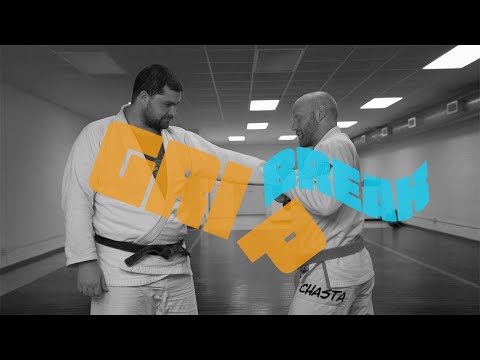
Breaking the Collar Grip
0
Grip Breaking·Augusta Jiu-Jitsu Academy
Here is a nice, quick fundamental for Friday. Getting grips is critically important. BREAKING those grips is crucial as …
Translation: grip breaking
The Grip Breaking family covers defensive techniques focused on breaking or stripping the opponent's grips to prevent submission setups, guard controls, and positional dominance. [1] Grip breaking is a proactive defensive approach that addresses submissions at their earliest stage — before the submission is applied, and even before the opponent achieves the position for a submission attempt. [1],[2] By denying the opponent the grips they need, the defender prevents entire chains of attacks from being initiated. [2],[3]
Grip breaking has been a fundamental skill in judo since kumi-kata (grip fighting) became recognised as a tactical discipline within the sport. [1] BJJ adopted and expanded grip breaking techniques, and the IJF's grip-related rule changes over the decades have driven continuous innovation in grip breaking methodology. [2],[3]
Grip breaking (kumi-kata) is fundamental in judo and gi BJJ. [1]
Grip fighting is one of the most important skills in judo competition. [1]
No images yet for this technique.
Sign in to suggest an image.
Here is a nice, quick fundamental for Friday. Getting grips is critically important. BREAKING those grips is crucial as …
No instructional courses yet for this technique.
Sign in to suggest a course.
Risk of injury to the person this technique is applied to
Submission defence involves resisting joint locks/chokes; risk of injury if defence fails or is delayed
Skill level needed to execute this technique reliably
Whether this technique is allowed under major competition rule sets
Boxing (Edwin Haislet, 1940)
Alias sources — [1] Kodokan Judo (Kano, 1986) [2] Jiu-Jitsu University (Ribeiro, 2008) [3] Kodokan Judo (Kano, 1986)
Effectiveness sources — [1] Kodokan Judo (Kano, 1986) [2] Jiu-Jitsu University (Ribeiro, 2008)
Official karate technique names (和語/漢語)
Established Japanese martial arts naming convention — native Japanese term (和語/漢語)
Alias sources — [1] Kodokan Judo (Kano, 1986) [2] Jiu-Jitsu University (Ribeiro, 2008) [3] Kodokan Judo (Kano, 1986)
Effectiveness sources — [1] Kodokan Judo (Kano, 1986) [2] Jiu-Jitsu University (Ribeiro, 2008)
grip fighting technique, forearm endurance, timing
strong hands and forearms, quick stripping motions
forearm flexors/extensors, wrist rotators, biceps
Every move, in any martial art, shares a few universal traits. Mix and match below to pinpoint the right tool — or compare equivalents across styles.
The Posture Break subfamily covers grip breaking techniques that deny or break the opponent's grips by using postural changes — standing up, posturing the spine upright, or changing the angle of the body — to make the grip mechanically unsustainable. [1] Posture-based grip breaking uses the strength of the legs and core to overpower the opponent's grip strength, as the large muscles of the lower body can generate far more force than the opponent's hands and forearms. [1,2] This approach is particularly effective against collar grips and sleeve grips in the gi, where posturing away from the opponent strips the grip through distance. [2,3]
The Two-On-One Grip Break subfamily covers grip breaking techniques where the defender uses both hands against one of the opponent's gripping hands, creating a two-against-one mechanical advantage to strip the grip. [1] The two-on-one grip break is the most reliable manual grip breaking method because it concentrates the defender's full hand and arm strength against a single grip. [1,2] The technique involves gripping the opponent's wrist with one hand and their fingers with the other, then peeling the grip off in the direction that opposes the finger curl. [2,3]
Grip breaking — stripping the opponent's grips on the gi — is a specialized skill in judo and gi BJJ. The IJF enforces a 5-second grip-breaking rule: if neither fighter attacks within 5 seconds of establishing grips, the referee may penalize. In BJJ, grip fighting determines who controls the pace. (IJF Sport and Organisation Rules 2025; judo coaching manuals)
Match the meat of your thumb against the meat of your opponent's thumb, then align your entire thumb against theirs for maximum leverage and control.
If your opponent is hanging on too tight, the grip break may not work—not because the technique is flawed, but because excessive grip tension can prevent the break from being applied effectively.
The Grip Breaking family covers defensive techniques focused on breaking or stripping the opponent's grips to prevent submission setups, guard controls, and positional dominance. Grip breaking is a proactive defensive approach that addresses submissions at their earliest stage — before the submission is applied, and even before the opponent achieves the position for a submission attempt.
Grip breaking has been a fundamental skill in judo since kumi-kata (grip fighting) became recognised as a tactical discipline within the sport. BJJ adopted and expanded grip breaking techniques, and the IJF's grip-related rule changes over the decades have driven continuous innovation in grip breaking methodology.
Unified MMA: legal — Legal defensive technique; IBJJF: legal — Legal — defensive techniques are fundamental to grappling; IJF: legal — Legal defensive action; ADCC: legal — Legal; UWW: legal — Legal defensive technique; FIAS Sport Sambo: legal — Legal
Danger rating 3/10. Moderate — submission defence involves resisting joint locks/chokes; risk of injury if defence fails or is delayed
The standard setup chain: Anticipate the Attack → Execute Defence → Recover Stance → Counter or Disengage.
Standard counters include: Timing — attack when the defence is recovering or between movements / Feint — use deception to create openings in the defensive structure / Angle Change — attack from an unexpected angle that the defence does not cover.
Common variants: Standard defence (primary defensive technique from the most common position); Reactive defence (triggered by the opponent's attack, minimal movement for …); Proactive defence (anticipating the attack and positioning to neutralise it …); Counter defence (using the defensive movement to create an immediate count…).
Grip fighting is one of the most important skills in judo competition.
Top errors to watch for: Trying to break grips by pulling straight away — always break toward the thumb in a circular motion / Using one hand to break a two-handed grip — you need mechanical advantage; use two hands against one / Ignoring grips until the submission is being applied — break grips proactively, not reactively / Breaking the grip but not immediately repositioning — if you break and stay still, the opponent will simply re-grip.
The Grip Breaking is also known as Kirite, Grip Strip, Grip Peel, Grip Fighting.