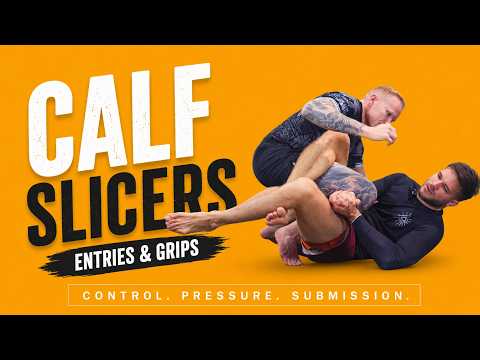
Calf SLICERS from everywhere!
0
Standard Calf Slicer Defence·Energia Martial Arts·Added by Admin
Calf SLICERS from everywhere! By now you must know how much I love leglocks! The calf slicer is no exception! It amazes …
Translation: standard calf slicer defence
The Standard Calf Slicer Defence works to extend the leg and remove the knee from the folded position that creates the compression. [1] The defender pushes against the attacker's leg or hip to create space, then works to straighten the knee and extract the calf from behind the fulcrum. [1],[2] If the calf slicer is combined with leg entanglement, the defender must address both the compression and the entanglement, typically by clearing the legs before extending. [2],[3]
The standard calf slicer defence prevents the compression. [1]
A BJJ defence. [1]
Used in BJJ competition. [1]
No images yet for this technique.
Sign in to suggest an image.
Calf SLICERS from everywhere! By now you must know how much I love leglocks! The calf slicer is no exception! It amazes …
No instructional courses yet for this technique.
Sign in to suggest a course.
Risk of injury to the person this technique is applied to
Submission defence involves resisting joint locks/chokes; risk of injury if defence fails or is delayed
Skill level needed to execute this technique reliably
Whether this technique is allowed under major competition rule sets
Jiu-Jitsu University (Saulo Ribeiro, 2008)
Alias sources — [1] Jiu-Jitsu University (Ribeiro, 2008) [2] Fundamentals of Brazilian Jiu-Jitsu (Danaher, 2012) [3] Brazilian Jiu-Jitsu: Theory and Technique (Gracie, 2001)
Effectiveness sources — [1] Jiu-Jitsu University (Ribeiro, 2008)
Standard katakana transliteration of Western martial arts terminology (外来語) — used in Japanese MMA, boxing, and BJJ communities
Alias sources — [1] Jiu-Jitsu University (Ribeiro, 2008) [2] Fundamentals of Brazilian Jiu-Jitsu (Danaher, 2012) [3] Brazilian Jiu-Jitsu: Theory and Technique (Gracie, 2001)
Effectiveness sources — [1] Jiu-Jitsu University (Ribeiro, 2008)
reaction speed, structural body mechanics, defensive awareness
quick reflexes and conditioned defensive surfaces
varies — forearms (blocking), legs (movement), core (stability)
Keep your hips forward as you fall into the submission. If you fall back, there's too much space between the opponent's heel and hips, making it very hard to close your legs and achieve a proper configuration. Staying forward with your hips ensures the leg is trapped and difficult for them to extend.
Instead of just pulling with your hands, attach yourself to the knee and fall with the entire force of your back and body while your hip scoots forward. This generates much more pressure than hand strength alone and is what creates a real tap in rolling.
Keep the sharp part of your shin facing toward your opponent's knee with your toes pointed that direction, then place your other foot on top to push into the knee rather than curling down. This pushing method is stronger and more effective than the triangle leg configuration.
When your partner commits to the leg drag pass and squats in, enter with either your inside or outside arm to catch the same triangle configuration as you would from other positions.
The Standard Calf Slicer Defence works to extend the leg and remove the knee from the folded position that creates the compression. The defender pushes against the attacker's leg or hip to create space, then works to straighten the knee and extract the calf from behind the fulcrum.
The standard calf slicer defence developed through competitive grappling as calf slicers became more common in both gi and no-gi competition. It is now included in most advanced BJJ and submission grappling defence curricula.
Unified MMA: legal — Legal defensive technique; IBJJF: legal — Legal — defensive techniques are fundamental to grappling; IJF: legal — Legal defensive action; ADCC: legal — Legal; UWW: legal — Legal defensive technique; FIAS Sport Sambo: legal — Legal
Danger rating 3/10. Moderate — submission defence involves resisting joint locks/chokes; risk of injury if defence fails or is delayed
The standard setup chain: Anticipate the Attack → Execute Defence → Recover Stance → Counter or Disengage.
Standard counters include: Timing — attack when the defence is recovering or between movements / Feint — use deception to create openings in the defensive structure / Angle Change — attack from an unexpected angle that the defence does not cover.
Common variants: Standard defence (primary defensive technique from the most common position); Reactive defence (triggered by the opponent's attack, minimal movement for …); Proactive defence (anticipating the attack and positioning to neutralise it …); Counter defence (using the defensive movement to create an immediate count…).
Used in BJJ competition.
Top errors to watch for: Focusing only on straightening the leg without pushing the hips — the opponent will close distance and re-compress / Leaving the heel exposed while defending — transition to heel hook is the primary secondary threat / Not clearing the entanglement after relieving pressure — the opponent will re-attack immediately / Using both hands on the leg instead of the hips — hip control gives better leverage for creating space.
The Standard Calf Slicer Defence is also known as Sutandādo Kāfu Suraisā Difensu, Basic Calf Slicer Defence, Standard Leg Crush Escape, Calf Compression Escape.