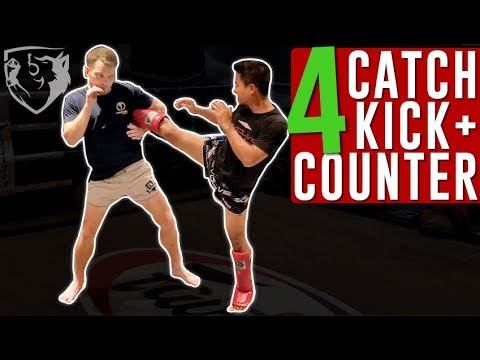
4 Ways to Catch and Counter (Roundhouse Kick)
0
Standard Kick Catch·fightTIPS·Added by Admin
On my trip to Evolve MMA in Singapore, I had a session with 2x Rajadamnern Muay Thai champion, Kru Day (Palangpol Petchy…
Translation: standard kick catch
The Standard Kick Catch intercepts an incoming round kick by scooping the kicking leg with the lead or rear arm, trapping the shin or ankle against the body while the other hand controls the opponent's body or posture. [1] The catch is executed by absorbing the kick's impact on the forearm and immediately wrapping the arm around the shin, pulling the leg tight against the body to trap it. [1],[2] From the catch position, the defender can execute foot sweeps on the opponent's standing leg, single-leg takedowns, or strikes to the trapped opponent. [2],[3]
The kick catch is highly effective in Muay Thai and MMA, allowing the defender to trap the opponent's kicking leg and immediately counter with sweeps, trips, or strikes while the opponent is on one leg. [1] In Muay Thai, catching the kick and sweeping the standing leg is a classic scoring combination. [2] The risk is that a missed catch leaves the defender's body exposed to the kick's impact. [1]
The kick catch is a fundamental Muay Thai technique that has been integral to Thai boxing since its earliest documented forms, with catching and dumping being a primary method of demonstrating dominance in Muay Thai scoring. [1]
Saenchai PKSaenchaimuaythaigym is renowned for his kick catches into sweeps and dumps, a technique that contributed to his four Lumpinee Stadium titles across multiple weight classes. [1]
No images yet for this technique.
Sign in to suggest an image.
On my trip to Evolve MMA in Singapore, I had a session with 2x Rajadamnern Muay Thai champion, Kru Day (Palangpol Petchy…
No instructional courses yet for this technique.
Sign in to suggest a course.
Risk of injury to the person this technique is applied to
Blocking and parrying absorb strike force; hand/forearm injury from repeated blocking
Skill level needed to execute this technique reliably
Whether this technique is allowed under major competition rule sets
Boxing (Edwin Haislet, 1940)
Alias sources — [1] Muay Thai: The Most Distinguished Art of Fighting (Kraitus, 1988) [2] MMA Instruction Manual (Ryan & Snowden, 2010) [3] MMA Instruction Manual (Ryan & Snowden, 2010)
Effectiveness sources — [1] Muay Thai: The Most Distinguished Art of Fighting (Kraitus, 1988) [2] Muay Thai Counters (Delp, 2005)
Standard katakana transliteration of Western martial arts terminology (外来語) — used in Japanese MMA, boxing, and BJJ communities
Alias sources — [1] Muay Thai: The Most Distinguished Art of Fighting (Kraitus, 1988) [2] MMA Instruction Manual (Ryan & Snowden, 2010) [3] MMA Instruction Manual (Ryan & Snowden, 2010)
Effectiveness sources — [1] Muay Thai: The Most Distinguished Art of Fighting (Kraitus, 1988) [2] Muay Thai Counters (Delp, 2005)
hand-eye coordination, quick reflexes, precise hand placement
fast hands, good reaction time
deltoids, forearms, core (for counter-rotation readiness)
According to fightTIPS instructor Crew Day, you must move with the kick by stepping to the side as you catch it, which takes the power off the strike. Then hold the caught kick tight and airtight in your armpit—if your grip is loose, your opponent can yank their foot free and create space.
Step back to create space, then swing the caught leg through to put your opponent in a compromised position before landing your own counter roundhouse kick. Crew Day emphasizes the importance of stepping your rear leg back first to clear the legs and generate proper power for the counter.
Step forward as you catch the kick, then lift the leg high while pushing to really knock them off balance. After the lift and push, stay in the fight and chase them down to land your counter—don't create too much distance or you'll be out of range to follow up.
Step directly forward without turning your body, hook low around the ankle, push on the head with your opposite hand to create leverage, and sweep the support leg out using the arch or inside of your foot. Keep your lower body strong and don't rotate with them—the push on the head and the lift of the caught leg do most of the work before the sweep finishes them.
The Standard Kick Catch intercepts an incoming round kick by scooping the kicking leg with the lead or rear arm, trapping the shin or ankle against the body while the other hand controls the opponent's body or posture. The catch is executed by absorbing the kick's impact on the forearm and immediately wrapping the arm around the shin, pulling the leg tight against the body to trap it.
The standard kick catch is a fundamental Muay Thai defensive technique that has been practised for centuries in Thai boxing. The catch-and-sweep combination is one of the most iconic defensive sequences in Muay Thai competition.
Unified MMA: legal — Legal defensive technique; IBJJF: legal — Legal; IJF: legal — Legal defensive action; WBC/Boxing: legal — Legal; WKF: legal — Legal; WT: legal — Legal
Danger rating 3/10. Moderate — blocking and parrying absorb strike force; hand/forearm injury from repeated blocking
The standard setup chain: Anticipate the Attack → Execute Defence → Recover Stance → Counter or Disengage.
Standard counters include: Timing — attack when the defence is recovering or between movements / Feint — use deception to create openings in the defensive structure / Angle Change — attack from an unexpected angle that the defence does not cover.
Common variants: Inside parry (deflecting the punch to the inside (toward the centre line)); Outside parry (deflecting the punch to the outside (away from the centre…); Catch parry (catching the punch in the open hand for a brief control m…).
Saenchai PKSaenchaimuaythaigym is renowned for his kick catches into sweeps and dumps, a technique that contributed to his four Lumpinee Stadium titles across multiple weight classes.
Top errors to watch for: Catching too high on the thigh — aim for the shin or ankle area for better leverage / Not stepping in after the catch — you need to close distance to threaten the standing leg / Holding the leg at arm's length — pin it against your body for control / Attempting to catch front kicks (teeps) the same way — teeps are straight; round kick catches work on the circular path.
The Standard Kick Catch is also known as Sutandādo Kikku Kyacchi, Basic Kick Catch, Standard Leg Catch, Round Kick Catch.