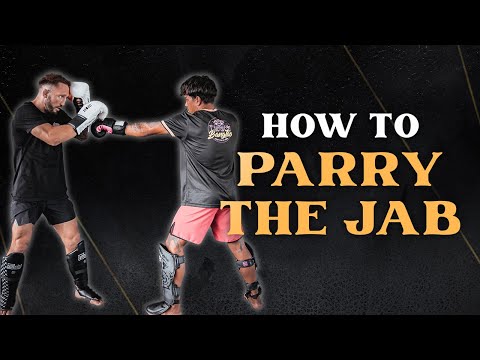
How to Parry as an Orthodox Fighter
0
Outside Jab Parry·Brad Riddell - Student of the Fight Game·Added by Admin
One of the most overlooked aspects of fundamental jab defence is the parry. In today's video I go over details of the pa…
Translation: outside jab parry
The Outside Jab Parry uses the lead hand to push the incoming jab outward, away from the defender's face and toward the outside, deflecting the punch past the defender's lead shoulder. [1] The outside parry turns the opponent's lead shoulder inward, closing their guard and limiting their follow-up options while creating an angle for the defender's jab or lead hook counter. [1],[2] The outside jab parry is less common than the inside parry but creates unique counter-attacking angles. [2],[3]
The outside jab parry deflects the jab to the outside. [1]
Used in boxing competition. [1]
No images yet for this technique.
Sign in to suggest an image.
One of the most overlooked aspects of fundamental jab defence is the parry. In today's video I go over details of the pa…
No instructional courses yet for this technique.
Sign in to suggest a course.
Risk of injury to the person this technique is applied to
Blocking and parrying absorb strike force; hand/forearm injury from repeated blocking
Skill level needed to execute this technique reliably
Whether this technique is allowed under major competition rule sets
Boxing (Edwin Haislet, 1940)
Alias sources — [1] Championship Fighting (Dempsey, 1950) [2] Boxing Mastery (Hatmaker, 2004) [3] Fighter's Fact Book (Christensen, 2000)
Effectiveness sources — [1] Championship Fighting (Dempsey, 1950) [2] Boxing Mastery (Hatmaker, 2004)
Standard katakana transliteration of Western martial arts terminology (外来語) — used in Japanese MMA, boxing, and BJJ communities
Alias sources — [1] Championship Fighting (Dempsey, 1950) [2] Boxing Mastery (Hatmaker, 2004) [3] Fighter's Fact Book (Christensen, 2000)
Effectiveness sources — [1] Championship Fighting (Dempsey, 1950) [2] Boxing Mastery (Hatmaker, 2004)
hand-eye coordination, quick reflexes, precise hand placement
fast hands, good reaction time
deltoids, forearms, core (for counter-rotation readiness)
Brad Riddell recommends using your rear hand to parry the jab. This is a key fundamental to remember when both fighters are in an orthodox stance.
Brad Riddell warns against reaching out with a large, obvious parrying motion, as opponents can read this habit, fake the jab, and slip around the side while you miss. Instead, use minimal wrist movement and move your head to the side.
Brad Riddell emphasizes using just your wrist, not your entire arm, especially when the jab comes at high velocity. This keeps the parry tight and efficient.
Brad Riddell explains that instead of pausing after the parry, you should turn your back heel and drive your hip forward as you launch your counter, rather than trying to pump or generate power separately after the parry.
The Outside Jab Parry uses the lead hand to push the incoming jab outward, away from the defender's face and toward the outside, deflecting the punch past the defender's lead shoulder. The outside parry turns the opponent's lead shoulder inward, closing their guard and limiting their follow-up options while creating an angle for the defender's jab or lead hook counter.
The outside jab parry is a traditional boxing defensive technique that complements the inside parry, providing an alternative deflection angle when the inside parry is anticipated. It is taught as part of the complete parrying system in boxing training.
Unified MMA: legal — Legal defensive technique; WBC/Boxing: legal — Legal — blocking and evasion are core boxing skills; WKF: legal — Legal — blocking is a fundamental karate skill; Kyokushin: legal — Legal; WT: legal — Legal; WAKO: legal — Legal; K: legal — 1/GLORY — Legal; IFMA: legal — Legal
Danger rating 3/10. Moderate — blocking and parrying absorb strike force; hand/forearm injury from repeated blocking
The standard setup chain: Anticipate the Attack → Execute Defence → Recover Stance → Counter or Disengage.
Standard counters include: Feint — fake an attack to draw out the block then strike the opening / Level Change — switch attack levels to go around the blocking defence / Combination — throw multiple strikes to overwhelm the single defensive response.
Common variants: Inside parry (deflecting the punch to the inside (toward the centre line)); Outside parry (deflecting the punch to the outside (away from the centre…); Catch parry (catching the punch in the open hand for a brief control m…).
Used in boxing competition.
Top errors to watch for: Pushing the jab too far out — a small outward tap is sufficient; over-parrying opens your own guard / Using the lead hand parry without maintaining chin protection — tuck the chin behind the lead shoulder / Not following the parry with an immediate counter — the centre is open; strike through it / Parrying with a straight arm — keep the elbow bent; the parry is a wrist/hand action, not an arm sweep.
The Outside Jab Parry is also known as Autosaido Jabu Parī, Outside Pat, Outward Jab Deflection, Lead Hand Parry.