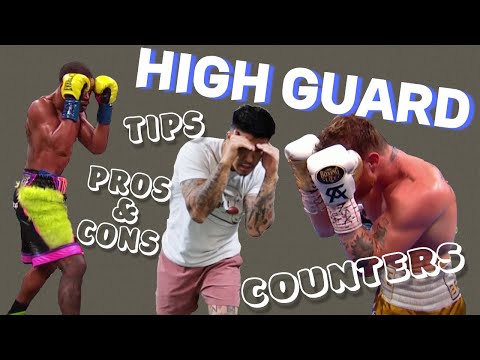
Why You Should Know the High Guard (Tips & Counter Punches)
0
Standard High Guard·Coach Pillow Fists·Added by Admin
The high guard is a boxing stance used commonly by aggressive fighters due to its shield-like protection as they pressur…
Translation: standard high guard
The Standard High Guard positions both fists beside the chin and temples, elbows tucked against the ribcage, with the forearms creating vertical shields on either side of the face. [1] The guard is held tight with the fists at cheekbone height, the chin tucked behind the lead shoulder, and the eyes visible between the gloves. [1],[2] The standard high guard is the default fighting posture in boxing, providing a balance of protection, vision, and readiness to punch. [2],[3]
The high guard is the most commonly used defensive cover in boxing and MMA, protecting the head by holding both gloves against the temples and forehead. [1] It is effective against hooks and overhands but can be split by straight punches aimed between the gloves, and body shots remain a vulnerability. [2]
The high guard is the default defensive position taught in boxing gyms worldwide and has been the standard protective cover since the adoption of padded gloves in the late 19th century. [1]
The high guard is the standard boxing defensive position. [1]
No images yet for this technique.
Sign in to suggest an image.
The high guard is a boxing stance used commonly by aggressive fighters due to its shield-like protection as they pressur…
No instructional courses yet for this technique.
Sign in to suggest a course.
Risk of injury to the person this technique is applied to
Blocking and parrying absorb strike force; hand/forearm injury from repeated blocking
Skill level needed to execute this technique reliably
Whether this technique is allowed under major competition rule sets
Boxing (Edwin Haislet, 1940)
Alias sources — [1] Championship Fighting (Dempsey, 1950) [2] Boxing Mastery (Hatmaker, 2004) [3] Fighter's Fact Book (Christensen, 2000)
Effectiveness sources — [1] Championship Fighting (Dempsey, 1950) [2] Boxing Mastery (Hatmaker, 2004)
Standard katakana transliteration of Western martial arts terminology (外来語) — used in Japanese MMA, boxing, and BJJ communities
Alias sources — [1] Championship Fighting (Dempsey, 1950) [2] Boxing Mastery (Hatmaker, 2004) [3] Fighter's Fact Book (Christensen, 2000)
Effectiveness sources — [1] Championship Fighting (Dempsey, 1950) [2] Boxing Mastery (Hatmaker, 2004)
reaction speed, structural body mechanics, defensive awareness
quick reflexes and conditioned defensive surfaces
varies — forearms (blocking), legs (movement), core (stability)
According to Coach Pillow Fists, many fighters hunch over in the high guard thinking their hands up by their face will defend everything, but this actually leaves your body wide open on both sides and exposes your head to strikes.
Coach Pillow Fists recommends catching and parrying straight shots as one of five counter-punching options available from the high guard.
Coach Pillow Fists emphasizes that your body is just as important to protect as your head—you need to be aware of and block shots to the body, and can deflect body jabs and straights with your elbow before countering with a hook.
According to Coach Pillow Fists, it's important to have the high guard in your toolkit as a backup option in case you need it, even if it's not your primary stance.
The Standard High Guard positions both fists beside the chin and temples, elbows tucked against the ribcage, with the forearms creating vertical shields on either side of the face. The guard is held tight with the fists at cheekbone height, the chin tucked behind the lead shoulder, and the eyes visible between the gloves.
The standard high guard is the most fundamental defensive posture in boxing and has been the default fighting stance since the Marquess of Queensberry rules formalised modern boxing in 1867. It remains the first defensive position taught to boxers and MMA fighters worldwide.
Unified MMA: legal — Legal defensive technique; IBJJF: legal — Legal; IJF: legal — Legal defensive action; WBC/Boxing: legal — Legal; WKF: legal — Legal; WT: legal — Legal
Danger rating 3/10. Moderate — blocking and parrying absorb strike force; hand/forearm injury from repeated blocking
The standard setup chain: Anticipate the Attack → Execute Defence → Recover Stance → Counter or Disengage.
Standard counters include: Timing — attack when the defence is recovering or between movements / Feint — use deception to create openings in the defensive structure / Angle Change — attack from an unexpected angle that the defence does not cover.
Common variants: Standard defence (primary defensive technique from the most common position); Reactive defence (triggered by the opponent's attack, minimal movement for …); Proactive defence (anticipating the attack and positioning to neutralise it …); Counter defence (using the defensive movement to create an immediate count…).
The high guard is the standard boxing defensive position.
Top errors to watch for: Elbows too far apart — the gap allows straight punches through to the chin / Fists too far from the head — press them near the temples for compact protection / Looking up over the guard instead of through it — eyes look through the gap between the forearms / Squeezing the guard so tight you can't see or move — maintain enough flexibility to counter.
The Standard High Guard is also known as Sutandādo Hai Gādo, Basic High Guard, Hands-Up Guard, Standard Peek-A-Boo.