MUST KNOW Self-Defense From Jab Cross
0
Standard Cross-Arm Cover·Sifu Nate
Watch Jeet Kune Do, Wing Chun and other martial arts tutorials by Ninja Nate. Subscribe and turn on notification to be n…
Translation: standard cross-arm cover
The Standard Cross-Arm Cover crosses both forearms in front of the face with the hands touching opposite shoulders or ears, creating a lattice of bone and muscle that protects the chin, nose, and temples. [1] The elbows are pulled tight together to protect the body, and the head is ducked slightly behind the forearm barrier. [1],[2] The standard cross-arm cover is a survival position — it provides excellent protection but limits the fighter's ability to see incoming strikes and delays their ability to counter. [2],[3]
The cross-arm cover is a standard emergency defence. [1]
Used in boxing and MMA. [1]
No images yet for this technique.
Sign in to suggest an image.
Watch Jeet Kune Do, Wing Chun and other martial arts tutorials by Ninja Nate. Subscribe and turn on notification to be n…
How to throw the right hand, cross for boxing, muay thai and MMA
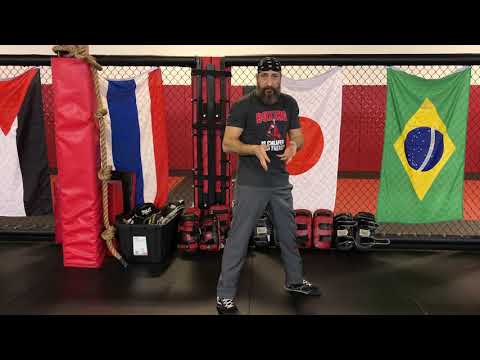
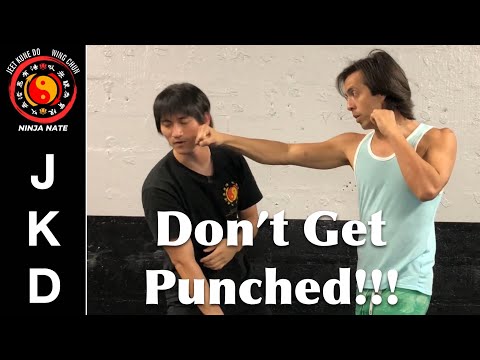
The standard cross-arm cover is a defensive technique employed against straight punches, particularly the jab-cross combination. TheUmmahFightCamp demonstrates this defense as part of a multi-layered system, teaching the double block against the jab followed by either an outside brush, outside weave, or slip against the incoming cross. The instructor emphasizes that the double block positions the defender mid-range, reducing the distance required to execute subsequent defensive movements—a principle termed "terrain traversal." This positioning advantage increases the likelihood of successfully intercepting the second punch. Sifu Nate provides complementary instruction on the mechanics of the cover itself, explaining that hands should be positioned high (near jawline level) with palms open rather than closed fists, which enhances reaction speed and versatility. Nate advocates keeping hands slightly above chest-to-throat level to maintain vision while remaining prepared to cover. Both instructors stress that the cover works effectively against both straight punches and hooks due to the high guard position. Sifu Nate also describes the high cover as part of a combined defense incorporating parrying, covering, and follow-up counter-attacks such as trapping or elbow strikes to the opponent's limbs. Shraims academy, while focused on cross mechanics rather than defense, provides context on cross execution that clarifies why covering position and timing are critical to the defensive response.
Synthesized from 3 instructors
No instructional courses yet for this technique.
Sign in to suggest a course.
Risk of injury to the person this technique is applied to
Blocking and parrying absorb strike force; hand/forearm injury from repeated blocking
Skill level needed to execute this technique reliably
Whether this technique is allowed under major competition rule sets
Boxing (Edwin Haislet, 1940)
Alias sources — [1] Championship Fighting (Dempsey, 1950) [2] Boxing Mastery (Hatmaker, 2004) [3] Fighter's Fact Book (Christensen, 2000)
Effectiveness sources — [1] Boxing Mastery (Hatmaker, 2004) [2] Championship Fighting (Dempsey, 1950)
Standard katakana transliteration of Western martial arts terminology (外来語) — used in Japanese MMA, boxing, and BJJ communities
Alias sources — [1] Championship Fighting (Dempsey, 1950) [2] Boxing Mastery (Hatmaker, 2004) [3] Fighter's Fact Book (Christensen, 2000)
Effectiveness sources — [1] Boxing Mastery (Hatmaker, 2004) [2] Championship Fighting (Dempsey, 1950)
reaction speed, structural body mechanics, defensive awareness
quick reflexes and conditioned defensive surfaces
varies — forearms (blocking), legs (movement), core (stability)
According to TheUmmahFightCamp, you want to step in on the outside and brush one and two if you can, but you won't always be able to step in on both depending on the skill level of your opponent—be prepared to improvise and adjust.
Sifu Nate teaches that you can slip the punches and counter immediately—for example, slipping the jab and cross, then hitting your opponent low to the ribs, or shifting down slightly with your lead foot driving in to trap and strike.
TheUmmahFightCamp recommends practicing side-to-side head movement with both hands, working in your footwork left and right, and then adding follow-ups like hand traps to develop a complete defense.
The Standard Cross-Arm Cover crosses both forearms in front of the face with the hands touching opposite shoulders or ears, creating a lattice of bone and muscle that protects the chin, nose, and temples. The elbows are pulled tight together to protect the body, and the head is ducked slightly behind the forearm barrier.
The standard cross-arm cover has been an emergency defensive position in boxing for over a century, used as a last-resort defence when the fighter is under heavy fire. It remains a commonly taught defensive option in both boxing and MMA.
Unified MMA: legal — Legal defensive technique; WBC/Boxing: legal — Legal — blocking and evasion are core boxing skills; WKF: legal — Legal — blocking is a fundamental karate skill; Kyokushin: legal — Legal; WT: legal — Legal; WAKO: legal — Legal; K: legal — 1/GLORY — Legal; IFMA: legal — Legal
Danger rating 3/10. Moderate — blocking and parrying absorb strike force; hand/forearm injury from repeated blocking
The standard setup chain: Anticipate the Attack → Execute Defence → Recover Stance → Counter or Disengage.
Standard counters include: Timing — attack when the defence is recovering or between movements / Feint — use deception to create openings in the defensive structure / Angle Change — attack from an unexpected angle that the defence does not cover.
Common variants: Standard defence (primary defensive technique from the most common position); Reactive defence (triggered by the opponent's attack, minimal movement for …); Proactive defence (anticipating the attack and positioning to neutralise it …); Counter defence (using the defensive movement to create an immediate count…).
Used in boxing and MMA.
Top errors to watch for: Holding the cross too long — it's a temporary emergency defence; exit it quickly / Crossing too high or too low — the X should be centred on the face / Leaving the body completely unprotected — tuck the elbows close to cover as much body as possible / Not transitioning to offence — the cross-arm cover without a counter is just absorbing punishment.
The Standard Cross-Arm Cover is also known as Sutandādo Kurosu Āmu Kabā, Basic Cross Cover, Standard Cross Guard, Double Arm Cover.