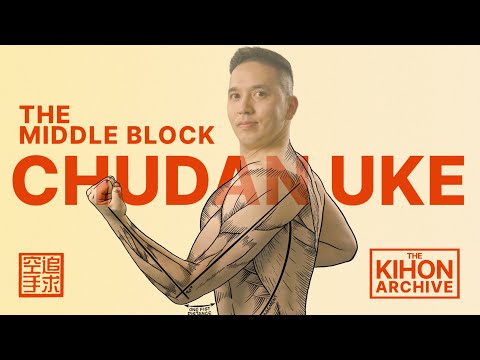
Why Chudan Uke Matter in Karate | Karate's Middle Block Explained
0
Middle Block·We Who Pursue
Chudan Uke is the middle block in Goju-Ryu Karate-Do, and it shows up everywhere in kihon and Karate Kata. In this video…
Translation: middle level block
The Middle Block subfamily covers blocking techniques that defend the midsection and torso area by positioning the forearm horizontally or diagonally to intercept strikes targeting the body. [1] Middle blocks protect the vital organs of the torso — ribs, solar plexus, liver — from punches, kicks, and knees. [1],[2] This subfamily includes inside-to-outside blocks (soto uke), outside-to-inside blocks (uchi uke), and knife-hand blocks (shuto uke), each sweeping the forearm across the body from different starting positions. [2],[3]
Middle blocks (soto uke, uchi uke) are fundamental in karate and other striking arts. [1]
Used in karate and MMA competition. [1]
No images yet for this technique.
Sign in to suggest an image.
Chudan Uke is the middle block in Goju-Ryu Karate-Do, and it shows up everywhere in kihon and Karate Kata. In this video…
No instructional courses yet for this technique.
Sign in to suggest a course.
Risk of injury to the person this technique is applied to
Blocking and parrying absorb strike force; hand/forearm injury from repeated blocking
Skill level needed to execute this technique reliably
Whether this technique is allowed under major competition rule sets
Karate-Do Kyohan: The Master Text (Gichin Funakoshi, 1935)
Alias sources — [1] Karate-Do Kyohan (Funakoshi, 1935) [2] The Kyokushin Way (Oyama, 1979) [3] Dynamic Karate (Nakayama, 1966)
Effectiveness sources — [1] Comprehensive Asian Fighting Arts (Draeger & Smith, 1969) [2] Boxing: The Complete Guide to Training and Fitness (Hatmaker, 2004)
Official karate technique names (和語/漢語)
Established Japanese martial arts naming convention — native Japanese term (和語/漢語)
Alias sources — [1] Karate-Do Kyohan (Funakoshi, 1935) [2] The Kyokushin Way (Oyama, 1979) [3] Dynamic Karate (Nakayama, 1966)
Effectiveness sources — [1] Comprehensive Asian Fighting Arts (Draeger & Smith, 1969) [2] Boxing: The Complete Guide to Training and Fitness (Hatmaker, 2004)
forearm conditioning, reaction speed, structural stability
dense bone structure, strong forearms
forearm flexors/extensors, deltoids, biceps, core (absorbing impact)
Every move, in any martial art, shares a few universal traits. Mix and match below to pinpoint the right tool — or compare equivalents across styles.
Shuto Uke (knife-hand block) is a traditional karate middle block that uses the outer edge of the open hand (the knife-hand or shuto) to deflect incoming strikes to the midsection. [1] The block is executed with an open hand, striking surface along the little-finger edge, sweeping from the opposite ear across the body to the outside. [1,2] Shuto uke is distinctive because the open-hand position allows the blocking hand to immediately transition to grabbing (hikite) the attacker's limb for counter-attacks. [2,3]
Soto Uke (outside-to-inside block) is a traditional karate middle block where the forearm sweeps from outside the body inward, intercepting a straight punch or kick targeting the torso. [1] The block starts with the arm chambered outside the body at shoulder height, then sweeps inward across the centreline, deflecting the attack to the inside. [1,2] Soto uke is effective against direct attacks to the midsection and creates an opening for counter-attacks on the outside line. [2,3]
Uchi Uke (inside-to-outside block) is a traditional karate middle block where the forearm sweeps from inside the body outward, intercepting an incoming strike and deflecting it to the outside. [1] The block starts with the arm chambered across the body at the opposite hip, then sweeps outward in an arc, using the inner forearm surface to redirect the attack. [1,2] Uchi uke creates an opening on the inside line for counter-attacks and is particularly effective against hooks and circular attacks to the body. [2,3]
The Middle Block subfamily covers blocking techniques that defend the midsection and torso area by positioning the forearm horizontally or diagonally to intercept strikes targeting the body. Middle blocks protect the vital organs of the torso — ribs, solar plexus, liver — from punches, kicks, and knees.
Middle blocks form a core component of traditional karate's blocking curriculum, systematically developed through Okinawan and Japanese karate traditions. The three primary middle blocks — soto uke, uchi uke, and shuto uke — are fundamental techniques in virtually all karate styles.
Unified MMA: legal — Legal defensive technique; WBC/Boxing: legal — Legal — blocking and evasion are core boxing skills; WKF: legal — Legal — blocking is a fundamental karate skill; Kyokushin: legal — Legal; WT: legal — Legal; WAKO: legal — Legal; K: legal — 1/GLORY — Legal; IFMA: legal — Legal
Danger rating 3/10. Moderate — blocking and parrying absorb strike force; hand/forearm injury from repeated blocking
The standard setup chain: Read the Attack → Position the Guard → Absorb Impact → Counter or Reset.
Standard counters include: Feint — fake an attack to draw out the block then strike the opening / Level Change — switch attack levels to go around the blocking defence / Combination — throw multiple strikes to overwhelm the single defensive response.
Common variants: High block (forearm raised above the head to protect against overhead…); Low block (forearm driven downward to deflect kicks or body strikes); Cross block (forearm crosses the body to protect the opposite side); Double forearm block (both forearms together for maximum coverage).
Used in karate and MMA competition.
Top errors to watch for: Reaching too far to block — keep the forearm close to the body for structural strength / Blocking across the body and exposing the other side — the sweep should stop at the centreline / Dropping the guard hand during the middle block — the other hand stays at chin level / Blocking with a soft forearm — tighten the forearm at the moment of impact.
The Middle Block is also known as Chūdan Uke, Chudan Uke, Mid-Level Block, Inside-Outside Block.