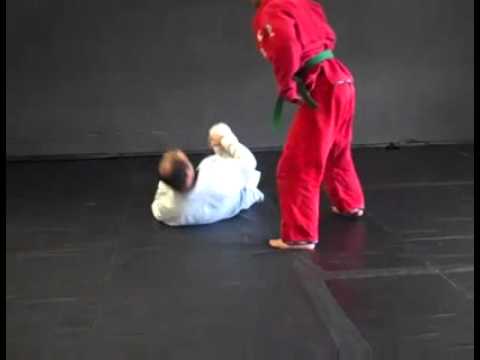
Shrimp Escape From Mount - Lesson 16
0
Standard Shrimp Recovery·Tom Dinklage·Added by Admin
Precision MMA in Houston offercs classes in Brazilian Jiu Jitsu, Kickboxing, and Mixed Martial Arts for all ages. Get y…
Translation: standard shrimp recovery
The Standard Shrimp Recovery executes the fundamental hip escape to recover guard, where the defender turns onto one hip, bridges to create momentary space, then drives the hips away from the opponent while sliding the near knee back to the centre line to re-establish guard. [1] The movement sequence is: frame against the opponent to prevent them from following, bridge the hips up, turn to one side, push the hips backward away from the opponent, and reinsert the knee or shin as a barrier. [1],[2] The standard shrimp is typically repeated multiple times in sequence (chain shrimping) to recover from progressively worse positions. [2],[3]
The standard shrimp recovery is considered the most fundamental technique in BJJ and is the single most drilled movement in grappling training worldwide. [1] Every BJJ class typically begins with shrimp drills, reflecting the technique's foundational importance to the entire defensive system. [2],[3]
The shrimp (hip escape) is universally regarded as the single most important defensive movement in BJJ, as it creates the space needed to recover guard from nearly any bottom position. [1] Ribeiro identifies the shrimp as the 'most important movement in jiu-jitsu' due to its applicability across virtually all defensive situations on the ground. [1] Its effectiveness depends on proper hip engagement and timing — shrimping too late, after the opponent has consolidated position, is significantly less effective. [2]
The shrimp is a foundational movement taught in every BJJ academy worldwide, directly traceable to the Gracie family's self-defence methodology. [1] Helio Gracie's emphasis on leverage-based defence for smaller practitioners relied heavily on the hip escape as the primary means of creating space. [2]
The shrimp is the most fundamental BJJ defensive movement. [1]
No images yet for this technique.
Sign in to suggest an image.
Precision MMA in Houston offercs classes in Brazilian Jiu Jitsu, Kickboxing, and Mixed Martial Arts for all ages. Get y…
No instructional courses yet for this technique.
Sign in to suggest a course.
Risk of injury to the person this technique is applied to
Guard retention uses frames and hip movement; minimal direct injury risk
Skill level needed to execute this technique reliably
Whether this technique is allowed under major competition rule sets
Boxing (Edwin Haislet, 1940)
Alias sources — [1] Jiu-Jitsu University (Ribeiro, 2008) [2] Fundamentals of Brazilian Jiu-Jitsu (Danaher, 2012) [3] Kodokan Judo (Kano, 1986)
Effectiveness sources — [1] Jiu-Jitsu University (Ribeiro, 2008) [2] Fundamentals of Brazilian Jiu-Jitsu (Danaher, 2012)
Mixed Japanese-Western terminology — combines traditional Japanese terms with katakana loanwords
Alias sources — [1] Jiu-Jitsu University (Ribeiro, 2008) [2] Fundamentals of Brazilian Jiu-Jitsu (Danaher, 2012) [3] Kodokan Judo (Kano, 1986)
Effectiveness sources — [1] Jiu-Jitsu University (Ribeiro, 2008) [2] Fundamentals of Brazilian Jiu-Jitsu (Danaher, 2012)
structural arm strength, forearm density, timing
strong arms and elbows for load-bearing frames
triceps, deltoids, forearms, core
According to Tom Dinklage, if your opponent is too strong or actively defending against bridging, you should switch to the elbow escape by sliding your legs out from underneath their legs instead.
First, stretch your legs out and place them together flat on the ground to prevent your opponent from establishing hooks. Then, turn your head to the side you're escaping toward, bring one leg in, turn to your side, and use your foot to reach over your opponent's leg and peel it between your feet while squeezing your knees together.
Tom Dinklage emphasizes that keeping your head up and in contact with your opponent's head protects you from strikes. In self-defense situations, you should position your arm to guard your face as you transition, and eventually move your head to the other side to prevent punches to the face.
Once you've peeled their leg between your knees, you can use either your hand or your elbow to push their leg further down between your legs, depending on the height of their knee.
The Standard Shrimp Recovery executes the fundamental hip escape to recover guard, where the defender turns onto one hip, bridges to create momentary space, then drives the hips away from the opponent while sliding the near knee back to the centre line to re-establish guard. The movement sequence is: frame against the opponent to prevent them from following, bridge the hips up, turn to one side, push the hips backward away from the opponent, and reinsert the knee or shin as a barrier.
The standard shrimp recovery is considered the most fundamental technique in BJJ and is the single most drilled movement in grappling training worldwide. Every BJJ class typically begins with shrimp drills, reflecting the technique's foundational importance to the entire defensive system.
Unified MMA: legal — Legal defensive technique; IBJJF: legal — Legal; IJF: legal — Legal defensive action; WBC/Boxing: legal — Legal; WKF: legal — Legal; WT: legal — Legal
Danger rating 2/10. Low — guard retention uses frames and hip movement; minimal direct injury risk
The standard setup chain: Anticipate the Attack → Execute Defence → Recover Stance → Counter or Disengage.
Standard counters include: Timing — attack when the defence is recovering or between movements / Feint — use deception to create openings in the defensive structure / Angle Change — attack from an unexpected angle that the defence does not cover.
Common variants: Standard defence (primary defensive technique from the most common position); Reactive defence (triggered by the opponent's attack, minimal movement for …); Proactive defence (anticipating the attack and positioning to neutralise it …); Counter defence (using the defensive movement to create an immediate count…).
The shrimp is the most fundamental BJJ defensive movement.
Top errors to watch for: Not turning to the side before shrimping — you must face the opponent, not the ceiling / Bridging too high and getting rolled — the bridge is slight, just enough to unload the hips / Shrimping with the wrong foot — push with the foot closest to the opponent's body / Not inserting the knee after the shrimp — the space closes if you don't immediately recover guard.
The Standard Shrimp Recovery is also known as Sutandādo Ebi, Basic Shrimp, Standard Hip Escape, Ebi Recovery.