Strike & defenceLocksClose rangeFighting multiple people
Distance
CloseMiddleLong
Body target
Upper bodyMiddle bodyLower body
Overview
The Hip Movement Defence family covers ground-based defensive techniques that use hip displacement and rotation to create space, recover guard position, or prevent the opponent from establishing dominant control. [1] Hip movement is the engine of all ground-based defence in BJJ — the ability to shrimp (hip escape), bridge, and invert creates the space needed to reguard, escape pins, and defend against submissions. [1],[2] This family includes shrimp (hip escape) recoveries and inversion recoveries, each using different hip mechanics to address different defensive scenarios. [2],[3]
Hip movement as a ground defence technique was developed and systematised through Brazilian Jiu-Jitsu, building on earlier judo ground-work (ne-waza) techniques. [1] The shrimp (hip escape) became the foundational defensive movement in BJJ, with every practitioner drilling it as the most important solo movement exercise. [2],[3]
Country of origin· shown in random order
🇧🇷BrazilBJJ, MMA
🇯🇵Japan腰の動きの防御(Koshi no Ugoki no Bōgyo)BJJ, Judo
🇺🇸USAMMA, Wrestling
🇷🇺RussiaSambo
🇬🇷GreeceWrestling
Effectiveness
Hip movement defences use shrimping, inversions, and hip escapes to create space and recover guard. [1],[2]
Lineage
Hip movement is the foundation of all BJJ ground defence. [1]
Competition Record
Hip escapes are essential defensive movements in BJJ and MMA. [1]
Images
No images yet for this technique.
Sign in to suggest an image.
Biomechanical Mechanism
Primary Action — Preventing or reducing the effect of an incoming attack through physical interception, evasion, or structural positioning
Joints Involved — Varies by defence type — blocks use arms/shins, evasions use head/body movement, sprawls use hips
Force Vector — Opposing or tangential to the attack — either absorbing, redirecting, or evading the incoming force
Defensive Principle — Economy of motion — the best defence uses minimal movement to neutralise the maximum threat
Position & Entry
From fighting stance (under fire) — Bring both hands to the head, elbows tight, tuck the chin — absorb the flurry while protecting vital targets
As emergency defence — When overwhelmed by volume, shell up in the cover position until the opponent pauses
✓Hip movement is the engine of guard retention — the ability to reposition your hips faster than the opponent can advance is the core BJJ bottom-game skill (Danaher, 2020)
✓The primary hip movements for guard retention are: shrimp (hip escape), inversion (granby roll), and reguard (re-inserting legs)
✓Your hips must always face the opponent — if your hips are flat to the ceiling, the guard is effectively passed
✓Move your hips away from the opponent to create space for leg re-insertion — never toward them
✓Hip movement is proactive: move before the pass is complete, not after
✓In MMA, hip movement from bottom position creates space for stand-ups and prevents the opponent from settling
✓Drill hip escapes and inversions as warm-up exercises every training session — they must be reflexive
Common Mistakes
!Lying flat with hips to the ceiling — turn to your side and move your hips AWAY from the opponent
!Moving the shoulders instead of the hips — guard retention is hip-driven; the shoulders follow
!Moving hips toward the opponent — move AWAY to create space for guard re-insertion
!Waiting until the pass is complete to move — hip movement must happen during the pass attempt, not after
!Not combining hip movement with frames — frames create the space; hip movement uses it
!Moving hips slowly — quick, explosive hip escapes are necessary; slow movement gets pinned
!Only shrimping in one direction — learn to shrimp both ways, invert, and granby roll for complete hip mobility
Hip escapes (shrimping) appear in 153 passages under 'shrimp' across 36 books. The fundamental defensive movement in BJJ — creating distance by pushing the hips away from the opponent. Used in every escape from every bottom position. (36 books; Ribeiro, Jiu-Jitsu University)
Frequently Asked Questions
Why is hip movement/hip escape so important in BJJ?
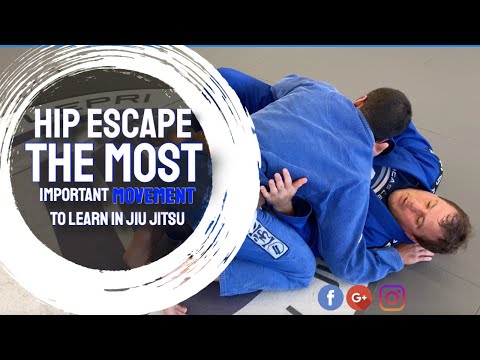
According to Lucas Lepri, hip escape is one of the most important movements you will ever learn in BJJ because it sets up submissions, sets up sweeps, allows you to regain control during scrambles, and is fundamental to recovering guard position.
What's the key principle when performing a hip escape?
Lucas Lepri emphasizes that when hip escaping, you should focus on moving your own hips rather than trying to move your opponent—it's always easier to move yourself than it is your opponent.
How do I execute a hip escape from side control?
Frame against your opponent, point your hips away, scoot your hips back while turning in to create space, then use your bottom-side knee to help you square back up and clear your feet so you can recover to a closed guard position.
Can I practice hip escape alone without a partner?
Yes, you can practice solo by laying on your back and pushing off your legs to move your hips away, rolling to your shoulder and side while making sure your hips move significantly from their starting position.
How does the Hip Movement Defence work?
The Hip Movement Defence family covers ground-based defensive techniques that use hip displacement and rotation to create space, recover guard position, or prevent the opponent from establishing dominant control. Hip movement is the engine of all ground-based defence in BJJ — the ability to shrimp (hip escape), bridge, and invert creates the space needed to reguard, escape pins, and defend against submissions.
Where does the Hip Movement Defence come from?
Hip movement as a ground defence technique was developed and systematised through Brazilian Jiu-Jitsu, building on earlier judo ground-work (ne-waza) techniques. The shrimp (hip escape) became the foundational defensive movement in BJJ, with every practitioner drilling it as the most important solo movement exercise.
Is the Hip Movement Defence legal in competition?
Unified MMA: legal — Legal defensive technique; IBJJF: legal — Legal — defensive techniques are fundamental to grappling; IJF: legal — Legal defensive action; ADCC: legal — Legal; UWW: legal — Legal defensive technique; FIAS Sport Sambo: legal — Legal
How dangerous is the Hip Movement Defence?
Danger rating 2/10. Low — guard retention uses frames and hip movement; minimal direct injury risk
How do I set up the Hip Movement Defence?
The standard setup chain: Anticipate the Attack → Execute Defence → Recover Stance → Counter or Disengage.
How do I defend against the Hip Movement Defence?
Standard counters include: Timing — attack when the defence is recovering or between movements / Feint — use deception to create openings in the defensive structure / Angle Change — attack from an unexpected angle that the defence does not cover.
What are the variants of the Hip Movement Defence?
Common variants: Standard defence (primary defensive technique from the most common position); Reactive defence (triggered by the opponent's attack, minimal movement for …); Proactive defence (anticipating the attack and positioning to neutralise it …); Counter defence (using the defensive movement to create an immediate count…).
How effective is the Hip Movement Defence in competition?
Hip escapes are essential defensive movements in BJJ and MMA.
What are common mistakes when doing the Hip Movement Defence?
Top errors to watch for: Lying flat with hips to the ceiling — turn to your side and move your hips AWAY from the opponent / Moving the shoulders instead of the hips — guard retention is hip-driven; the shoulders follow / Moving hips toward the opponent — move AWAY to create space for guard re-insertion / Waiting until the pass is complete to move — hip movement must happen during the pass attempt, not after.
What are other names for the Hip Movement Defence?
The Hip Movement Defence is also known as Koshi no Ugoki no Bōgyo, Hip Escape Defence, Shrimping, Elbow Escape.