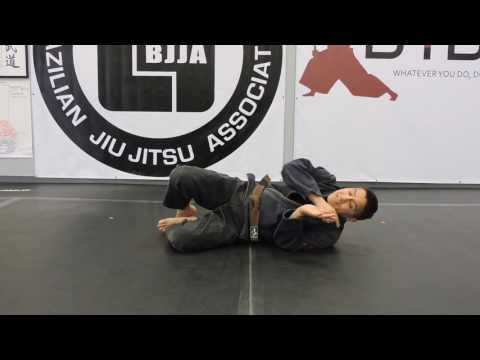
BJJ Fundamentals Warm Up - Reverse Shrimp
0
Shrimp Recovery·Otomi Martial Arts | Caio Terra Association
Quick Start your child today for only $49! - https://otomimartialarts.sites.zenplanner.com/registration.cfm?payment=MEMB…
Translation: shrimp escape
The Shrimp Recovery subfamily covers defensive techniques that use the shrimp (hip escape) movement to create space and recover guard position when under pressure or when the guard has been partially passed. [1] The shrimp is the single most important defensive movement in BJJ — it involves turning onto one side and pushing the hips away from the opponent, creating the space needed to reinsert a knee or leg between the fighters. [1],[2] The shrimp recovery is the primary method of recovering guard after a partial pass and is drilled thousands of times in every BJJ practitioner's training career. [2],[3]
The shrimp movement was developed in Brazilian Jiu-Jitsu as the fundamental ground-based escape and recovery technique, built upon earlier judo ne-waza (ground work) movement principles. [1] Helio Gracie's emphasis on efficient movement from the bottom position helped establish the shrimp as the cornerstone defensive movement in BJJ. [2],[3]
Shrimp recovery uses the hip escape to create space and recover guard from bottom positions. [1]
The shrimp is the most fundamental movement in BJJ ground fighting. [1]
Essential in all BJJ and MMA ground fighting. [1]
No images yet for this technique.
Sign in to suggest an image.
Quick Start your child today for only $49! - https://otomimartialarts.sites.zenplanner.com/registration.cfm?payment=MEMB…
How To Shrimp In BJJ (A.K.A. Elbow Escape) In this video, I show how to perform the continuous elbow escape drill calle…
The shrimp recovery—also called the elbow escape—is a foundational hip-displacement movement in BJJ that enables practitioners to create space and transition out of positional disadvantage, particularly from mounted or side-control positions. The unifying principle across variants is the sequential use of shoulder contact, core engagement, and leg drive to pivot the hips away from an opponent's weight. Michael Foley's Academy of Martial Arts identifies four distinct mechanical variations: the standard shrimp (both feet pushing simultaneously), inside-leg-dominant shrimp (outside leg stays flat), outside-leg-dominant shrimp (inside leg stays flat), and the slide shrimp (minimal hip elevation, continuous contact maintained). The choice among variants depends on positional constraints—leg positioning relative to the opponent, available base, and the urgency of space creation. Otomi Martial Arts emphasizes progressive drill sequencing for skill acquisition, beginning with basic scooting to establish push-pull differentiation, progressing through side-lying hip isolation, and advancing to single-leg versions that replicate live defensive scenarios. Both instructors stress foot-to-mat contact and core stability as non-negotiable technical foundations. The movement serves as a staple warm-up drill in many BJJ programs, trained repeatedly to develop neuromotor efficiency and hip mobility before rolling.
Synthesized from 2 instructors
No instructional courses yet for this technique.
Sign in to suggest a course.
Risk of injury to the person this technique is applied to
Guard retention uses frames and hip movement; minimal direct injury risk
Skill level needed to execute this technique reliably
Whether this technique is allowed under major competition rule sets
Boxing (Edwin Haislet, 1940)
Alias sources — [1] Jiu-Jitsu University (Ribeiro, 2008) [2] Fundamentals of Brazilian Jiu-Jitsu (Danaher, 2012) [3] Kodokan Judo (Kano, 1986)
Effectiveness sources — [1] Jiu-Jitsu University (Ribeiro, 2008)
Official karate technique names (和語/漢語)
Established Japanese martial arts naming convention — native Japanese term (和語/漢語)
Alias sources — [1] Jiu-Jitsu University (Ribeiro, 2008) [2] Fundamentals of Brazilian Jiu-Jitsu (Danaher, 2012) [3] Kodokan Judo (Kano, 1986)
Effectiveness sources — [1] Jiu-Jitsu University (Ribeiro, 2008)
reaction speed, structural body mechanics, defensive awareness
quick reflexes and conditioned defensive surfaces
varies — forearms (blocking), legs (movement), core (stability)
Every move, in any martial art, shares a few universal traits. Mix and match below to pinpoint the right tool — or compare equivalents across styles.
You need to use your core to move your body in the direction of your feet. Michael Foley's Academy emphasizes that you should bring your toes as close to your hips as possible, press your heels down, and push with your outside leg while digging your toe into the mat to shift your hips back.
No—Michael Foley's Academy emphasizes that you should not shift your foot position when transitioning between sides; instead, you repeat the same movement on the other side while maintaining your foot grip on the floor.
Bring your toes as close to your hips as you can, then press your heels down into the mat. Michael Foley's Academy stresses the importance of maintaining foot contact with the floor and digging your toes in to generate leverage for the escape.
The Shrimp Recovery subfamily covers defensive techniques that use the shrimp (hip escape) movement to create space and recover guard position when under pressure or when the guard has been partially passed. The shrimp is the single most important defensive movement in BJJ — it involves turning onto one side and pushing the hips away from the opponent, creating the space needed to reinsert a knee or leg between the fighters.
The shrimp movement was developed in Brazilian Jiu-Jitsu as the fundamental ground-based escape and recovery technique, built upon earlier judo ne-waza (ground work) movement principles. Helio Gracie's emphasis on efficient movement from the bottom position helped establish the shrimp as the cornerstone defensive movement in BJJ.
Unified MMA: legal — Legal defensive technique; IBJJF: legal — Legal; IJF: legal — Legal defensive action; WBC/Boxing: legal — Legal; WKF: legal — Legal; WT: legal — Legal
Danger rating 2/10. Low — guard retention uses frames and hip movement; minimal direct injury risk
The standard setup chain: Anticipate the Attack → Execute Defence → Recover Stance → Counter or Disengage.
Standard counters include: Timing — attack when the defence is recovering or between movements / Feint — use deception to create openings in the defensive structure / Angle Change — attack from an unexpected angle that the defence does not cover.
Common variants: Standard defence (primary defensive technique from the most common position); Reactive defence (triggered by the opponent's attack, minimal movement for …); Proactive defence (anticipating the attack and positioning to neutralise it …); Counter defence (using the defensive movement to create an immediate count…).
Essential in all BJJ and MMA ground fighting.
Top errors to watch for: Shrimping with flat hips — turn to your side before shrimping; flat shrimps barely move / Not bridging before the shrimp — the bridge unloads your hips from the mat; without it, you drag against the floor / Pushing with the wrong foot — push with the foot closest to the opponent / Shrimping toward the opponent — move AWAY to create space.
The Shrimp Recovery is also known as Ebi, Hip Escape, Shrimping.