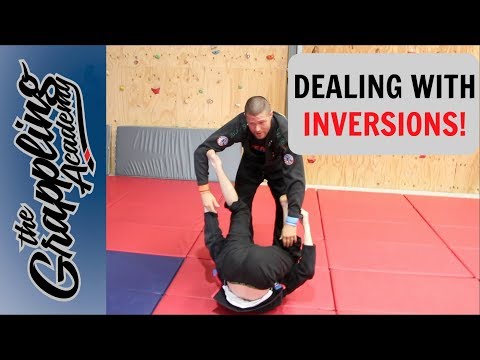
Dealing With Inversion!
0
Inversion Recovery·The Grappling Academy
SALE SALE SALE OVER 50% OFF – BOX SET – ALL 4 COURSES 50% OFF CLICK HERE – https://bit.ly/2lAOHmp • The Blue Belt Sup…
Translation: inversion recovery
The Inversion Recovery subfamily covers defensive techniques where the fighter inverts their body (rolling onto the upper back/shoulders with hips elevated) to recover guard position when the guard has been partially or fully passed. [1] The inversion uses the flexibility and mobility of the spine and hips to create a rolling motion that brings the legs back between the fighters, re-establishing a guard position from what would otherwise be a passed guard. [1],[2] Inversions are a hallmark of modern sport BJJ, where they provide last-resort guard recovery options against aggressive passing. [2],[3]
Inversion-based guard recovery became prominent in sport BJJ during the 2000s and 2010s, associated with the modern guard retention movement pioneered by competitors like the Miyao brothers, Ryan Hall, and Rafa Mendes. [1] The technique represented a significant evolution in guard retention philosophy, adding a dynamic recovery tool to the traditional hip-escape-based approach. [2],[3]
Inversion recovery uses an inverting motion to reguard or create leg entanglements from disadvantaged positions. [1]
Inversions became prominent in modern BJJ competition with the development of berimbolo and leg lock systems. [1]
Inversions are used in advanced BJJ competition. [1]
No images yet for this technique.
Sign in to suggest an image.
SALE SALE SALE OVER 50% OFF – BOX SET – ALL 4 COURSES 50% OFF CLICK HERE – https://bit.ly/2lAOHmp • The Blue Belt Sup…
No instructional courses yet for this technique.
Sign in to suggest a course.
Risk of injury to the person this technique is applied to
Guard retention uses frames and hip movement; minimal direct injury risk
Skill level needed to execute this technique reliably
Whether this technique is allowed under major competition rule sets
Boxing (Edwin Haislet, 1940)
Alias sources — [1] Jiu-Jitsu University (Ribeiro, 2008) [2] Fundamentals of Brazilian Jiu-Jitsu (Danaher, 2012) [3] Brazilian Jiu-Jitsu: Theory and Technique (Gracie, 2001)
Effectiveness sources — [1] Jiu-Jitsu University (Ribeiro, 2008)
Standard katakana transliteration of Western martial arts terminology (外来語) — used in Japanese MMA, boxing, and BJJ communities
Alias sources — [1] Jiu-Jitsu University (Ribeiro, 2008) [2] Fundamentals of Brazilian Jiu-Jitsu (Danaher, 2012) [3] Brazilian Jiu-Jitsu: Theory and Technique (Gracie, 2001)
Effectiveness sources — [1] Jiu-Jitsu University (Ribeiro, 2008)
reaction speed, structural body mechanics, defensive awareness
quick reflexes and conditioned defensive surfaces
varies — forearms (blocking), legs (movement), core (stability)
Every move, in any martial art, shares a few universal traits. Mix and match below to pinpoint the right tool — or compare equivalents across styles.
Grab hold of your opponent's pants and use your knee as a shell to help control their leg placement and prevent leg attacks from that position.
Inversion recovery is a super important and wonderful skill that requires dedicated partner work to develop the necessary flexibility and control needed to safely escape inverted positions.
The Inversion Recovery subfamily covers defensive techniques where the fighter inverts their body (rolling onto the upper back/shoulders with hips elevated) to recover guard position when the guard has been partially or fully passed. The inversion uses the flexibility and mobility of the spine and hips to create a rolling motion that brings the legs back between the fighters, re-establishing a guard position from what would otherwise be a passed guard.
Inversion-based guard recovery became prominent in sport BJJ during the 2000s and 2010s, associated with the modern guard retention movement pioneered by competitors like the Miyao brothers, Ryan Hall, and Rafa Mendes. The technique represented a significant evolution in guard retention philosophy, adding a dynamic recovery tool to the traditional hip-escape-based approach.
Unified MMA: legal — Legal defensive technique; IBJJF: legal — Legal; IJF: legal — Legal defensive action; WBC/Boxing: legal — Legal; WKF: legal — Legal; WT: legal — Legal
Danger rating 2/10. Low — guard retention uses frames and hip movement; minimal direct injury risk
The standard setup chain: Anticipate the Attack → Execute Defence → Recover Stance → Counter or Disengage.
Standard counters include: Timing — attack when the defence is recovering or between movements / Feint — use deception to create openings in the defensive structure / Angle Change — attack from an unexpected angle that the defence does not cover.
Common variants: Standard defence (primary defensive technique from the most common position); Reactive defence (triggered by the opponent's attack, minimal movement for …); Proactive defence (anticipating the attack and positioning to neutralise it …); Counter defence (using the defensive movement to create an immediate count…).
Inversions are used in advanced BJJ competition.
Top errors to watch for: Inverting when a shrimp would suffice — inversion is for when the pass is deep; shrimp first, invert if needed / Inverting without protecting the neck — the neck bears load during inversion; strength and positioning must protect it / Rolling over the wrong shoulder — invert over the inside shoulder (the one facing the opponent) / Inverting slowly — the roll must be quick; slow inversions get caught in bad positions.
The Inversion Recovery is also known as Inbājon Rikabarī, Inversion Guard, Granby Roll Recovery, Upside-Down Guard.